Biology 9700/35 — October/November 2011
Cambridge AS Level · Advanced Practical Skills · worked solutions for every part, with the mark scheme
Topics Analysis, Conclusions and Evaluation · Manipulation, Measurement and Observation · Presentation of Data and Observations · Use of the Light Microscope
Enzyme E catalyses the hydrolysis of sucrose to the reducing sugars, glucose and fructose.
Glucose and fructose can diffuse through a partially permeable (selectively-permeable) membrane.
The wall of Visking (dialysis) tubing is partially permeable.
A bag made of Visking tubing, containing enzyme E and sucrose solution, is placed into a large test-tube containing distilled water. The large test-tube is placed in a water-bath.
You are required to follow the time course of this enzyme-catalysed reaction by testing the distilled water surrounding the bag.
Samples of water around the bag are taken at intervals during 20 minutes and tested for reducing sugars using Benedict's solution.
You are provided with:
| labelled | contents | hazard | volume / |
|---|---|---|---|
| E | invertase solution | irritant | 15 |
| S | sucrose solution | none | 15 |
| Benedict's solution | Benedict's solution | harmful irritant | 60 |
| W | distilled water | none | 200 |
You are also provided with:
- V, one length of Visking (dialysis) tubing in distilled water.
You will need to run the time course for the enzyme-catalysed reaction for 20 minutes.
Fig. 1.1 shows the procedure for investigating the time course of the enzyme-catalysed reaction. The times you will use are 5 minutes, 10 minutes, 15 minutes and 20 minutes.
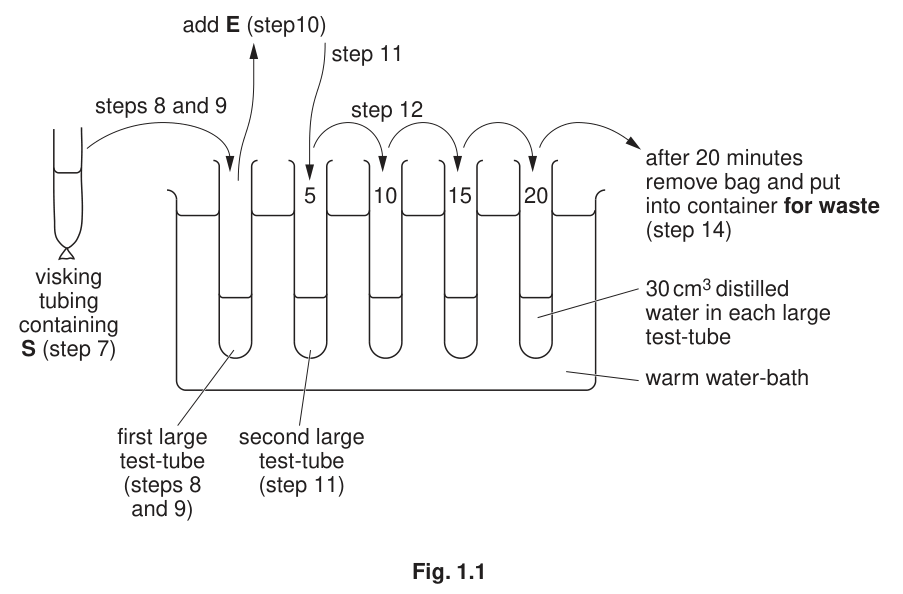
Fig. 1.1
You are advised to read steps 1 to 19 before proceeding.
Proceed as follows:
- Label the large test-tubes with the times and put of distilled water into each one.
- While you are doing steps 3 to 16 you will need to heat up the beaker of water labelled for Benedict's test so that it can be used later to carry out the Benedict's test.
Decide on the temperature you plan to use for this water-bath.
State the temperature you have chosen in the space below.
temperature = ______
- Prepare a water-bath between and using the beaker of water labelled for reaction.
- Put all the labelled large test-tubes into the water-bath labelled for reaction.
- Tie a knot in the Visking tubing as close as possible to one end so that it seals the end forming a bag.
- To open the other end, wet the Visking tubing and rub the tubing gently between your fingers.
- Put of S into the open end of the bag.
- Put the bag into the water in the first large unlabelled test-tube.
- Allow 3 minutes for S in the bag to reach the same temperature as the distilled water surrounding the bag.
- Put of enzyme E into the bag. You need to mix the enzyme with the substrate. Remove the bag, close the open end between your fingers. Holding both ends tightly, turn the bag upside down several times and this will mix the contents.
- Put the bag back into the second large test-tube, labelled 5. Start timing the time course.
- After 5 minutes remove the bag and contents and place it into the next large test-tube.
- Repeat step 12 as shown in Fig. 1.1.
- After 20 minutes, put your bag with its contents into the container labelled for waste.
- At the end of the 20 minutes put the contents of each large test-tube into separate labelled small containers.
- Test the contents of the small containers for reducing sugars using Benedict's solution. You will need to keep the volume of Benedict's solution the same for each test.
Decide on the volume of sampling solution and Benedict's solution you plan to use for each test.
State the volume of sampling solution and Benedict's solution you have chosen.
volume of sampling solution = ______
volume of Benedict's solution = ______
- In the small test-tubes, add the volumes of samples and Benedict's given in (ii).
- Put all the test-tubes into the water-bath for Benedict's test and immediately start timing.
- Record the time for the change from blue to the first colour you see (ignore any further colour changes). If there is no colour change at 10 minutes, record "more than 600".
Prepare the space below and record your results.
Identify one significant source of error in this investigation.
Describe a suitable control for this investigation.
Suggest how you would make two improvements to this investigation.
A student investigated the effect of placing pieces of tissue from a potato in sucrose solutions of different concentrations.
At the start, each sample of potato tissue was weighed and the initial mass was recorded.
Then each sample of potato tissue was placed into a different concentration of sucrose solution.
After a set time the potato tissue was removed and the final mass of the potato tissue was recorded.
The change in mass and percentage change of mass for each sample of potato tissue was calculated.
The results of the student's investigation are shown in Table 1.1.
Table 1.1
| sucrose concentration / | initial mass / | final mass / | change in mass / | percentage change in mass |
|---|---|---|---|---|
| 0.0 | 2.54 | 3.18 | 0.64 | 25.0 |
| 0.2 | 2.43 | 2.62 | 0.19 | |
| 0.4 | 2.40 | 2.45 | 0.05 | 2.0 |
| 0.6 | 2.71 | 2.30 | ||
| 0.8 | 2.44 | 2.49 | 0.05 | 2.0 |
| 1.0 | 2.58 | 1.80 |
Complete Table 1.1.
Plot a graph of the data shown in Table 1.1.
Draw a circle around the anomalous result on the graph.
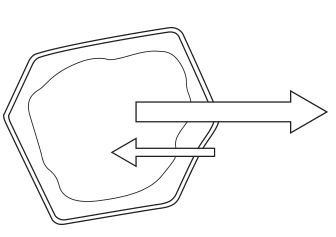
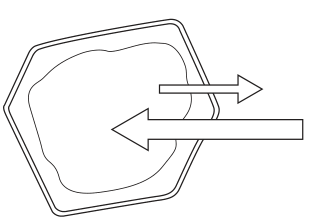
Complete Table 1.2 below.
Table 1.2
| diagrams of potato cells with arrows showing the direction and quantity of water movement | from your graph, state one example of a sucrose concentration where this water movement occurs and explain how you chose this example |
|---|---|
| Cell A | example: explanation: _________________________________________________ _______________ |
| Cell B | example: explanation: _________________________________________________ _______________ |
| Cell C | example: explanation: _________________________________________________ _______________ |
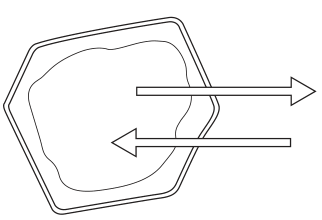
Explain, in terms of water potential, the movement of water in cell A.
The rest of this paper
1 more questions- Q2Use of the Light Microscope · Analysis, Conclusions and Evaluation18M