Biology 9700/23 — October/November 2011
Cambridge AS Level · AS Level Structured Questions · worked solutions for every part, with the mark scheme
Topics Infectious Diseases · Cell Structure · Enzymes · Biological Molecules · Transport in Mammals · Transport in Plants · +2 more
Fig. 1.1 is an electron micrograph of three cells of the same species of bacterium, Erwinia carotovora.
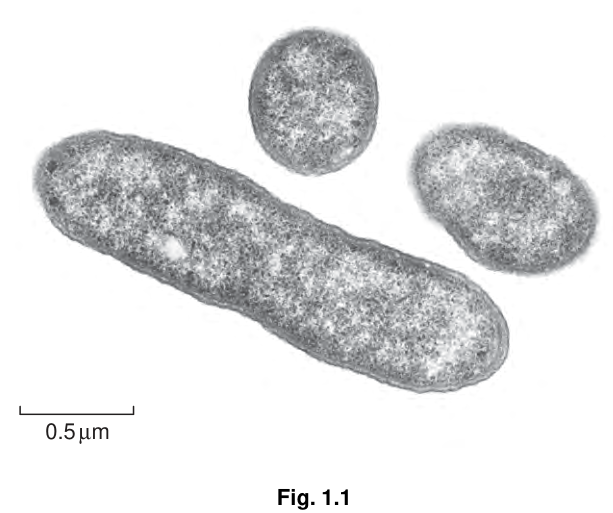
Calculate the magnification of the electron micrograph in Fig. 1.1.
Show your working and give your answer to the nearest 10 000.
magnification = ______
Name three structures, present in animal cells, which are not present in the cells shown in Fig. 1.1.
-
______
-
______
-
______
E. carotovora is a rod-shaped bacterium.
Explain why two of the bacterial cells in Fig. 1.1 do not appear rod-shaped.
E. carotovora causes a disease in carrot and potato plants.
The bacteria release an enzyme called pectinase which hydrolyses the polysaccharide pectin. Pectin helps plant cells to attach to each other.
Name the type of chemical bond which will be hydrolysed by pectinase.
Suggest what effect this disease will have on vegetables, such as carrots and potatoes.
The rest of this paper
5 more questions- Q2Transport in Mammals10M
- Q3Transport in Plants10M
- Q4Infectious Diseases11M
- Q5Nucleic Acids and Protein Synthesis10M
- Q6(outdated) Ecology10M