Biology 9700/13 — May/June 2011
Cambridge AS Level · Multiple Choice (AS Level) · answer key with instant marking and worked solutions
Topics Biological Molecules · Cell Membranes and Transport · Cell Structure · Transport in Plants · Transport in Mammals · Nucleic Acids and Protein Synthesis · +5 more
Tap an option under each question to check it — your score builds as you go.
The diagram represents the movement of water through a plant.
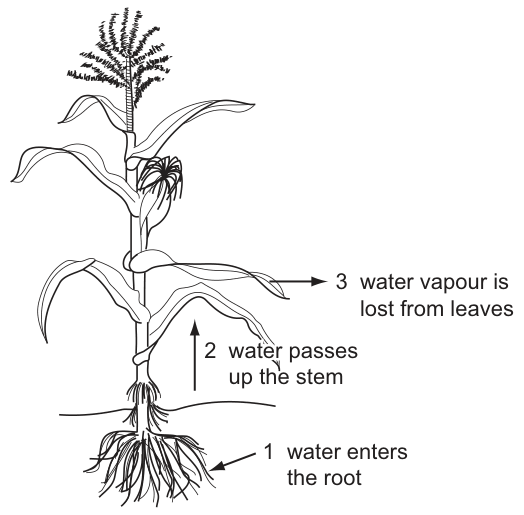
Which row identifies the processes involved during the stages of water movement shown?
Options
| cohesion and adhesion | transpiration | osmosis | |
|---|---|---|---|
| A | 1 | 2 | 3 |
| B | 1 | 3 | 2 |
| C | 2 | 1 | 3 |
| D | 2 | 3 | 1 |
Working
The three processes must be matched to the stages shown in Fig. 1.1:
- Stage 1 — water enters the root: water moves from the soil into root hair cells down a water potential gradient, across a partially permeable membrane. This is osmosis.
- Stage 2 — water passes up the stem: water is pulled up the xylem in a continuous column because water molecules cohere to each other and adhere to the walls of the xylem vessels. This is cohesion and adhesion.
- Stage 3 — water vapour is lost from leaves: water evaporates from the moist cell walls of the mesophyll and diffuses out through the stomata. This is transpiration.
So: cohesion and adhesion = 2, transpiration = 3, osmosis = 1.
Answer
D
D
Background Concept
Three distinct physical processes drive water movement through a plant, and each one is associated with a different part of the plant:
-
Osmosis — the net movement of water molecules across a partially permeable membrane from a region of higher (less negative) water potential to a region of lower (more negative) water potential. No energy from the plant is required. In the root, soil water has a higher water potential than the cytoplasm of root hair cells (because the cells contain dissolved solutes), so water enters the root by osmosis.
-
Cohesion and adhesion (the cohesion–tension theory) — once inside the xylem, water is pulled upwards as an unbroken column. Cohesion is the attraction between like water molecules (hydrogen bonds) and adhesion is the attraction between water molecules and the walls of the xylem vessels. The upward pull is generated by the loss of water from the leaves (transpiration), which creates a negative pressure (tension) in the xylem.
-
Transpiration — the loss of water vapour from the aerial parts of the plant, mainly through the stomata in the leaves. Water evaporates from the moist cell walls of the spongy mesophyll into the air spaces, then diffuses out via the stomata. This is the driving force for the whole transpiration stream because it generates the tension that pulls the water column up the xylem.
Understanding the Question
The diagram shows a maize plant with three labelled arrows indicating the stages of water movement:
- 1: water enters the root
- 2: water passes up the stem
- 3: water vapour is lost from leaves
The question asks us to match the three processes (cohesion and adhesion, transpiration, osmosis) to these three stages. The correct option is the one that places each process in the correct anatomical position.
Approach
Think about where each process happens. Cohesion–adhesion operates within the xylem in the stem; transpiration happens in the leaves (loss of vapour); osmosis happens at the root surface (water entering root hair cells). Then match these locations to the three numbered labels and read off the row that gives the correct numbering for each process.
Step-by-Step Reasoning
- Stage 1 — root: Water here crosses the plasma membrane of root hair cells down a water potential gradient. The only membrane-crossing movement of water is osmosis, so process 1 = osmosis.
- Stage 2 — stem: Water here moves up through the xylem vessels. The mechanism that sustains an unbroken column of water under tension is cohesion between water molecules and adhesion to the xylem walls, so process 2 = cohesion and adhesion.
- Stage 3 — leaves: Water here is lost as vapour through the stomata. This is the definition of transpiration, so process 3 = transpiration.
Reading the answer columns: cohesion and adhesion = 2, transpiration = 3, osmosis = 1 → row D.
Key Takeaways
- Osmosis occurs at the root–soil interface (water entry).
- Cohesion–adhesion is what keeps the water column continuous inside the xylem as it is pulled up the stem.
- Transpiration is the loss of water vapour from the leaves, and is the ultimate driving force for the whole stream.
- These three processes are sequential and causally linked: transpiration in the leaves pulls the column up via cohesion–adhesion, while osmosis at the root replaces the water that has been lost.
Common Mistakes
- Confusing transpiration (loss of water vapour from leaves) with the upward movement of water in the stem. Transpiration does not itself move water up the stem; the tension it creates, transmitted via cohesion–adhesion, does.
- Thinking that "water passes up the stem" is transpiration. It is not — the actual movement in the xylem is driven by cohesion–tension.
- Putting osmosis at the leaves or the stem. Osmosis requires a partially permeable membrane, which is only present at the root surface (or between cells along the symplast pathway).
Things to Be Careful About
- Read the question's column headers carefully — they list the three processes in a different order from the three stages. Make sure you are matching the correct process to the correct number, not the other way round.
- Cohesion–adhesion operates inside the xylem; it is not a feature of the root or the leaf surface.
- The question is about processes, not structures. Do not pick an option just because the word sounds right — match the mechanism to the location.
The rest of this paper
39 more questions- Q2Transport in Plants1M
- Q3Transport in Plants · Cell Membranes and Transport1M
- Q4Transport in Mammals1M
- Q5Transport in Mammals1M
- Q6Transport in Mammals1M
- Q7Transport in Mammals1M
- Q8Cell Structure1M
- Q9Cell Structure1M
- Q10Cell Structure1M
- Q11Cell Structure1M
- Q12Cell Membranes and Transport1M
- Q13Cell Membranes and Transport1M
- Q14Cell Membranes and Transport1M
- Q15Cell Structure1M
- Q16Gas Exchange1M
- Q17Gas Exchange1M
- Q18Gas Exchange1M
- Q19(outdated) Ecology1M
- Q20(outdated) Ecology1M
- Q21Transport in Plants1M
- Q22Enzymes1M
- Q23Enzymes1M
- Q24Enzymes1M
- Q25Nucleic Acids and Protein Synthesis · Biological Molecules1M
- Q26The Mitotic Cell Cycle1M
- Q27The Mitotic Cell Cycle1M
- Q28The Mitotic Cell Cycle · Nucleic Acids and Protein Synthesis1M
- Q29Nucleic Acids and Protein Synthesis1M
- Q30Nucleic Acids and Protein Synthesis1M
- Q31Biological Molecules1M
- Q32Biological Molecules1M
- Q33Biological Molecules1M
- Q34Biological Molecules1M
- Q35Biological Molecules1M
- Q36Biological Molecules1M
- Q37Infectious Diseases1M
- Q38Infectious Diseases1M
- Q39Infectious Diseases1M
- Q40Cell Membranes and Transport1M