Biology 9700/21 — May/June 2010
Cambridge AS Level · AS Level Structured Questions · worked solutions for every part, with the mark scheme
Topics Biological Molecules · Enzymes · Cell Structure · Gas Exchange · Transport in Mammals · Infectious Diseases · +4 more
Fig. 1.1 shows the breakdown of a molecule of sucrose.
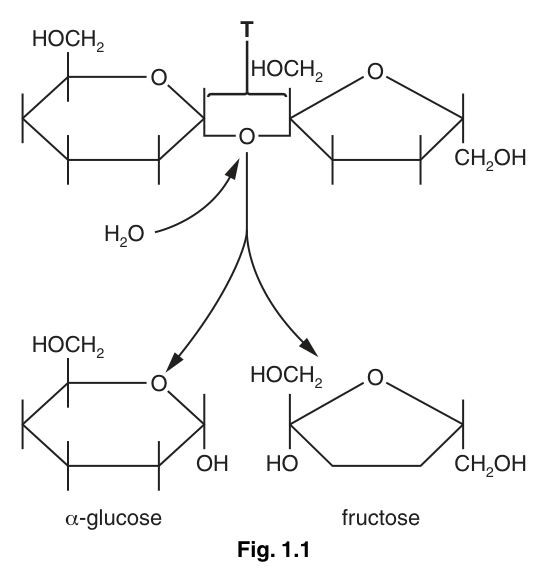
Name the bond indicated by T.
Answer
glycosidic (bond);
glycosidic (bond)
Background Concept
A disaccharide such as sucrose is built from two monosaccharide units joined by a covalent bond. The bond formed between the -OH of one sugar and the -OH of another, with the elimination of water, is called a glycosidic bond. In sucrose the bond joins the C1 of -glucose to the C2 of fructose, and is therefore more precisely an glycosidic bond.
Understanding the Question
Fig. 1.1 shows a sucrose molecule split by the addition of into -glucose and fructose. The bond labelled T is the single covalent link holding the two sugars together. The question simply asks you to name this bond.
Approach
Recognise the structural context: two sugar rings joined by a bridging oxygen. The covalent bond that joins monosaccharides into disaccharides (and into polysaccharides) is named for the sugars it links — the glycosidic bond.
Step-by-Step Reasoning
- Two monosaccharides condense together with the elimination of water to form a disaccharide; the bond formed between them is a glycosidic bond.
- In sucrose (a glucose–fructose disaccharide) the labelled link T is therefore a glycosidic bond.
Key Takeaways
- All bonds between monosaccharide units in sugars are glycosidic bonds.
- The same naming system covers disaccharides (maltose, lactose, sucrose) and polysaccharides (starch, glycogen, cellulose).
Common Mistakes
- Writing 'peptide bond' or 'hydrogen bond' — these are bonds of proteins or weak intermolecular forces respectively.
- Writing 'ester bond' — that joins glycerol to fatty acids in lipids.
Things to Be Careful About
- The bond joins sugar units to sugar units, so the word you need is glycosidic (from the Greek 'glyco-' meaning sugar).
State the name given to this type of reaction in which water is involved.
Answer
hydrolysis;
hydrolysis
Background Concept
Reactions involving water have specific names. When a water molecule is consumed to break a covalent bond, the reaction is called hydrolysis (Greek hydro- = water, -lysis = loosening). It is the reverse of a condensation (dehydration) reaction, in which water is produced as two molecules are joined.
For sucrose, hydrolysis gives back the two monosaccharides from which it was built:
Understanding the Question
Fig. 1.1 shows water being added to the bond, splitting sucrose into two monosaccharides. The question asks for the generic name of any reaction in which water is used in this way.
Approach
Read the figure: one molecule of water is consumed and a covalent bond is broken into two halves. That is the textbook definition of hydrolysis.
Step-by-Step Reasoning
- A water molecule is taken up.
- A covalent (glycosidic) bond in the substrate is broken.
- The -H and -OH from water attach to the two fragments, completing them as separate monosaccharides.
- A reaction in which water is consumed to split a bond is hydrolysis.
Key Takeaways
- Hydrolysis and condensation are complementary: hydrolysis splits a polymer using water; condensation joins monomers by removing water.
- Hydrolysis is used in digestion to break down starch, glycogen, proteins, lipids and nucleic acids into their monomers.
Common Mistakes
- Writing 'dehydration' — that is the reverse, where water is removed to form a bond.
- Writing 'hydration' — that means adding water across a double bond, not splitting a polymer.
Things to Be Careful About
- The word 'hydrolysis' is the only accepted term; 'splitting' or 'digestion' would not score.
State two roles of water within plant cells other than taking part in breakdown reactions.
- ______
- ______
Answer
- solvent / medium for (metabolic) reactions;
- transport medium.
Two roles of water inside plant cells, e.g. solvent/medium for reactions and transport medium.
Background Concept
Water is the most abundant substance in living cells, typically 70–95% of fresh mass. Its unusual properties — polarity, hydrogen bonding, high specific heat, cohesion, and being a liquid at body temperature — give it an unusually wide range of roles in plant cells. Beyond simply taking part in reactions such as hydrolysis, water is the medium in which biochemistry happens and the transport fluid of the plant.
Understanding the Question
The question asks for two roles of water within plant cells other than acting as a reactant such as the hydrolysis in Fig. 1.1. Anything that describes water acting as a solvent, transport medium, structural contributor (turgidity), reactant for photosynthesis, or contributor to growth will be accepted.
Approach
Think first about the universal roles of water in any cell — solvent, transport, temperature buffer, participant in reactions — then add plant-specific roles such as turgidity and stomatal opening. Pick two distinct points.
Step-by-Step Reasoning
Two creditable answers (any two from the list score):
- Solvent / medium for metabolic reactions — most cellular chemistry occurs in aqueous solution because reactants and enzymes must be dissolved to collide.
- Transport medium — water carries solutes (mineral ions, sugars, hormones) within the cell and around the plant.
- Maintaining turgidity — water in the vacuole pushes the protoplast against the cell wall, keeping non-woody plant tissues firm.
- Reactant for photosynthesis — water is split (photolysis) in the light-dependent reactions to provide electrons, releasing .
- Cell expansion / growth — uptake of water drives elongation of cells in growing regions.
- Maintains hydrostatic / pressure potential and the water-potential gradient that drives water movement.
- Stomatal opening — water entering guard cells makes them turgid and opens the stoma.
- Hydrophilic interactions of membrane components.
- (In the vacuole) pushes chloroplasts to the edge of the cell so light reaches them efficiently.
Key Takeaways
- Water's role in plant cells is much wider than being a reactant.
- Turgidity, transport, solvent action and photosynthesis are the headline answers.
Common Mistakes
- Listing the role of water in hydrolysis (already done in the figure).
- Vague answers such as 'keeps the plant alive' or 'helps with reactions' — too imprecise.
- Citing hydrogen bonding without linking it to a biological role such as membrane structure or cohesion-tension.
Things to Be Careful About
- Two distinct points are required; do not repeat the same idea reworded.
- The mark scheme allows any two valid roles, so a plant-specific role (turgidity, stomata) scores as much as a general one (solvent, transport).
Enzymes are globular proteins.
State what is meant by the term globular.
Answer
- spherical / ball-shaped;
- hydrophilic / polar R-groups on the outside / water-soluble.
Spherical shape with hydrophilic / polar R-groups on the outside; water-soluble.
Background Concept
Proteins adopt two broad shapes. Fibrous proteins (such as collagen and keratin) are long, parallel polypeptide chains, insoluble and structural. Globular proteins (such as enzymes, haemoglobin and antibodies) fold into compact, rounded shapes in which hydrophobic R-groups are buried inside and hydrophilic R-groups sit on the outside. The outward-facing hydrophilic groups make the protein soluble in the aqueous cytosol — essential if the protein is to act as an enzyme, transporter or signalling molecule.
Understanding the Question
You are asked for the meaning of 'globular' as applied to enzymes. The term covers both shape and surface chemistry; two marks are available, so two distinct ideas are needed.
Approach
Recall the structural features that define a globular protein: a compact shape caused by its tertiary folding, and the position of its R-groups that makes it soluble in water.
Step-by-Step Reasoning
- Globular proteins have a roughly spherical / ball-shaped tertiary structure.
- The hydrophobic R-groups are folded into the interior; the hydrophilic / polar R-groups are exposed on the outside.
- The exposed polar groups interact with water, so the protein is water-soluble.
Key Takeaways
- 'Globular' describes shape (round) and solubility (water-soluble because of surface polar groups).
- These features enable globular proteins to act as enzymes, hormones, antibodies and transport proteins in the cytosol or blood.
Common Mistakes
- Saying 'fibrous' or 'long' — that is the opposite.
- Only mentioning shape without the solubility aspect.
- Stating 'quaternary structure' — the question asks about the protein class, not its level of structure.
Things to Be Careful About
- The mark scheme will not award a mark for 'has more than one polypeptide chain' — that is not what globular means.
- Two marks require two distinct points; do not write the same idea twice.
The reaction shown in Fig. 1.1 is catalysed by the enzyme sucrase. Fig. 1.2 shows an enzyme-catalysed reaction.
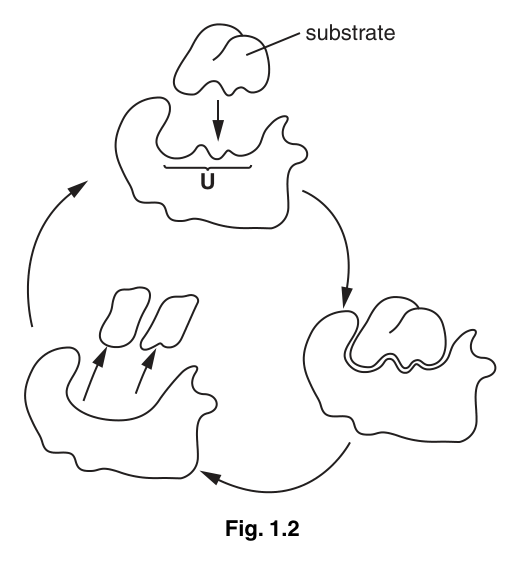
Name the part of the enzyme labelled U.
Answer
active site;
active site
Background Concept
An enzyme is a globular protein that catalyses a specific metabolic reaction. The catalytic action happens at a small three-dimensional cleft on the surface of the protein where the substrate binds. This cleft is called the active site. Its shape, charge distribution and chemistry are determined by the R-groups of the amino acids that line it, and they are specific to the substrate(s) of that enzyme.
Understanding the Question
Fig. 1.2 shows the catalytic cycle of an enzyme. The label U points to the cleft on the enzyme surface into which the substrate docks. You are asked to name this feature.
Approach
Identify the labelled region by its function — it is the site on the enzyme where the substrate binds. That is the textbook definition of an active site.
Step-by-Step Reasoning
- The substrate is shown fitting precisely into the cleft labelled U.
- A binding site on an enzyme that accepts the substrate is called the active site.
Key Takeaways
- The active site is where catalysis occurs: substrate binding, transition-state formation and product release.
- Only the right substrates fit the active site — this is the basis of enzyme specificity.
Common Mistakes
- Writing 'binding site' or 'catalytic site' — the mark scheme ignores these and accepts only 'active site'.
- Writing 'allosteric site' — that is a different, regulatory site on some enzymes.
Things to Be Careful About
- The mark is for the exact term 'active site'.
With reference to Fig. 1.2, explain the mode of action of enzymes.
Answer
- (shape of) U / active site, gives specificity;
- substrate, fits into / binds with, active site;
- complementary (shape) / matching shape (lock-and-key / induced fit);
- forms, enzyme-substrate / E-S, complex.
(Any 4 from: specificity, substrate binding, complementary shape, E-S complex, stress in substrate, lowers activation energy, enzyme unchanged / reusable, high turnover number.)
Any 4 of: specificity of active site; substrate fits active site; complementary shape; E-S complex; stress in substrate; lowers activation energy; enzyme unchanged / reusable; high turnover number.
Background Concept
Enzymes are biological catalysts: they speed up reactions without being consumed. They do this by binding the substrate at the active site, holding it in an orientation that distorts key bonds, and thereby lowering the activation energy needed to reach the transition state. Two models describe how the substrate fits the active site. The lock-and-key model says the active site and substrate have rigid, complementary shapes. The induced-fit model adds that the active site moulds itself around the substrate as binding occurs, bringing catalytic R-groups into closer contact with the substrate. After catalysis the products are released and the enzyme is unchanged, free to bind more substrate.
Understanding the Question
Fig. 1.2 shows the catalytic cycle: substrate binds at U (the active site), an enzyme-substrate complex forms, products are released, and the enzyme is restored. You are asked to explain how the enzyme works, referring to Fig. 1.2.
Approach
Pick four marking points that together cover (i) specificity, (ii) substrate binding, (iii) the E-S complex, and (iv) one further point (stress on substrate, lowering activation energy, reusability or turnover). The mark scheme offers nine alternative points — choose the strongest four.
Step-by-Step Reasoning
- Specificity: the shape of U (the active site) gives the enzyme its specificity — only substrates with a complementary shape can bind.
- Binding: the substrate fits into / binds with the active site U. The shape is complementary — the lock-and-key or induced-fit model applies.
- E-S complex: binding forms the enzyme-substrate (E-S) complex — an unstable intermediate in which the substrate is held in the correct orientation for reaction.
- Stress / activation energy: the active site strains or puts stress on particular bonds in the substrate, so less energy is needed to break them. The reaction therefore proceeds faster and at body temperature.
- Reusability: the enzyme itself is not used up in the reaction; once the products leave, the active site is unchanged and ready to accept another substrate.
- Turnover number: enzymes have a high turnover number — each enzyme molecule catalyses many substrate molecules per second.
Key Takeaways
- Enzyme action can be summarised as: bind substrate → form E-S complex → lower activation energy → release products → enzyme recycled.
- Specificity is a direct consequence of the active site shape being complementary to the substrate.
- Enzymes are not consumed and so can work at very high rates (high turnover number).
Common Mistakes
- Saying the enzyme and substrate 'have the same shape' — they have complementary, not identical, shapes.
- Saying the enzyme is 'used up' or 'changed' — it is recycled.
- Confusing specificity (which substrate can bind) with reaction rate (how fast it reacts once bound).
Things to Be Careful About
- Use Fig. 1.2 in your answer where possible; the question explicitly says 'with reference to Fig. 1.2'.
- The mark scheme accepts either 'lock-and-key' or 'induced fit' as the description of complementarity.
- Stress / strain on the substrate is the link to lowering activation energy.
The rest of this paper
5 more questions- Q2Cell Structure · Gas Exchange12M
- Q3Transport in Mammals13M
- Q4Infectious Diseases · Immunity12M
- Q5The Mitotic Cell Cycle · Nucleic Acids and Protein Synthesis7M
- Q6(outdated) Ecology5M