Biology 9700/41 — October/November 2023
Cambridge A-Level · A Level Structured Questions · worked solutions for every part, with the mark scheme
Topics Genetic Technology · Selection and Evolution · Control and Coordination · Photosynthesis · Homeostasis · Classification, Biodiversity and Conservation · +2 more
Chloroplasts carry out photosynthesis.
Fig. 1.1 shows some structural features of a chloroplast and some processes that occur within it.
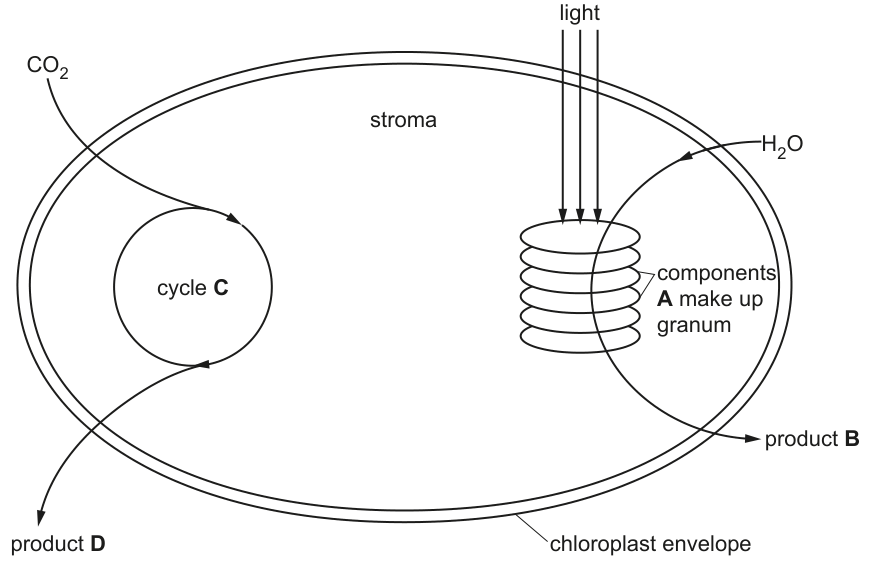
Identify the structures labelled A in Fig. 1.1.
A ______
Answer
thylakoids
thylakoids
Background Concept
The chloroplast is the organelle in plant cells where photosynthesis takes place. Its internal structure is highly organised to separate the two main stages of photosynthesis:
- The light-dependent reactions occur on the thylakoid membranes, where the pigments (chlorophyll a, chlorophyll b, carotenes, xanthophylls), photosystems (PSI and PSII), electron carriers and ATP synthase are embedded.
- The light-independent reactions (the Calvin cycle) take place in the stroma, the fluid matrix surrounding the thylakoids.
A granum (plural: grana) is a stack of disc-shaped thylakoids. A thylakoid is a flattened, membrane-bound sac, and the space inside it is the thylakoid lumen. The thylakoid membrane separates the lumen from the stroma and is the site of the electron transport chain, photophosphorylation and chemiosmosis.
Understanding the Question
This is a pure recall question. The diagram shows a chloroplast with a granum (a stack of flat sacs) on the right, and the individual sacs making up the granum are labelled A. You must name those individual discs.
Approach
Identify the part of the chloroplast being indicated: the granum is the whole stack, but each flattened disc within the stack is a separate structure with its own name. That name is the answer.
Step-by-Step Reasoning
- The label A points to one of the individual flattened discs in the stack on the right of the chloroplast.
- Each disc is a thylakoid — a flattened, membrane-bound compartment containing the light-dependent reaction machinery.
- A whole stack of thylakoids is a granum (plural grana); different grana are linked by intergranal lamellae (stroma thylakoids), but those are not what is being asked here.
- The credited answer is the singular or plural form: thylakoid / thylakoids.
Key Takeaways
- Thylakoid = the individual flattened sac inside a chloroplast.
- Granum = a stack of thylakoids.
- Stroma = the fluid surrounding the thylakoids.
- Thylakoid membranes carry the light-dependent reactions; the stroma carries the Calvin cycle.
Common Mistakes
- Writing "granum" for A — the granum is the whole stack, not one of its discs. The mark scheme specifically credits thylakoid(s).
- Writing "chloroplast" or "chlorophyll" — these are the whole organelle and a pigment, not the structural component being labelled.
Things to Be Careful About
- The plural form "thylakoids" is also accepted.
- Do not confuse the thylakoid lumen (the space inside) with the thylakoid (the sac itself).
Explain how the structure and appearance of the granum, and the components labelled A, relate to their function.
Answer
- Thylakoids are stacked into a granum, providing a large surface area to increase light absorption.
- The thylakoid membrane contains pigments (chlorophyll), photosystems, electron carriers and enzymes for the light-dependent reaction.
- The light-dependent reaction / photophosphorylation occurs on the thylakoid membrane, producing ATP and creating a proton gradient across the membrane (chemiosmosis).
- The thylakoid lumen accumulates , providing the high concentration that drives chemiosmotic ATP synthesis.
- The granum appears green because chlorophyll absorbs red and blue light, so green light is reflected.
See answer
Background Concept
A chloroplast's thylakoid system is a textbook example of structure–function matching in biology. The light-dependent reactions of photosynthesis require:
- A large area to capture light efficiently (a high surface-area-to-volume ratio).
- Pigments and photosystems arranged in a membrane to absorb photons and pass electrons along an electron transport chain.
- A way to separate charge (protons) across a membrane to drive ATP synthesis via chemiosmosis.
The granum/thylakoid architecture delivers all three:
- Stacks of thylakoids maximise surface area for light capture.
- The thylakoid membrane embeds chlorophyll, accessory pigments, photosystems I and II, the electron transport chain, and ATP synthase.
- The thylakoid lumen traps protons pumped across the membrane by the electron transport chain, building the proton-motive force used by ATP synthase to phosphorylate ADP.
The green colour of grana (and chloroplasts in general) arises because chlorophyll absorbs red (~660 nm) and blue (~430 nm) light most strongly, reflecting/transmitting green light.
Understanding the Question
This is a 4-mark "structure–function" question. The mark scheme is "any four from" with paired description (D) and function (F) points — you need to give up to three structural descriptions and link them to functions. Each clearly paired D–F earns a mark.
The question says "structure AND appearance" — so the marks can be earned from visible features (stacking, green colour, lumen) as well as molecular structure (membrane composition).
Approach
- Identify the structural features of a granum/thylakoid you can confidently link to a function.
- For each, write a short description and then say what that structure allows the cell to do.
- Aim for at least three different pairings to be safe; you only need four marks' worth.
Step-by-Step Reasoning
-
Stacking → light absorption
- Description: thylakoids are stacked into a granum, giving a large surface area.
- Function: this increases the amount of light that can be absorbed by the pigments embedded in the membranes.
-
Membrane composition → light-dependent reaction
- Description: the thylakoid membrane contains pigments (chlorophyll a/b, carotenoids), photosystems (PSI and PSII), electron carriers and enzymes (e.g. ATP synthase).
- Function: this is where the light-dependent reaction / photophosphorylation / chemiosmosis takes place, producing ATP and reduced NADP.
-
Lumen → proton gradient
- Description: there is a space inside the thylakoid (the lumen) separated from the stroma by the membrane.
- Function: the lumen accumulates , providing the high concentration that drives chemiosmotic ATP synthesis via ATP synthase.
-
Green appearance → pigment absorption
- Description: the granum appears green under the light microscope.
- Function: this is because chlorophyll absorbs red and blue light, so green light is reflected/transmitted.
You need any four of the eight points (D1/F2, D3/F4, D5/F6, D7/F8). The cleanest answer picks one D–F pair from each of the four sub-points above, giving you a balanced four-mark answer.
Key Takeaways
- The granum's stack structure is a form-fits-function adaptation for light capture.
- Thylakoid membrane components (pigments, photosystems, electron carriers, ATP synthase) make the light-dependent reaction possible.
- The thylakoid lumen is essential to chemiosmosis: it traps protons to make the gradient that drives ATP synthesis.
- The green colour of chloroplasts is a direct consequence of the absorption spectrum of chlorophyll.
Common Mistakes
- Giving descriptions with no function (or vice versa) — the mark scheme credits paired points, and isolated descriptions do not earn marks on their own in this question.
- Writing "absorbs sunlight" without naming what is absorbed (light) and what is captured (photons by pigments) — the mark scheme credits light absorption by the pigments/photosystems.
- Confusing the lumen (inside the thylakoid) with the stroma (around the thylakoids) — only the lumen accumulates ; the stroma has a low during the light-dependent reaction.
- Saying the granum "makes glucose" — glucose is made by the Calvin cycle in the stroma, not on the thylakoid membrane.
Things to Be Careful About
- Pair each structural point with its function in the same sentence or short bullet — the mark scheme rewards linked D–F pairs.
- "Any four from" means you do not need to cover all four pairings, but covering three pairings is the safest route to four marks.
- Use the correct term thylakoid (not "thylacoid" or "thylakoyd").
Identify the metabolic pathway labelled cycle C in Fig. 1.1.
C ______
Answer
Calvin (cycle)
Calvin (cycle)
Background Concept
Photosynthesis is divided into two linked stages:
- The light-dependent reaction on the thylakoid membranes, which uses light energy to photolyse water, release and generate ATP and reduced NADP.
- The light-independent reaction (the Calvin cycle) in the stroma, which uses the ATP and reduced NADP from the light-dependent reaction to fix into triose phosphate (TP), a 3-carbon sugar.
The Calvin cycle is a circular pathway — hence "cycle". It is sometimes called the Calvin–Benson cycle or the reductive pentose phosphate (RPP) cycle.
Understanding the Question
The diagram shows a circular pathway (cycle C) inside the chloroplast, with entering and a product D leaving. It is also linked by arrows to the granum (the light-dependent reaction). From these clues you must name the pathway.
Approach
The key features are: the cycle is in the stroma, it takes in , and it is fed by the light-dependent reaction. There is only one pathway in a chloroplast with all three features.
Step-by-Step Reasoning
- The cycle is in the stroma → light-independent stage of photosynthesis.
- It takes in → carbon-fixation step (catalysed by rubisco).
- It is fed by the light-dependent reaction (via ATP and reduced NADP) → it must be the Calvin cycle.
So cycle C = Calvin cycle.
Key Takeaways
- The Calvin cycle is the light-independent reaction of photosynthesis and happens in the stroma.
- It is the only metabolic pathway in plants that fixes inorganic into organic carbon.
- It is a cycle (regenerates its starting material) — this is the focus of part (ii).
Common Mistakes
- Writing "Krebs cycle" or "citric acid cycle" — these are stages of respiration in the mitochondrial matrix, not of photosynthesis.
- Writing "Calvin–Benson cycle" only (without "Calvin") is also accepted by CIE, but the expected form is "Calvin cycle".
- Writing "light-independent reaction" only is acceptable, but the precise pathway name is safer.
Things to Be Careful About
- Do not confuse the Calvin cycle (chloroplast stroma) with the Krebs cycle (mitochondrial matrix) — the names look similar but the locations and products are completely different.
Explain why pathway C is described as a cycle.
Answer
- There is no distinct start or end point — the same set of intermediates is present all the time.
- The starting molecule RuBP (ribulose bisphosphate, a 5C compound) is regenerated at the end of each turn, so the cycle can repeat.
- Numerical detail: e.g. six turns of the cycle fix six and produce one hexose (glucose) while regenerating six RuBP, consuming 18 ATP and 12 reduced NADP.
See answer
Background Concept
A cycle in biology is a series of enzyme-catalysed reactions in which the final product regenerates the starting molecule, so the same sequence can repeat indefinitely as long as inputs are supplied. Classic examples are the Krebs cycle, the Calvin cycle and the urea cycle.
In the Calvin cycle:
- combines with the 5-carbon acceptor ribulose bisphosphate (RuBP), catalysed by rubisco.
- The unstable 6C intermediate splits into two molecules of 3-carbon glycerate-3-phosphate (GP).
- GP is reduced to triose phosphate (TP) using ATP and reduced NADP from the light-dependent reaction.
- Most TP is used to regenerate RuBP (using more ATP); some TP leaves the cycle to form glucose and other carbohydrates.
Because RuBP is regenerated, the pathway qualifies as a cycle.
Understanding the Question
The question asks you to explain why the pathway shown in cycle C is described as a cycle. The mark scheme rewards any two of four points: no start/end, all intermediates present all the time, RuBP is regenerated, and numerical detail.
Approach
The cleanest way to answer is to identify what makes any pathway "cyclical" (regeneration of the starting molecule) and back it up with the specific example from the Calvin cycle. Adding a numerical point makes the answer more rigorous.
Step-by-Step Reasoning
-
No distinct start or end point
- A cycle is not a linear sequence. The Calvin cycle is a circular series of reactions in which the final step regenerates the starting molecule, so there is no fixed start or end.
-
All intermediates are present all the time
- Because RuBP is regenerated each turn, the intermediates of the cycle (RuBP, GP, TP) are present continuously. Inputs (, ATP, reduced NADP) enter and products (TP → glucose) leave, but the catalyst pool itself is constant.
-
RuBP is regenerated
- The 5C acceptor RuBP combines with at the start, and is reformed at the end. Without regeneration, the cycle would grind to a halt.
-
Numerical detail
- 6 turns of the cycle fix 6 and produce 12 GP, which are reduced to 12 TP.
- 2 of those 12 TP leave to form 1 hexose (e.g. glucose); the remaining 10 TP are rearranged (using 6 ATP) to regenerate 6 RuBP.
- So one glucose molecule needs 6 , 18 ATP and 12 reduced NADP overall.
You only need two of these for full marks; combining "no start/end" with "RuBP is regenerated" is the most efficient route.
Key Takeaways
- A cycle in biochemistry = a pathway whose end product regenerates its starting material.
- The Calvin cycle is cyclical because RuBP is regenerated each turn.
- Inputs (, ATP, reduced NADP) and outputs (TP / glucose) flow through, but the intermediates stay.
- Stoichiometrically, six turns of the cycle produce one hexose sugar.
Common Mistakes
- Saying "because the diagram shows it as a circle" — the shape on a diagram is just a visual convention; the mark scheme credits the underlying biology (regeneration).
- Confusing "cycle" with "reversible" — the Calvin cycle is cyclical (regenerates RuBP), not reversible in the simple sense.
- Saying the cycle "starts with " or "ends with glucose" — these are inputs/outputs, not the start/end of the cycle itself.
- Writing "5C → 6C → 3C" as the start — the 5C is RuBP, the 6C is the unstable intermediate, and 3C is GP. Confusing the labels loses marks.
Things to Be Careful About
- Numerical detail (point 4) is accepted as a single mark; you don't need to give all the numbers, but specific counts strengthen the answer.
- The mark scheme explicitly accepts "5C molecule" as well as "RuBP".
- Don't be tempted to call it a "loop" — biology texts and mark schemes use "cycle".
Identify the products of photosynthesis labelled B and D in Fig. 1.1.
B ______
D ______
Answer
- B: oxygen (from the light-dependent reaction / photolysis of water on the thylakoid membrane)
- D: glucose (or triose phosphate / hexose / sugar / carbohydrate / starch) — the product of the Calvin cycle
B = oxygen; D = glucose (or triose phosphate / hexose / sugar / carbohydrate / starch)
Background Concept
Photosynthesis has two linked sets of products:
- The light-dependent reaction on the thylakoid membrane photolyses water:
The is released as a by-product into the atmosphere (or into the surrounding water in aquatic plants). The electrons and protons are used in the electron transport chain to make ATP and reduced NADP.
- The Calvin cycle in the stroma fixes into triose phosphate (TP, a 3C sugar). Two TP molecules can combine to form one hexose (e.g. glucose). Glucose can then be polymerised into starch for storage, or used to make sucrose, cellulose and other carbohydrates.
Understanding the Question
The diagram has two labelled products: B leaves the granum (the light-dependent reaction site) and D leaves cycle C (the Calvin cycle). You must identify each.
Approach
Work out which stage each label belongs to, then recall what that stage releases.
- B leaves the granum → B is a product of the light-dependent reaction.
- D leaves the Calvin cycle → D is a product of the light-independent reaction.
Step-by-Step Reasoning
- B = oxygen (): the light-dependent reaction photolyses water; the produced is the gas that diffuses out of the chloroplast, then out of the leaf.
- D = triose phosphate / glucose / hexose / sugar / carbohydrate / starch: the Calvin cycle's first stable product is triose phosphate (3C). TP can be combined to form glucose (6C), and glucose is the building block for starch, sucrose, cellulose, lipids and amino acids. Any of these terms is accepted by the mark scheme.
Key Takeaways
- The two products of the whole of photosynthesis (combining both stages) are commonly given as and glucose.
- The product of the Calvin cycle specifically is triose phosphate; the product of the light-dependent reaction (other than ATP/NADPH) is .
- CIE accepts a wide range of names for D (glucose, triose phosphate, hexose, sugar, carbohydrate, starch) — any one is fine.
Common Mistakes
- Swapping B and D (calling B glucose and D oxygen). Follow the arrow: B leaves the granum, D leaves the cycle.
- Writing "ATP" or "reduced NADP" for either B or D — these are intermediates that pass between the two stages, not the products that leave each stage to the rest of the cell/plant.
- Writing "water" for B — water is an input to the light-dependent reaction, not a product.
- Writing "carbon dioxide" for D — is an input to the Calvin cycle, not a product.
Things to Be Careful About
- "Triose phosphate" and "glucose" are both correct for D — but on a Cambridge A-level mark scheme, you only need to give one of the accepted terms.
- CIE sometimes distinguishes "product of the light-dependent reaction" (where is correct) from "product of photosynthesis" (where and glucose are both correct). On this diagram, B is unambiguously and D is unambiguously the carbohydrate product.
Suggest and explain the importance of glucose and the product labelled B in Fig. 1.1 to ecosystems.
Answer
- Glucose is a source / store of chemical energy / a food; it is the basis of food chains and food webs, so energy flows from producers to consumers through it.
- Oxygen (B) is required for aerobic respiration / oxidative phosphorylation in the cells of almost all organisms, releasing ATP for metabolism.
- Together, glucose and oxygen underpin the energy flow and respiration that drive ecosystem function.
See answer
Background Concept
The two products of photosynthesis underpin almost all life on Earth:
- Glucose is the primary biological fuel. It is used directly in respiration (glycolysis, link reaction, Krebs cycle) to generate ATP, and is also stored as starch in plants or converted into other carbohydrates, lipids and amino acids. When a herbivore eats a plant, or a carnivore eats the herbivore, the chemical energy locked in those glucose-derived molecules passes up the food chain.
- Oxygen is the final electron acceptor in the electron transport chain in mitochondria. Without , oxidative phosphorylation cannot occur, and the vast majority of eukaryotic and many prokaryotic organisms cannot extract enough ATP from glucose to support large, active bodies. The evolution of oxygenic photosynthesis, ~2.4 billion years ago, transformed Earth's atmosphere and enabled the evolution of aerobic respiration.
The flow of energy through an ecosystem (sunlight → producers → consumers → decomposers) and the cycling of matter (carbon, oxygen, water, nitrogen) are both ultimately driven by photosynthesis.
Understanding the Question
The question asks you to suggest and explain the importance of both glucose and oxygen (B) to ecosystems. "Suggest" is the key word — CIE wants you to apply your knowledge to a wider context rather than just recall from the photosynthesis topic. The mark scheme rewards three points:
- oxygen linked to aerobic respiration / oxidative phosphorylation
- glucose as source/store of chemical energy / ATP / food
- reference to energy flow through food chains / food web / ecosystem
Approach
- For oxygen: connect it to aerobic respiration / oxidative phosphorylation.
- For glucose: connect it to being a food / energy source.
- Then make a more general ecological point: these products underpin the energy flow through food chains and food webs.
Step-by-Step Reasoning
-
Oxygen supports aerobic respiration
- Most organisms (animals, plants, most fungi, many bacteria and protists) use as the final electron acceptor in the electron transport chain in their mitochondria.
- This drives oxidative phosphorylation and produces most of the ATP that powers cellular work (active transport, biosynthesis, movement, division, etc.).
- Without photosynthesis producing , aerobic ecosystems could not exist.
-
Glucose is a food/energy source
- Glucose and the molecules made from it (starch, sucrose, lipids, proteins) are the chemical energy store of plants.
- Plants are autotrophs (producers); they form the base of nearly every food chain.
- Heterotrophs (consumers) obtain their chemical energy by eating plants or other animals — so the energy in their food is, ultimately, energy that was once fixed by photosynthesis into glucose.
-
Energy flows through ecosystems
- Light energy is captured by photosynthesis and stored in glucose.
- The chemical energy in glucose is transferred along food chains and food webs as one organism eats another.
- At each trophic level, some energy is lost as heat (respiration); the rest is passed on. This is the energy flow that powers ecosystem function.
Key Takeaways
- Photosynthesis is the ultimate source of both the food (chemical energy) and the oxygen (respiratory substrate) on which ecosystems depend.
- Energy flows through ecosystems in one direction (with losses as heat); matter (carbon, oxygen) cycles.
- Plants are the entry point for energy into almost every ecosystem on Earth.
Common Mistakes
- Saying glucose is "used in respiration" without linking it to food webs / energy flow — the mark scheme credits the broader ecological connection.
- Saying oxygen is "needed for breathing" — true at organism level, but CIE prefers the cellular mechanism: aerobic respiration / oxidative phosphorylation.
- Confusing the flow of energy (one-way, with losses as heat) with the cycling of matter (carbon, oxygen, nitrogen) — energy does not cycle; it is dissipated.
- Saying plants "produce oxygen for us to breathe" — this anthropocentric framing misses the broader ecological point about energy flow and respiration across all aerobic organisms.
Things to Be Careful About
- The word "suggest" means you are expected to apply knowledge, not just recall — a candidate who only writes photosynthesis facts will not score the ecology marks.
- The mark scheme explicitly credits the link to aerobic respiration / oxidative phosphorylation for oxygen, not just "breathing".
- The mark scheme credits food chains / food webs / ecosystem for the energy-flow point — the keywords are flow through chains or webs.
The rest of this paper
9 more questions- Q2Classification, Biodiversity and Conservation · Genetic Technology · Selection and Evolution14M
- Q3Selection and Evolution · Homeostasis · Control and Coordination16M
- Q4Genetic Technology7M
- Q5Energy and Respiration7M
- Q6—11M
- Q7Control and Coordination · Homeostasis9M
- Q8Photosynthesis · Genetic Technology · Inheritance6M
- Q9Selection and Evolution · Control and Coordination10M
- Q10Genetic Technology7M