Biology 9700/42 — May/June 2023
Cambridge A-Level · A Level Structured Questions · worked solutions for every part, with the mark scheme
Topics Selection and Evolution · Classification, Biodiversity and Conservation · Photosynthesis · Homeostasis · Control and Coordination · Energy and Respiration · +2 more
(a) Glycolysis is a biochemical pathway that occurs in the cytoplasm of cells.
In glycolysis, a molecule of glucose is metabolised to two molecules of pyruvate. The process is outlined in Fig. 1.1.
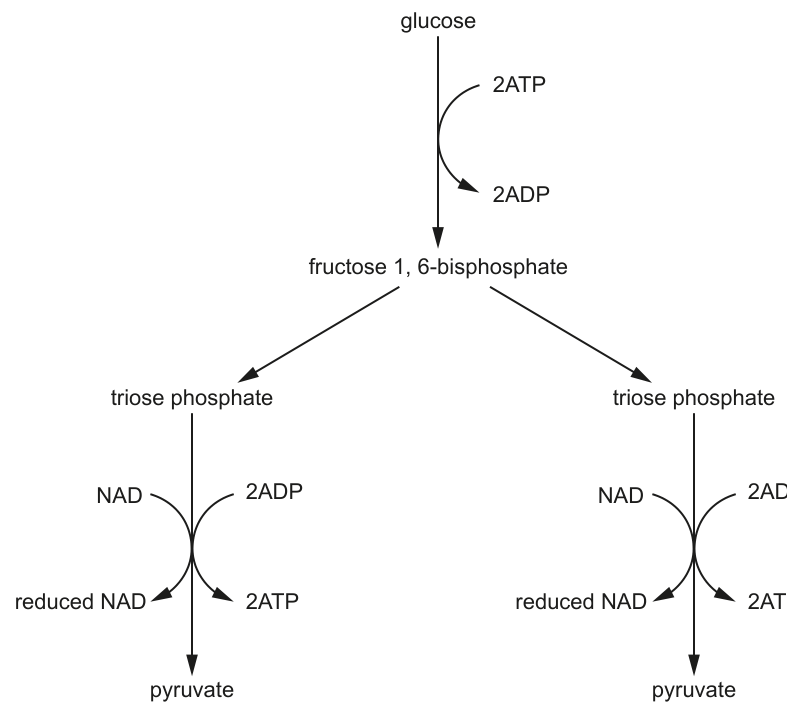
Explain why glucose is phosphorylated at the beginning of glycolysis.
Suggest one use of the reduced NAD that is produced in glycolysis.
Name the type of phosphorylation reaction by which ATP is made during glycolysis.
Pyruvate can enter the mitochondrion by active transport.
Describe the main conditions that are required for pyruvate to enter the mitochondrion by active transport.
Pyruvate is involved in the link reaction in the matrix of the mitochondrion.
Describe the link reaction.
The rest of this paper
9 more questions- Q2Inheritance7M
- Q3Selection and Evolution · Classification, Biodiversity and Conservation11M
- Q4Genetic Technology · Photosynthesis12M
- Q5Selection and Evolution10M
- Q6Homeostasis15M
- Q7Control and Coordination7M
- Q8Photosynthesis9M
- Q9Control and Coordination · Homeostasis10M
- Q10Classification, Biodiversity and Conservation10M