Biology 9700/53 — October/November 2022
Cambridge A-Level · Planning, Analysis and Evaluation · worked solutions for every part, with the mark scheme
Topics Planning · Analysis, Conclusions and Evaluation
Antibiotic resistance in bacteria is a global problem that has caused scientists to research into antibacterial substances other than antibiotics. Honey has properties that make it a good antibacterial substance. For example, honey contains hydrogen peroxide, which is known to kill bacteria.
The most effective honey tested so far for antibacterial activity is Manuka honey. It contains less hydrogen peroxide than many other types of honey, but it does contain an antibacterial compound, methylglyoxal (MGO), which is not found in other types of honey.
A student decided to investigate the effect of two antibacterial substances on the bacterium Bacillus subtilis, which respires aerobically:
• MGO in Manuka honey
• an antibiotic solution used in cell cultures to prevent contamination.
The student wanted to find the lowest concentration of each antibacterial substance that would kill or inhibit the growth of B. subtilis.
The student used a broth culture for the investigation. To make a broth culture, a small quantity of B. subtilis is added to a clear nutrient solution. A fresh (newly made) broth culture of B. subtilis is also clear.
Fig. 1.1 is a diagram of a fresh broth culture of B. subtilis.
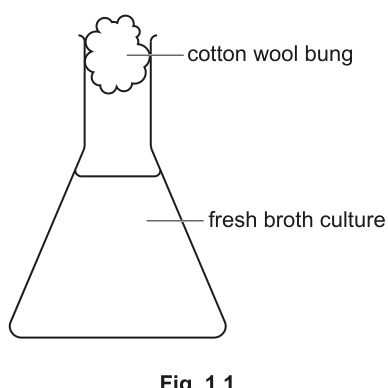
A sterile cotton wool bung was used in the top of the flask containing the fresh broth culture of B. subtilis to protect the culture from contamination.
Explain why it is better to use a sterile cotton wool bung in a flask containing broth culture of B. subtilis, rather than using a sterile rubber bung.
Before comparing the two antibacterial substances, the student carried out a trial experiment.
The student transferred a sample of fresh broth culture to a culture tube and incubated the tube at for 24 hours.
Fig. 1.2 summarises the results of the trial experiment.
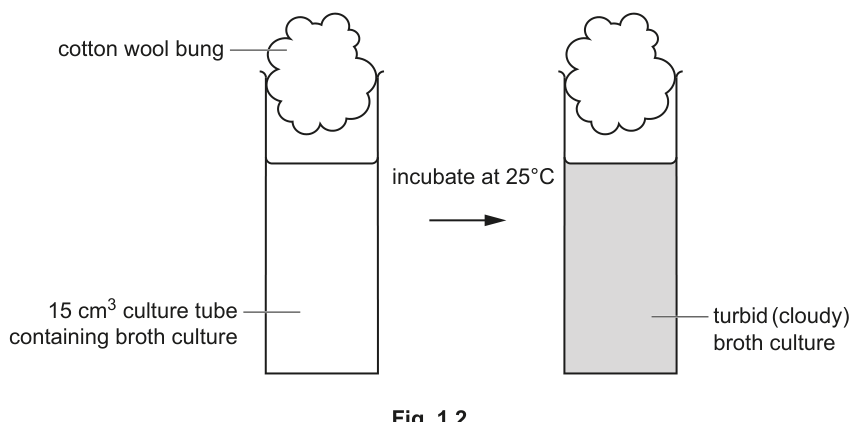
The student decided that turbidity of the broth culture is a measure of bacterial population growth (bacterial growth).
Explain how this concept can be used in an investigation to measure the extent of bacterial growth.
The student decided to test the antibiotic solution before testing the Manuka honey.
In addition to normal laboratory apparatus and materials, the student was provided with:
• a fresh broth culture of B. subtilis
• a clear antibiotic stock solution
• nutrient solution to dilute the antibiotic stock solution
• flat-bottomed glass culture tubes with sterile cotton wool bungs
• a choice of graduated pipettes to measure volumes accurately: , , , .
The student:
• prepared dilutions of the antibiotic stock solution and added a volume of each to different culture tubes
• added a volume of fresh broth culture of B. subtilis to each culture tube
• incubated the culture tubes in an incubator
• allowed time for bacterial growth to occur and then checked each culture tube
• recorded and analysed the results
• decided on the lowest concentration of antibiotic solution that appeared to kill or inhibit the growth of B. subtilis.
Outline a control for this part of the investigation.
In the next part of the investigation, the student used a stock solution of Manuka honey. The student remembered that hydrogen peroxide could be present but could not think of a way to break down the hydrogen peroxide to remove it from the solution.
Describe how the student can improve the investigation by removing hydrogen peroxide from the Manuka honey solution and explain why this improvement makes the results more valid.
The student was provided with a stock solution of Manuka honey containing an MGO concentration of . This was a clear solution, labelled '100% honey'.
The same apparatus and materials were available.
Describe how the student could prepare a 10% solution of honey using the stock solution.
Construct a table to show how the dilution is made for the 10% solution and the other concentrations that the student could use.
Space for table.
State the independent variable and dependent variable for the part of the investigation involving Manuka honey solution.
independent variable ______
dependent variable ______
Predict the results the student would expect when investigating the effect of Manuka honey on B. subtilis.
Explain the reasoning behind the prediction.
Describe how the student could determine the lowest concentration of Manuka honey solution that would kill or inhibit the growth of B. subtilis.
• Do not repeat any detail given in (d) of how to prepare the different concentrations of Manuka honey solution
• Do not give details of using aseptic technique (techniques to prevent contamination of the student, the environment or other people).
Your method should be set out in a logical way and be detailed enough to let another person follow it.
MRSA, methicillin-resistant Staphylococcus aureus, is an example of antibiotic resistance in bacteria. There is evidence that medical-grade Manuka honey is effective in treating wounds infected with MRSA. This honey has been sterilised by gamma irradiation and filtered to remove contaminants.
A study was carried out to see if another type of honey, Germania honey, is as effective as Manuka honey in killing bacteria removed from wounds of 50 people with MRSA.
Five different concentrations of each type of honey were compared. The concentrations were numbered 1 to 5, with 1 being the highest concentration and 5 the lowest concentration.
At the concentrations where there was no visible growth in a broth culture of S. aureus, the researchers transferred samples onto nutrient agar plates containing no antibacterial substance. Incubation of these plates confirmed that there was no bacterial growth.
The results were analysed using the chi-squared () test.
Table 1.1 shows the results of the study and the statistical analysis using the test.
Table 1.1
| concentration of honey M=Manuka G=Germania | number of cultures with bacterial growth | number of cultures with no bacterial growth | value | significant |
|---|---|---|---|---|
| M1 | 2 | 48 | ||
| G1 | 9 | 41 | 5.005 | yes |
| M2 | 5 | 45 | ||
| G2 | 21 | 29 | 13.306 | |
| M3 | 11 | 39 | ||
| G3 | 30 | 20 | 14.923 | |
| M4 | 43 | 7 | ||
| G4 | 48 | 2 | 3.052 | |
| M5 | 47 | 3 | ||
| G5 | 49 | 1 | 1.042 | no |
State a null hypothesis for the investigation.
Table 1.2 shows some critical values for at different probabilities.
Table 1.2
| degrees of freedom | probability | ||||||
|---|---|---|---|---|---|---|---|
| 0.99 | 0.95 | 0.90 | 0.10 | 0.05 | 0.01 | 0.001 | |
| 1 | 0.0002 | 0.0039 | 0.0158 | 2.706 | 3.841 | 6.635 | 10.827 |
| 2 | 0.0201 | 0.1026 | 0.2107 | 4.605 | 5.991 | 9.210 | 13.815 |
Use Table 1.2 to decide whether the values for concentrations 2, 3 and 4 in Table 1.1 are significant or not significant. Write your decision in the final column of Table 1.1:
• write yes if the value is significant
• write no if the value is not significant
This study compared the effectiveness of the two honey varieties in treating wounds infected with MRSA.
State the conclusions that can be made from the results and statistical analysis of this study.
The rest of this paper
1 more questions- Q2Planning · Analysis, Conclusions and Evaluation10M