Biology 9700/43 — May/June 2022
Cambridge A-Level · A Level Structured Questions · worked solutions for every part, with the mark scheme
Topics Homeostasis · Genetic Technology · Classification, Biodiversity and Conservation · Control and Coordination · Photosynthesis · Energy and Respiration · +2 more
The water potential of mammalian blood needs to be maintained within narrow limits so that cells function efficiently. This process is called osmoregulation.
The relative medullary thickness (RMT) indicates the proportion of a kidney that is composed of medullary tissue.
Table 1.1 shows the relationship between the RMT and the concentration of urine produced by four mammals from different habitats.
Table 1.1
| mammal | habitat | RMT | urine concentration / arbitrary units |
|---|---|---|---|
| beaver | rivers and lakes | 1.4 | 0.90 |
| warthog | savannah | 2.8 | 2.35 |
| human | variable | 3.2 | 2.50 |
| kangaroo rat | desert | 8.6 | 10.50 |
Name the parts of the nephron that are located in the medulla.
Answer
- Loop of Henle
- Collecting duct
Loop of Henle and collecting duct.
Background Concept
A mammalian kidney has three main regions when cut in longitudinal section: an outer cortex, a deeper medulla (divided into pyramids in humans), and a central pelvis that collects urine into the ureter. The nephron — the functional unit of the kidney — is not confined to a single region. Its different segments lie in different parts of the kidney, and this positioning is critical to the way the kidney concentrates urine.
The nephron consists of:
- A renal capsule (Bowman's capsule) and glomerulus — in the cortex.
- A proximal convoluted tubule (PCT) — in the cortex.
- A loop of Henle — descends into the medulla (descending limb), loops at the tip (hairpin), and ascends back to the cortex (ascending limb).
- A distal convoluted tubule (DCT) — in the cortex.
- A collecting duct — passes from the cortex down through the medulla to the papilla, where it opens into the pelvis.
The longer the loop of Henle (and the longer the collecting duct it feeds into), the deeper it can penetrate the medulla and the steeper the osmotic gradient it can maintain, allowing more water to be reabsorbed and more concentrated urine to be produced. This is why desert mammals (e.g. the kangaroo rat) have very long loops of Henle, and why the relative medullary thickness (RMT) correlates with urine-concentrating ability.
Understanding the Question
The stem describes water-potential regulation in blood and introduces the medulla of the kidney. Part (a)(i) simply asks the candidate to name the parts of the nephron that lie in the medulla. Two structures are expected.
Approach
Recall the layout of a nephron and identify which segments pass into the medulla. The two key structures that dip into the medulla are the loop of Henle and the collecting duct.
Step-by-Step Reasoning
- The loop of Henle has a descending limb that plunges down into the medulla, a hairpin turn at the bottom (the tip of the loop), and an ascending limb that climbs back to the cortex. The medullary portion is what is being credited.
- The collecting duct receives filtrate from many nephrons and runs from the cortex, through the medulla, to the renal pelvis. It is the final site at which water can be reabsorbed under the control of ADH, and it is in the medulla where this controlled reabsorption occurs.
- The Bowman's capsule, PCT, and DCT are not in the medulla — they are in the cortex — so they are not credited here.
Key Takeaways
- The medulla contains the loop of Henle and the collecting duct.
- These are the segments that interact with the cortico-medullary osmotic gradient.
Common Mistakes
- Writing "nephron" on its own — too vague, does not name a specific part.
- Listing the proximal convoluted tubule or Bowman's capsule — these lie in the cortex, not the medulla.
- Writing "distal convoluted tubule" — this is in the cortex, not the medulla.
Things to Be Careful About
- The question asks for parts of the nephron. The glomerulus is not a named part of the nephron in this specification, and it sits in the cortex anyway.
- The loop of Henle is the standard CIE term; "loop of the nephron" is too vague and would not normally be credited.
Name a hormone involved in osmoregulation.
Answer
Antidiuretic hormone (ADH) [A vasopressin]
Antidiuretic hormone (ADH) / vasopressin.
Background Concept
Osmoregulation in mammals is achieved largely by adjusting how much water the kidney reabsorbs from the forming urine, and this adjustment is controlled by hormones. The two main hormones involved in mammalian water/salt balance are:
- Antidiuretic hormone (ADH) — also called vasopressin. It is released from the posterior pituitary gland (made in the hypothalamus) and acts on the collecting duct, increasing its permeability to water so more water is reabsorbed back into the blood and the urine becomes more concentrated.
- Aldosterone — from the adrenal cortex, acts on the distal tubule and collecting duct to reabsorb Na⁺ (which indirectly increases water reabsorption). Often classed as a salt-balance hormone.
Other hormones that touch water balance (e.g. atrial natriuretic peptide, ANP) exist but are not the primary osmoregulatory hormone at A-level.
Understanding the Question
The question gives 1 mark for the name of a hormone involved in osmoregulation. There is one mark available so only one clear, correctly spelled answer is needed.
Approach
The classic answer at CIE is ADH (or the accepted synonym vasopressin). State it and stop.
Step-by-Step Reasoning
- ADH is released when blood water potential falls (e.g. after sweating or in dehydration), detected by osmoreceptors in the hypothalamus.
- It travels in the blood to the collecting duct, where it causes aquaporin-2 channels to be inserted into the apical membrane of the collecting-duct cells.
- Water then leaves the collecting duct down the osmotic gradient set up by the loop of Henle, producing small volumes of concentrated urine.
- ADH is therefore the hormone most directly involved in osmoregulation.
Key Takeaways
- ADH (vasopressin) is the principal osmoregulatory hormone in mammals.
- It acts on the collecting duct, increasing water reabsorption.
Common Mistakes
- Writing "ADH" only with no expansion — acceptable, but a candidate is safer writing the full name at least once.
- Writing "insulin" — this regulates blood glucose, not water balance.
- Writing "glucagon" — this also regulates blood glucose, not water balance.
- Writing "aldosterone" — this is acceptable biologically but is not the first answer CIE examiners expect for "a hormone involved in osmoregulation"; if used it should be paired with a brief note that it acts on the distal tubule / collecting duct.
Things to Be Careful About
- Spelling: "antidiuretic" is often mis-spelled as "antidiabetic". The question is about water balance, not blood-sugar control.
- "Vasopressin" is the only accepted alternative at CIE; "ADH" alone is fine; "anti-diuretic hormone" (with a hyphen) is also acceptable.
Describe the relationship between the RMT and the concentration of urine produced and explain the differences between the data for the beaver and the kangaroo rat.
Answer
- (Positive correlation) — as the RMT increases, the concentration of urine produced increases.
- Paired data from Table 1.1:
| RMT | urine concentration / a.u. | |
|---|---|---|
| beaver | 1.4 | 0.90 |
| kangaroo rat | 8.6 | 10.50 |
- The kangaroo rat lives where little water is available (desert).
- Its loop of Henle / collecting duct is longer (so it penetrates deeper into a thicker medulla, giving a high RMT).
- This allows more reabsorption of water from the collecting duct.
- Hence the kangaroo rat produces a much more concentrated urine than the beaver (which lives surrounded by water and does not need to conserve it).
Positive correlation between RMT and urine concentration, illustrated by the beaver (RMT 1.4, urine 0.90 a.u.) and the kangaroo rat (RMT 8.6, urine 10.50 a.u.); the kangaroo rat has a longer loop of Henle/collecting duct, more water reabsorption and so more concentrated urine — an adaptation to its dry habitat (ora for the beaver).
Background Concept
The mammalian kidney concentrates urine by using a counter-current multiplier in the loop of Henle. The thick ascending limb actively pumps out Na⁺ and Cl⁻ into the medullary interstitium but is impermeable to water, so the interstitium becomes increasingly salty towards the tip of the papilla. The descending limb is permeable to water but not to salts, so water leaves the filtrate as it descends, concentrating it. The net effect is a steep osmotic gradient from cortex (low solute, ~300 mOsm) to medulla (very high, up to ~1200 mOsm in humans, and considerably higher in desert mammals).
When ADH is present, the collecting duct (which also runs through the medulla) becomes permeable to water, so water flows out of the filtrate down this gradient and back into the blood. The longer the loop of Henle, the deeper the gradient, and the more water that can be reabsorbed. This is why the relative medullary thickness (RMT) is a useful proxy for a species' urine-concentrating ability: a thicker medulla means longer loops and more capacity to build a steep gradient, and hence to produce concentrated urine.
The ecological corollary is that mammals in dry habitats (desert species) tend to have higher RMTs, longer loops of Henle, and the ability to produce very concentrated (small-volume) urine, conserving water. Mammals in aquatic habitats (e.g. beavers) have low RMTs and produce dilute, large-volume urine because they have plenty of water.
Understanding the Question
The stem provides Table 1.1 giving RMT and urine-concentration values for four mammals from different habitats. The question has two halves:
- Describe the relationship between RMT and urine concentration.
- Explain the difference between the beaver (RMT 1.4, urine 0.90 a.u.) and the kangaroo rat (RMT 8.6, urine 10.50 a.u.).
The mark scheme requires (i) a description of the overall trend, (ii) two paired figures from the table, and (iii) an explanation involving the habitat, the length of the loop of Henle / collecting duct, water reabsorption, and the concentration of the urine produced. "ORA" (or reverse argument) is allowed, so a candidate could equally explain the beaver's data in the same framework.
Approach
- State the general relationship in one short sentence — there is a positive correlation between RMT and urine concentration.
- Quote paired data for beaver and kangaroo rat (both numbers, with no need for units because the table header gives the arbitrary units).
- For the explanation, build a chain: habitat → loop of Henle / collecting duct length → amount of water reabsorbed → urine concentration / volume. This is exactly the chain the mark scheme rewards.
Step-by-Step Reasoning
Point 1 — the relationship:
Reading across the rows of Table 1.1, RMT rises from 1.4 (beaver) to 2.8 (warthog) to 3.2 (human) to 8.6 (kangaroo rat), and urine concentration rises in the same order (0.90 → 2.35 → 2.50 → 10.50 a.u.). The relationship is positive: as one variable increases, the other increases. The mark scheme accepts "positive correlation" or "as the RMT increases the concentration of urine increases".
Point 2 — paired figures:
The beaver has an RMT of 1.4 and produces urine of concentration 0.90 a.u.; the kangaroo rat has an RMT of 8.6 and produces urine of concentration 10.50 a.u. These are the two extreme data points and clearly illustrate the trend. (A candidate could also use warthog and human, but the mark scheme's worked example uses beaver and kangaroo rat.)
Points 3–6 — the biological explanation:
- The kangaroo rat lives in the desert where very little drinking water is available; the beaver lives in rivers and lakes where water is abundant. This is the ecological driving force.
- In the kangaroo rat the loop of Henle (and collecting duct) is much longer than in the beaver, so it plunges deeper into the medulla and the medulla itself is thicker — hence the higher RMT.
- A longer loop of Henle establishes a steeper osmotic gradient in the medulla, and the long collecting duct travels through this steep gradient, so more water is reabsorbed from the filtrate back into the blood.
- As a result, the kangaroo rat produces a much smaller volume of much more concentrated urine, conserving water. The beaver, with a short loop and thin medulla, cannot generate a steep gradient and so cannot reabsorb as much water; it produces large volumes of dilute urine — but it does not need to conserve water because it lives in it.
ORA (or reverse argument) for the beaver is explicitly allowed: the beaver lives where water is plentiful, has a short loop of Henle, reabsorbs less water, and produces dilute urine in large volume.
Key Takeaways
- Relative medullary thickness (RMT) is a good proxy for urine-concentrating ability.
- A long loop of Henle + long collecting duct = steep medullary osmotic gradient = high water reabsorption = small volume of concentrated urine.
- Desert mammals are adapted to conserve water by having long loops and concentrated urine; aquatic mammals (e.g. beaver) are not — they have short loops and dilute urine.
Common Mistakes
- Vague description such as "they are related" or "they are connected" — too imprecise; the mark scheme wants "as one increases the other increases".
- Quoting only one number from the table — the mark scheme requires two pairs of figures.
- Saying "the kangaroo rat produces more urine" — the volume is actually smaller; it is the concentration that is higher.
- Saying the kangaroo rat "retains more water" without saying from where (i.e. from the filtrate in the collecting duct) — the mark scheme explicitly rejects "retaining more water".
- Saying the kangaroo rat "drinks less water" — the question is about the kidney's ability to make concentrated urine, not about drinking behaviour.
- Explaining only the habitat and not the loop-of-Henle mechanism.
Things to Be Careful About
- The data are quoted as paired figures; do not mix the beaver's RMT with the kangaroo rat's urine concentration.
- "More reabsorption of water occurs" is credited; "more water is retained" is not credited (it is on the reject list).
- The mark scheme says "ignore desert" on its own — the examiner wants the underlying reason ("little water available"), not a one-word habitat label.
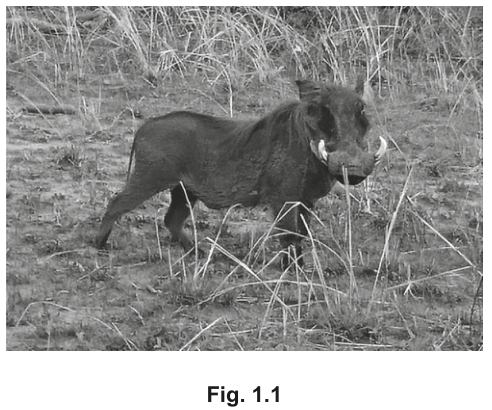
The warthog, Phacochoerus africanus, is a member of the pig family. The warthog lives in dry savannah areas of sub-Saharan Africa.
Fig. 1.1 shows a warthog.
A warthog and a human have similar values of RMT and concentration of urine. A human can survive only a few days without drinking water, whereas a warthog can live for several months without drinking water.
Suggest how a warthog is able to survive several months without drinking water.
Answer
- The warthog gains water from the food it eats (e.g. succulent roots, tubers, plants).
- The warthog produces metabolic water during aerobic respiration of its food.
- (AVP) e.g. behavioural — it is mainly active at cooler times of day and rests in burrows, reducing water loss from sweating / panting; its sparse coat reduces water loss.
Warthogs obtain water from the food they eat and from metabolic water produced in respiration (plus any valid additional point such as behavioural reduction of water loss).
Background Concept
Mammals gain water from three main sources and lose it by four main routes.
Water gain:
- Drinking water — the most obvious source.
- Preformed water in food — most foods (plants, meat, even dry seeds) contain a large fraction of water by mass. Succulent plant material (roots, tubers, fruits) can be >80% water.
- Metabolic water — water produced as a product of aerobic respiration, especially from the oxidation of carbohydrates, lipids and proteins. A typical mammal produces roughly 0.3–0.6 g of metabolic water per kJ of energy released, which can be a significant fraction of daily water turnover in small or dry-habitat species.
Water loss:
- Urine (regulated by ADH and the loop of Henle).
- Faeces.
- Evaporation from the skin and respiratory tract (sweating, panting).
- Milk in lactating females.
An animal that can survive for months without drinking must (a) be very good at minimising water loss and (b) be very good at replacing drinking water by food and metabolic sources.
The kidney's role is just one part of this whole-animal water balance. The RMT in Table 1.1 is the same for the warthog as for a human (both around 2.8–3.2), so the warthog's kidney is not unusually good at concentrating urine — the survival strategy must lie elsewhere.
Understanding the Question
Part (b) provides the contrast: a human and a warthog have similar RMT and similar urine concentration, yet the human needs water within a few days whereas the warthog can go for months. The candidate must suggest how the warthog manages this, given the information in the table and any valid biological knowledge.
The command word is "suggest", which means the candidate is expected to apply biological understanding to a context that the data do not directly prove, rather than to recall a single fact.
Approach
Think of water balance as an income-and-expenditure equation:
- Income of water — preformed water in food, metabolic water from respiration, and any drinking water.
- Expenditure of water — urine, faeces, evaporation (sweating, panting, breathing).
If the warthog has the same urinary water loss as a human, the difference must be in (a) the other routes of water loss, or (b) the non-drinking sources of water. Two well-supported points are:
- The warthog eats food (plants, roots, tubers) that contains preformed water.
- Aerobic respiration of its food produces metabolic water.
A third valid point is a behavioural / anatomical reduction in water loss (e.g. activity at cooler times, sheltering in burrows, sparse coat to limit sweating). The mark scheme lists "behavioural response" and "no or less sweating" as AVP (any valid point).
Step-by-Step Reasoning
- Point 1 — preformed water in food. Warthogs are omnivores that eat grasses, roots, tubers, bulbs and carrion. These foods contain a large amount of water (roots and tubers in particular can be 70–90% water). The warthog therefore takes in a substantial amount of water with every meal, and never needs to drink separately.
- Point 2 — metabolic water. When carbohydrates, lipids and proteins in the food are oxidised during aerobic respiration, water is one of the products. For example, the complete oxidation of 1 g of glucose yields about 0.6 g of water, and the oxidation of 1 g of lipid yields about 1.1 g. Over weeks, this metabolic water adds up to a significant contribution to the warthog's water budget.
- Point 3 (AVP) — reduced water loss. Warthogs are largely crepuscular, sheltering in burrows (often taken over from aardvarks) during the hottest part of the day. This behaviour reduces water lost by evaporation and panting. They also have a sparse coat, which may help with heat dissipation without losing large amounts of water in sweat (pigs in general have few sweat glands and rely on wallowing and behavioural thermoregulation rather than sweating).
Any one of these AVP points is enough to pick up the extra mark if it is expressed as a clear, biologically valid suggestion.
Key Takeaways
- "Not needing to drink" does not mean "not needing water" — the animal must replace drinking water by other means.
- The two main replacements are preformed water in food and metabolic water from respiration.
- Behavioural and anatomical reductions in water loss (crepuscular activity, burrow use, minimal sweating) are also important.
- Kidney ability (RMT, urine concentration) is only one component of whole-animal water balance.
Common Mistakes
- Saying "the warthog's kidneys are more efficient" — directly contradicted by the stem, which says the kidney parameters are similar to a human's.
- Saying "it stores water in its body" — biologically implausible for a mammal of this size and not credited.
- Saying "it does not sweat at all" without any qualification — pigs have very few sweat glands but they do lose water through evaporation; the better answer is "it loses less water by sweating" or pairs the point with a behaviour (wallowing, burrow use).
- Naming "metabolic water" without saying what produces it — the mark scheme requires it to be linked to respiration; simply saying "it makes water" is too vague.
Things to Be Careful About
- The stem tells you the kidneys are not the answer — the RMT and urine concentration are similar to a human. Do not contradict this by saying the warthog has a more efficient kidney.
- "Suggest" questions do not require you to prove your point from data; you need a biologically credible suggestion that the examiner would accept.
- Stay close to the mark scheme wording where possible: "metabolic water / water from respiration" is the precise phrase.
The rest of this paper
9 more questions- Q2Photosynthesis13M
- Q3Energy and Respiration10M
- Q4Genetic Technology9M
- Q5Selection and Evolution · Genetic Technology · Classification, Biodiversity and Conservation14M
- Q6Control and Coordination9M
- Q7Inheritance11M
- Q8Classification, Biodiversity and Conservation9M
- Q9Control and Coordination6M
- Q10Homeostasis10M