Biology 9700/42 — February/March 2022
Cambridge A-Level · A Level Structured Questions · worked solutions for every part, with the mark scheme
Topics Selection and Evolution · Classification, Biodiversity and Conservation · Genetic Technology · Inheritance · Homeostasis · Control and Coordination · +2 more
The European hedgehog, Erinaceus europaeus, is a small omnivorous mammal. Its body is covered in spines, which are usually brown. A rare variant, which lacks the brown pigment, has blonde (pale yellow) spines. This characteristic is coded for by a recessive allele.
Fig. 1.1 shows a European hedgehog with blonde spines.
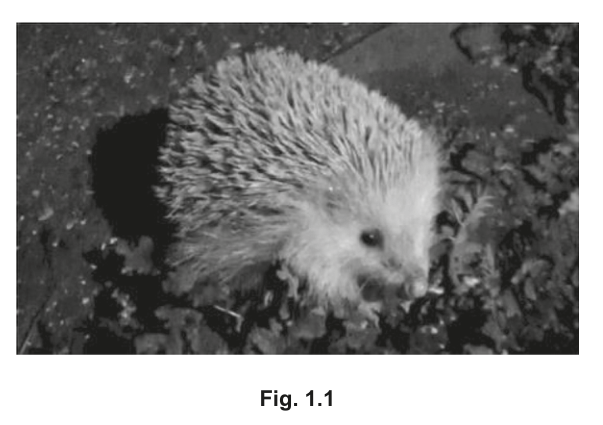
Fig. 1.1
Alderney is a small island between the UK and France. Hedgehogs were not found on Alderney until the 1960s, when three pairs of hedgehogs were introduced to the island. The hedgehogs started to breed and some of the offspring had blonde spines.
By 2017, the population of hedgehogs, including individuals with brown spines and individuals with blonde spines, had increased to approximately 600.
Suggest reasons why the population of hedgehogs increased to such a large number.
Answer
Any two from:
- High birth rate / short generation time, so the population grows quickly.
- Few / no natural predators on the island, so mortality is low.
- Little interspecific competition for food or other resources.
- Plenty of food available / wide range of food types eaten (omnivore), so resources are not limiting.
- No / fewer diseases than on the mainland.
- Well adapted to the conditions, so no selection pressures are acting against them.
Any two credible reasons; e.g. few predators + plentiful food.
Background Concept
When a species is introduced to a new environment, its population growth is shaped by the same biotic and abiotic factors that act on any population. Growth is rapid when:
- Reproductive rate is high (many offspring per breeding event and a short generation time).
- Mortality is low because natural predators, parasites and pathogens are absent or reduced.
- Resources are abundant (food, water, shelter, mates, breeding sites).
- Competitors are absent, so interspecific competition is minimal.
- The species is pre-adapted to the local climate and habitat.
In the absence of these 'checks', a population grows exponentially until density-dependent factors (food, disease, space) begin to bite.
Understanding the Question
The stem says three pairs (six individuals) of hedgehogs were introduced to Alderney in the 1960s, and by 2017 the population had reached about 600. The question asks the candidate to suggest (i.e. propose plausible ecological) reasons for this large increase. The command word 'suggest' tells you that you do not need proof — a reasonable ecological explanation earns the mark.
Approach
Think about what normally limits a population on the mainland (predators, food, disease, competitors) and then argue that one or more of those limitations are absent or reduced on Alderney. Two clearly distinct points are required.
Step-by-Step Reasoning
- Few or no predators — islands typically lack large native predators (e.g. badgers, foxes, owls) that eat hedgehogs on the mainland, so fewer individuals are killed and population growth is unchecked.
- Plentiful food / omnivore — hedgehogs eat slugs, beetles, earthworms and a wide range of other items. With abundant prey on the island and few competitors, food is not a limiting factor.
- Little competition — other small insectivores are scarce, so the hedgehogs do not have to compete for the same niche.
- No/fewer diseases — pathogens that maintain hedgehog populations at low density on the mainland may be absent.
- High reproductive rate — short generation time and several offspring per litter allow rapid multiplication.
- Well adapted — the climate and habitat of Alderney suit hedgehogs, so selection is not removing individuals.
Any two of these are credited. Two distinct ideas (e.g. predators + food) score two marks.
Key Takeaways
- Population growth in a new environment is determined by how many of the usual limiting factors are removed.
- Islands often lack the predators, competitors and pathogens that limit populations on the mainland.
Common Mistakes
- Giving only one reason (only one mark).
- Vague answers such as 'they survived' or 'there was a lot of space' — these do not name a specific ecological factor.
- Confusing reasons for population increase with reasons for the high frequency of blonde spines (which is part (ii)).
Things to Be Careful About
- The command word is 'suggest', so a reasoned ecological proposal is sufficient — no data are required.
- 'Well adapted' is acceptable only when it is clear what the hedgehogs are adapted to; otherwise the mark scheme prefers a more concrete factor.
A survey taken in 2017 showed that 60% of the hedgehogs on Alderney had blonde spines.
Suggest and explain reasons why the proportion of hedgehogs with blonde spines was so high.
Answer
Any three from:
- The population started from only six individuals (three pairs), so the initial gene pool was very small.
- Founder effect / genetic drift / bottleneck effect — allele frequencies in the new population reflect chance events in those six founders rather than the mainland population, and the recessive blonde allele can reach a high frequency by chance.
- Inbreeding among the descendants of so few founders further increases homozygosity, so the recessive blonde phenotype appears more often.
- (Directional) selection — blonde spines may have a selective advantage on Alderney (e.g. camouflage on pale substrates / less visible to predators / different thermal properties), so the allele frequency for blonde increases over generations.
- Allele frequency for blonde spines increases / increased homozygosity for the recessive allele as the population grows.
Founder effect/genetic drift + inbreeding + (directional) selection acting on the recessive allele.
Background Concept
Three ideas are needed:
- Founder effect / genetic drift — when a new population is started by very few individuals, the allele frequencies in that population are determined by which alleles happened to be carried by those founders. Alleles that were rare on the mainland can become common in the new population purely by chance.
- Inbreeding — in a small, closed population, close relatives mate, increasing homozygosity. A recessive allele is then more likely to be expressed in the phenotype.
- Directional selection — if one phenotype has a higher fitness than another, the frequency of the advantageous allele rises across generations.
The blonde allele is recessive, so it is only seen in homozygous individuals. A small founder population + inbreeding makes homozygosity much more likely than in a large, randomly-mating mainland population.
Understanding the Question
The stem tells you that the blonde trait is recessive and that 60% of the hedgehogs on Alderney had blonde spines in 2017 — an extraordinarily high proportion. The question asks you to suggest and explain why this proportion is so high. You need to use information from the stem (only six founders) plus evolutionary principles.
Approach
Combine (a) chance effects from a small founder population and inbreeding with (b) any selective advantage the blonde phenotype might have on the island. Three distinct points are required for three marks.
Step-by-Step Reasoning
- Founder effect / bottleneck / genetic drift — only six founders started the population, so the original gene pool was very small. The frequency of the blonde allele in the founders could already have been much higher than on the mainland simply by chance. As the population grew, this unusual allele frequency was preserved.
- Inbreeding — with so few founders and a closed island population, related individuals mate, increasing homozygosity. The recessive blonde allele is therefore expressed in the phenotype more often than expected from its allele frequency alone.
- Directional selection / selective advantage — blonde spines may be advantageous on Alderney (e.g. better camouflage against pale substrates, less visible to the few aerial predators, or thermal advantages). Hedgehogs with blonde spines leave more offspring, so the blonde allele frequency rises over generations.
- Allele frequency change — the allele frequency for blonde increases (and the frequency of the dominant brown allele falls) over the ~50 years since introduction.
Any three of these ideas, made clear, score three marks.
Key Takeaways
- A high frequency of a recessive trait in a small, isolated population can be explained by founder effect + inbreeding, with or without selection.
- '60% blonde' is a phenotype frequency, not an allele frequency — but the underlying allele frequency for blonde must also be high.
Common Mistakes
- Confusing phenotype frequency (60%) with allele frequency (which would be under Hardy–Weinberg, ignoring inbreeding).
- Saying 'natural selection caused the high proportion' without specifying a selective advantage of the blonde phenotype.
- Forgetting the founder/bottleneck effect — this is the central point of the stem ('only three pairs were introduced').
Things to Be Careful About
- The marking scheme credits 'directional selection' as a stand-alone point, but only when accompanied by a clear selective advantage.
- Inbreeding and founder effect are related but distinct — credit both if both are described.
The hedgehogs on Alderney are an example of an invasive alien species.
Explain why it is sometimes important to control invasive alien species.
Answer
Any four from:
- The hedgehogs compete with native species for food / the same niche / resources.
- They may reduce the food source available to native species.
- They feed on / are predators of native species.
- This can cause extinction of native species.
- They can breed more successfully than native species (because they have no natural predators / grazers / diseases here).
- They often have no natural predator / grazer in the new environment, so their population is not controlled.
- They may disrupt habitats / ecosystems / food webs / food chains.
- This causes a reduction in biodiversity.
- They may introduce (new) diseases to which native species have no immunity.
Four impacts on the native ecosystem, e.g. competition + predation + no natural control + biodiversity loss.
Background Concept
An invasive alien species is a non-native species whose introduction and spread threaten native biodiversity. Problems arise because:
- The alien species arrives without the natural enemies (predators, parasites, pathogens) that kept its population in check in its native range.
- Native species have not co-evolved with the alien, so they have no behavioural or physiological defence against it.
- The alien can therefore reach very high densities and exert strong pressure on the native community.
The impacts operate through several mechanisms:
- Competition for shared resources (food, space, light, nesting sites).
- Predation on native species that have no effective anti-predator response.
- Hybridisation with closely related natives (genetic pollution).
- Introduction of novel pathogens.
- Habitat alteration (e.g. trampling, grazing, burrowing).
Any of these can drive native species to local extinction and reduce overall biodiversity.
Understanding the Question
The stem reminds you that the hedgehogs on Alderney are an example of an invasive alien species. The question asks you to explain why it is sometimes important to control such species — i.e. give the negative ecological consequences of leaving them unchecked. The command word 'explain' requires both a mechanism (what the alien does) and an outcome (what happens to natives or to the ecosystem).
Approach
Think of two or three distinct mechanisms by which an alien species damages the native community, and for each one state the consequence. Four marking points are required, and they should come from at least three different categories (competition, predation, disease, ecosystem effects, biodiversity loss).
Step-by-Step Reasoning
- Competition — the alien species competes with native species for the same food/niche/space/light/resources, so natives get less of what they need.
- Predation — the alien feeds on native species that have not evolved defences against it.
- Lack of natural control — without their usual predators/grazers/diseases, alien populations grow unchecked.
- Reproductive advantage — aliens often breed faster/more successfully than natives, outcompeting them numerically.
- Habitat / ecosystem disruption — aliens can damage habitats and disrupt food webs and food chains.
- Extinction — the combined pressure can drive native species to local extinction.
- Biodiversity loss — overall species richness and genetic diversity decline.
- Disease introduction — aliens can bring novel pathogens to which natives have no immunity.
Any four clearly-stated, distinct points score four marks.
Key Takeaways
- Invasive species cause harm through competition, predation, disease, and habitat disruption.
- The absence of natural enemies in the new environment allows alien populations to explode.
- The combined effect is reduced biodiversity and possible extinction of native species.
Common Mistakes
- Only listing mechanisms without naming the consequence (e.g. 'they compete' without 'so natives decline/extinct').
- Vague answers like 'they harm the environment' — these do not name a process.
- Confusing 'alien' with 'endangered' — the question is about the harm aliens do to natives, not about the aliens themselves.
Things to Be Careful About
- The mark scheme accepts 'local for native' — so 'local species' is fine.
- 'Reduce biodiversity' and 'cause extinction' are distinct credit-worthy points; do not collapse them into one.
The rest of this paper
9 more questions- Q2Control and Coordination · Genetic Technology10M
- Q3Inheritance · Homeostasis14M
- Q4Inheritance15M
- Q5Genetic Technology8M
- Q6Photosynthesis10M
- Q7Energy and Respiration11M
- Q8Selection and Evolution8M
- Q9Classification, Biodiversity and Conservation8M
- Q10Homeostasis7M