Biology 9700/53 — October/November 2021
Cambridge A-Level · Planning, Analysis and Evaluation · worked solutions for every part, with the mark scheme
Topics Planning · Analysis, Conclusions and Evaluation
Baker’s yeast, Saccharomyces cerevisiae, has two metabolic pathways for the production of ATP, aerobic respiration and fermentation. Oxygen is not used in fermentation.
These pathways are summarised in Fig. 1.1.
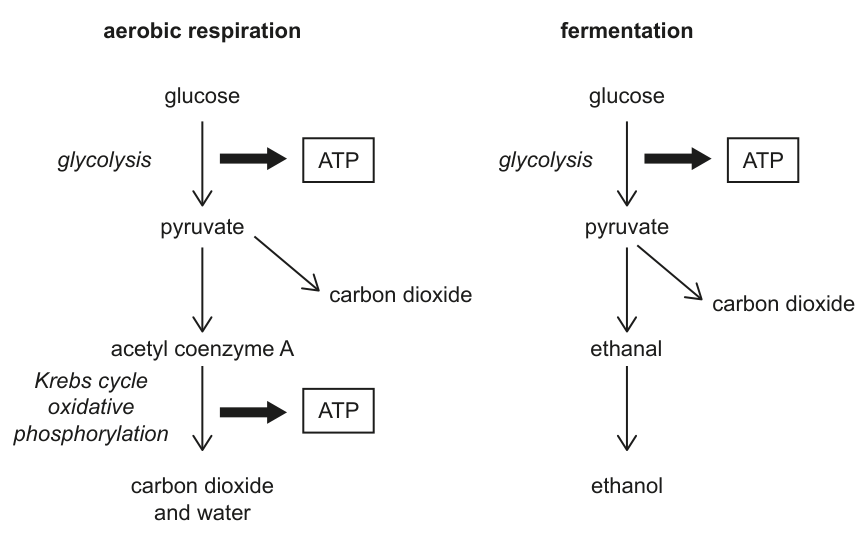
Some students were researching details of the respiration of yeast. In their research, the students found information about the Crabtree effect. This effect occurs when yeast is kept in high concentrations of glucose. The yeast gains sufficient ATP from substrate-linked phosphorylation during glycolysis. Yeast does not carry out the Krebs cycle or oxidative phosphorylation and therefore does not use oxygen.
The students wanted to investigate the effect of temperature on the activity of yeast and decided to use yeast solutions in which the yeast obtained all of its ATP by fermentation.
- The students made a suspension of yeast from of dried yeast and of water.
- The suspension was left for 2 hours at .
- After 2 hours, of glucose solution was added to the yeast suspension and the mixture was stirred.
- Some of the mixture was added immediately to the apparatus shown in Fig. 1.2.
The students measured the volume of carbon dioxide produced by yeast fermentation.
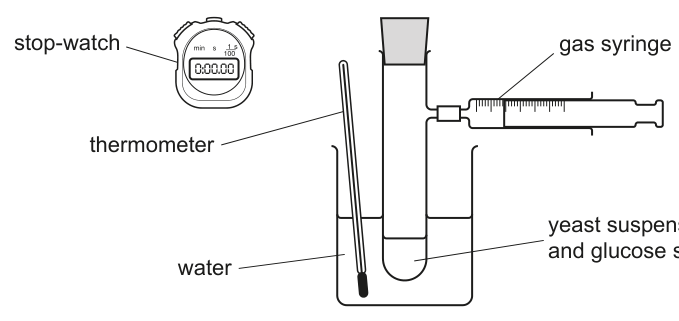
State the independent variable and the dependent variable in this investigation.
independent variable = ______
dependent variable = ______
Explain why the students stirred the mixture of yeast and glucose before adding it to the tube in the apparatus in Fig. 1.2.
Describe a method using the apparatus, set up as shown in Fig. 1.2, that the students could use to find the temperature at which yeast carries out fermentation at its maximum rate.
Your method should be set out in a logical order and be detailed enough for another person to follow.
You should not include details of how to make the yeast suspension or how to set up the apparatus.
Complete the sketch graph to predict the results that you would expect from the method that you have given in part (iii). Include axes labels with units in your answer.
Scientists have discovered that some other species of yeast show the Crabtree effect.
The Crabtree effect means that in high concentrations of glucose and with oxygen present, pyruvate is not metabolised in mitochondria so aerobic respiration does not occur.
Yeast species that are able to maintain their levels of ATP production when conditions suddenly change and no oxygen is available show the Crabtree effect.
An investigation compared S. cerevisiae with the yeast Candida tropicalis to see if this other species also shows the Crabtree effect.
Three flasks containing suspensions of S. cerevisiae in a growth medium were initially kept in different conditions (conditions for growth).
After a set time, the yeast in each flask was transferred to a flask containing a fresh medium with high glucose concentration and no oxygen (experimental conditions). All other conditions were standardised.
The same procedure was repeated for C. tropicalis.
The conditions for growth and the experimental conditions in the flasks are summarised in Table 1.1.
Table 1.1
| flask | conditions for growth | experimental conditions |
|---|---|---|
| flask 1 | high glucose concentration with no oxygen | high glucose concentration with no oxygen |
| flask 2 | high glucose concentration with oxygen | high glucose concentration with no oxygen |
| flask 3 | water (no glucose) with oxygen | high glucose concentration with no oxygen |
Samples taken from the flasks kept in the experimental conditions were put into the apparatus shown in Fig. 1.2 to measure the volume of carbon dioxide produced by the two yeast species.
The results are shown in Fig. 1.3.
The final volume of carbon dioxide produced by the sample of yeast from flask 1 at 30 minutes is shown as a maximum volume of 100% in Fig. 1.3. All other volumes were calculated as a proportion of this maximum. This allows a direct comparison to be made between the two species.
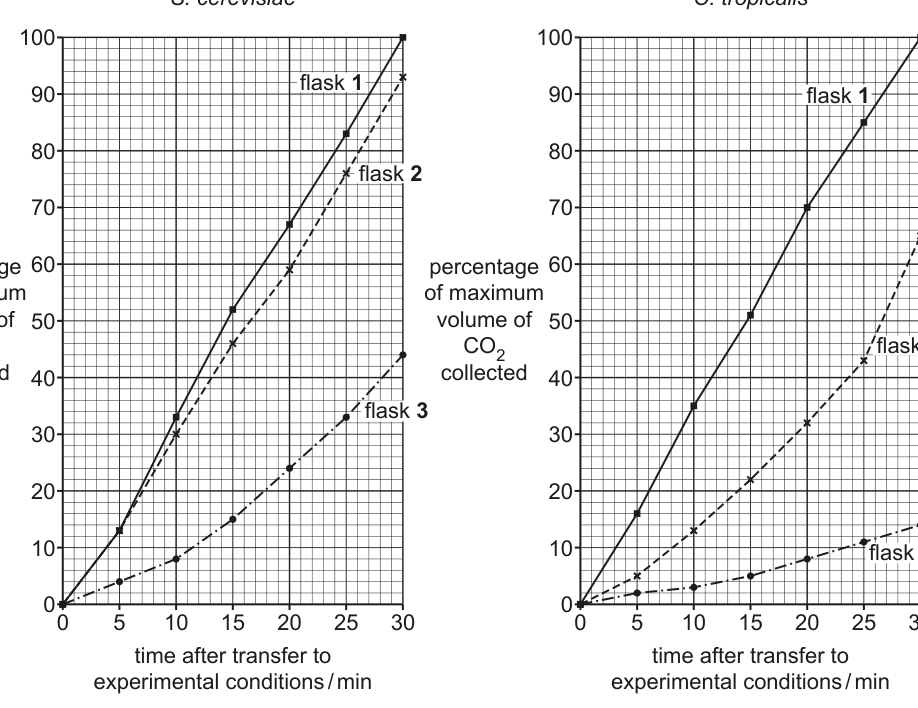
State and explain the evidence in Fig. 1.3 that supports the idea that C. tropicalis does not show the Crabtree effect.
The rest of this paper
1 more questions- Q2Analysis, Conclusions and Evaluation · Planning15M