Biology 9700/41 — October/November 2021
Cambridge A-Level · A Level Structured Questions · worked solutions for every part, with the mark scheme
Topics Homeostasis · Inheritance · Photosynthesis · Genetic Technology · Control and Coordination · Selection and Evolution · +3 more
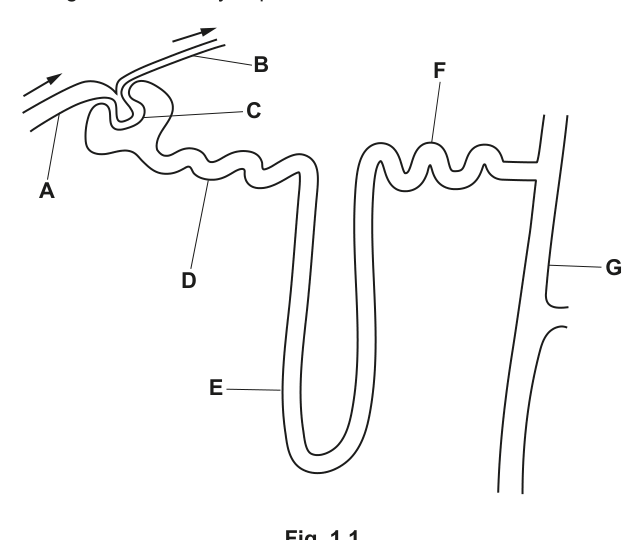
Fig. 1.1 is a diagram of a kidney nephron and some of its blood vessels.
With reference to Fig. 1.1, complete Table 1.1 using the letters A – G.
Each letter may be used once, more than once or not at all.
Table 1.1
| description | letter |
|---|---|
| efferent blood vessel | ______ |
| part of nephron containing cells that respond to ADH | ______ |
| part of nephron where podocyte cells are located | ______ |
| part of nephron containing cells that are located in the medulla | ______ |
Describe and explain how the cells of the proximal convoluted tubule are adapted to carry out selective reabsorption.
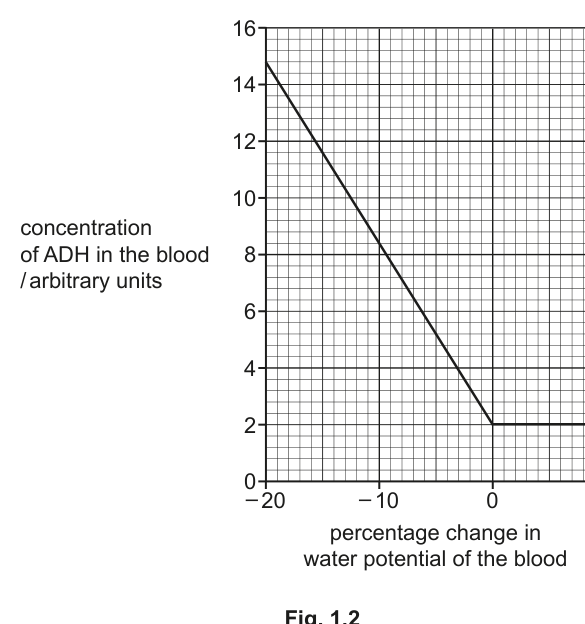
Fig. 1.2 shows the concentrations of ADH in the blood at different percentage changes in water potential of the blood.
Describe the trend shown in Fig. 1.2.
Sometimes a person will have a low concentration of ADH in the blood even though there is a change in the water potential.
Suggest one effect on the circulatory system of a low concentration of ADH in the blood.
The rest of this paper
9 more questions- Q2Photosynthesis · Inheritance · Genetic Technology12M
- Q3Classification, Biodiversity and Conservation13M
- Q4Genetic Technology10M
- Q5Control and Coordination · Homeostasis · Inheritance · Selection and Evolution12M
- Q6Energy and Respiration12M
- Q7Inheritance9M
- Q8Selection and Evolution5M
- Q9Homeostasis · (outdated) Crop Plants · Photosynthesis15M
- Q10Control and Coordination · Homeostasis15M