Biology 9700/42 — May/June 2021
Cambridge A-Level · worked solutions for every part, with the mark scheme
Topics Control and Coordination · Inheritance · Energy and Respiration · Photosynthesis · Homeostasis · Genetic Technology · +2 more
Fig. 1.1 is a diagram of part of a neurone membrane at resting potential.
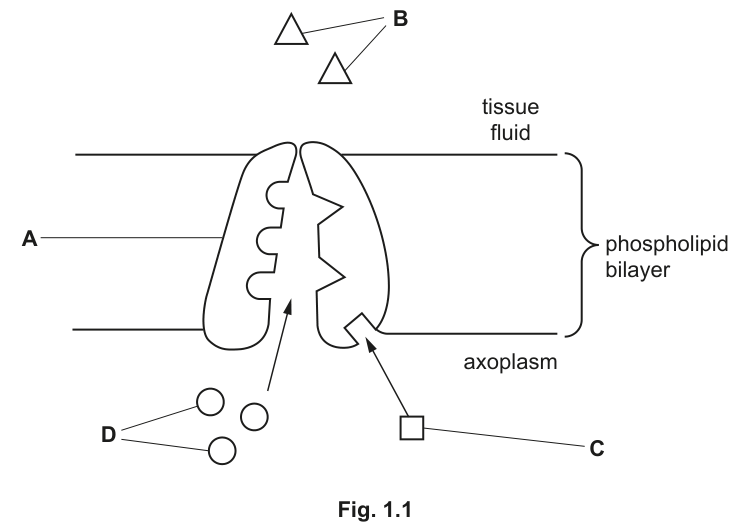
With reference to Fig. 1.1, name A, B, and D.
A ______
B ______
D ______
Answer
- A – sodium–potassium () pump
- B – potassium ions ()
- D – sodium ions ()
A: sodium–potassium pump; B: potassium ions; D: sodium ions
Background Concept
At the resting potential, a neurone membrane actively maintains steep ionic gradients using the sodium–potassium (Na⁺/K⁺) pump. This is an integral transport protein that spans the phospholipid bilayer. With each cycle it hydrolyses one molecule of ATP and moves 3 Na⁺ out of the axon into the tissue fluid and 2 K⁺ into the axon from the tissue fluid, both against their concentration gradients. As a result, at rest the tissue fluid is rich in Na⁺ and the axoplasm is rich in K⁺. The pump therefore both creates and maintains the electrochemical gradient on which action potentials depend.
Understanding the Question
Fig. 1.1 shows a small section of a neurone membrane at resting potential. The figure labels four things: a large structure (A) that crosses the bilayer, two triangular molecules in the tissue fluid (B), a small square molecule in the axoplasm entering the pump (C), and three circular molecules in the axoplasm (D). The question simply asks us to name each structure (apart from C, which is asked in (a)(ii)).
Approach
Identify each structure by what it physically is in the diagram and where it sits relative to the bilayer, then link this to the biology of the resting membrane.
Step-by-Step Reasoning
- A crosses the entire bilayer and has a small molecule entering it from the axoplasm — this is consistent with the active-transport protein that uses ATP, i.e. the sodium–potassium pump (not a channel, which would have no use for ATP).
- B is in the tissue fluid — at rest the tissue fluid is rich in K⁺ (the ions that, having been pumped in, leak back out through K⁺ leak channels).
- D is in the axoplasm — at rest the axoplasm contains a high concentration of Na⁺ relative to the inside (although the absolute concentration inside is lower than outside, the pump has loaded the inside with Na⁺ that has not yet left).
Key Takeaways
- The Na⁺/K⁺ pump is an active transport protein that uses ATP to move ions against their concentration gradients.
- At resting potential, Na⁺ is high outside and K⁺ is high inside — these gradients are the energy store for future action potentials.
- "Channel" is wrong for A; the Na⁺/K⁺ pump is a carrier protein (active transport), not a channel.
Common Mistakes
- Writing "sodium channel" or "potassium channel" for A — the pump is active transport, not a channel. The mark scheme explicitly rejects this.
- Writing "sodium" without specifying ions ("Na⁺"). The mark scheme caps at 2 marks if "ions" is omitted.
- Confusing the locations of Na⁺ and K⁺ at resting potential.
Things to Be Careful About
- Use the precise term sodium–potassium pump (or Na⁺/K⁺ pump), not just "transporter" or "protein".
- Always say "ions" after Na⁺ or K⁺ if the structure is an ion species — the word "ions" is part of the marking point.
- The "CON if channel mentioned" annotation in the mark scheme for A means writing "sodium–potassium channel" loses the mark for A entirely.
Substance C is required to make structure A function.
Name substance C.
Answer
ATP (adenosine triphosphate)
ATP
Background Concept
The sodium–potassium pump moves ions against their concentration gradients. Movement against a gradient requires energy; in cells that energy is supplied by the hydrolysis of ATP to ADP + Pᵢ. Without ATP the pump stops, the Na⁺ and K⁺ gradients run down, and the membrane can no longer maintain its resting potential or fire repeated action potentials.
Understanding the Question
The stem tells us that substance C (the small square molecule shown in Fig. 1.1 entering the pump from the axoplasm) is required to make structure A function. The question is simply asking for the name of C.
Approach
A molecule that is consumed to power an active transport protein is, by definition, ATP.
Step-by-Step Reasoning
The pump is active transport. Active transport is fuelled by ATP. The molecule drawn entering the pump from the axoplasm is therefore ATP.
Key Takeaways
- Active transport always requires ATP (or another energy source).
- ATP is hydrolysed to ADP + Pᵢ during each pump cycle.
- Without ATP, ion gradients — and therefore all nerve signalling — fail.
Common Mistakes
- Writing "ADP" — this is the product, not the substrate.
- Writing "glucose" — glucose is the long-term energy source, but the molecule entering the pump directly is ATP.
Things to Be Careful About
- The mark scheme accepts "ATP" alone; do not pad the answer with extra text.
Some drugs can affect the functioning of neuromuscular junctions or cholinergic synapses.
Table 1.1 lists three drugs and describes their action on neuromuscular junctions or cholinergic synapses.
Table 1.1
| drug | action of drug |
|---|---|
| curare | blocks muscle cell membrane receptors at neuromuscular junctions |
| nerve gas | inhibits acetylcholinesterase function in synapses |
| alcohol | inhibits exocytosis of neurotransmitters in synapses |
Suggest and describe the immediate consequence of the action of each drug on a neuromuscular junction or cholinergic synapse.
Answer
Curare
- Less / no acetylcholine (ACh) binds to the receptors on the sarcolemma / post-synaptic membrane.
- Fewer / no (ligand-gated) channels open, so less / no enters the sarcoplasm / post-synaptic neurone and there is no / less depolarisation of the sarcolemma / post-synaptic membrane.
Nerve gas
3. Less / no acetylcholine is broken down in the synaptic cleft; ACh remains bound to the receptors on the post-synaptic membrane.
4. (Ligand-gated) channels remain open / continues to enter the post-synaptic neurone, giving permanent depolarisation of the post-synaptic membrane.
Alcohol
5. Less / no neurotransmitter (acetylcholine) is released because exocytosis is inhibited; therefore less / no acetylcholine binds to receptors.
6. Fewer / no (ligand-gated) channels open, so less / no enters the post-synaptic neurone and there is no / less depolarisation.
See working
Background Concept
A cholinergic synapse (and the neuromuscular junction, which is also cholinergic) transmits a signal in this fixed sequence:
- An action potential arrives at the presynaptic terminal.
- Voltage-gated Ca²⁺ channels open; Ca²⁺ flows in.
- Ca²⁺ triggers exocytosis of vesicles, releasing acetylcholine (ACh) into the synaptic cleft.
- ACh diffuses across the cleft and binds to specific receptors on the postsynaptic membrane (or sarcolemma at the neuromuscular junction).
- Binding opens ligand-gated Na⁺ channels; Na⁺ flows in down its electrochemical gradient and depolarises the postsynaptic membrane.
- ACh is then hydrolysed by the enzyme acetylcholinesterase in the cleft, terminating the signal.
Any drug that interrupts steps 3, 4 or 6 will distort this sequence in a predictable way.
Understanding the Question
Table 1.1 lists three drugs and the step each one blocks:
- Curare — blocks the postsynaptic receptors themselves (step 4).
- Nerve gas — inhibits acetylcholinesterase (step 6).
- Alcohol — inhibits exocytosis of neurotransmitter (step 3).
For each drug we must describe the immediate consequence on the synapse or neuromuscular junction. The mark scheme rewards six points (any 5 needed for full marks) covering both halves of the cause-and-effect chain for each drug: what fails to happen at the synapse, and the downstream consequence for Na⁺ entry and depolarisation.
Approach
For each drug, walk forward through the sequence above and ask: "because this step is blocked, what does ACh fail to do next, and what does that mean for Na⁺ entry and depolarisation?" Two linked points are credited for each drug.
Step-by-Step Reasoning
Curare (receptor blocker)
- ACh is still released normally into the cleft, but less / no ACh can bind to the receptors on the sarcolemma / postsynaptic membrane.
- With no (or fewer) receptors occupied, fewer / no ligand-gated Na⁺ channels open, less / no Na⁺ enters the sarcoplasm and there is no / less depolarisation. The muscle therefore cannot contract (neuromuscular block).
Nerve gas (acetylcholinesterase inhibitor)
- ACh is still released and binds normally, but it is not broken down in the cleft — ACh remains bound to the receptors.
- Because ACh is not removed, the Na⁺ channels stay open and Na⁺ continues to enter, producing permanent depolarisation of the postsynaptic membrane. Continuous firing of muscle (or neuronal) activity follows.
Alcohol (exocytosis inhibitor)
- Fewer / no vesicles fuse with the presynaptic membrane, so less / no ACh is released into the cleft. Consequently less / no ACh binds to receptors.
- With no ACh bound, fewer / no Na⁺ channels open, less / no Na⁺ enters and there is no / less depolarisation of the postsynaptic membrane.
Key Takeaways
- Receptor blockade and exocytosis inhibition both produce the same visible outcome — no depolarisation — but for different upstream reasons.
- Enzyme inhibition has the opposite outcome — permanent depolarisation — because the neurotransmitter accumulates.
- Each answer must carry two linked points: the immediate biochemical consequence (binding / breakdown / release) and the downstream consequence (Na⁺ entry and depolarisation). One without the other does not score full marks.
Common Mistakes
- Writing only "the synapse cannot function" or "signalling stops" — too vague. You must specify which step fails and what then happens to Na⁺ entry / depolarisation.
- Saying "neurotransmitter" instead of acetylcholine (ACh). The mark scheme ignores "neurotransmitter" in the curare and alcohol points; only "acetylcholine" scores.
- For curare, writing that Na⁺ channels "close" — they were never opened because no ACh bound.
- For nerve gas, writing "no depolarisation" — the opposite happens; the depolarisation is permanent / sustained.
- For alcohol, omitting the link to exocytosis — you must state that exocytosis is inhibited and therefore less / no ACh is released.
Things to Be Careful About
- Use "acetylcholine" (or ACh), not "neurotransmitter", in curare and alcohol points — the mark scheme explicitly ignores "neurotransmitter".
- The mark scheme accepts "sarcolemma" in place of "post-synaptic membrane" when discussing curare (because it acts at a neuromuscular junction), so either wording is acceptable in that context.
- "Permanent depolarisation" is the specific wording credited for nerve gas; "continuous depolarisation" or "sustained depolarisation" is also accepted by the marker.
- The mark scheme allows either "fewer / no Na⁺ channels open" or "less / no Na⁺ enters" or "less / no depolarisation" as alternatives within a single numbered point — any one of these three is enough to score that mark.
The rest of this paper
9 more questions- Q2Energy and Respiration · Photosynthesis · Homeostasis12M
- Q3Classification, Biodiversity and Conservation · Genetic Technology14M
- Q4Genetic Technology9M
- Q5Photosynthesis11M
- Q6Control and Coordination · Homeostasis · Inheritance11M
- Q7Inheritance10M
- Q8Selection and Evolution9M
- Q9Energy and Respiration · Control and Coordination15M
- Q10Inheritance15M