Biology 9700/41 — May/June 2021
Cambridge A-Level · A Level Structured Questions · worked solutions for every part, with the mark scheme
Topics Energy and Respiration · Selection and Evolution · Classification, Biodiversity and Conservation · Genetic Technology · Photosynthesis · Control and Coordination · +2 more
Photosynthesis is a complex process involving the transfer of light energy into chemical energy.
Describe the role of photosynthetic pigments.
Answer
- Absorb / harvest / capture / trap, light (photons) ;
- (To) excite electrons (for photophosphorylation / electron transport) ;
Pigments absorb light and use it to excite electrons for photophosphorylation.
Background Concept
Photosynthetic pigments are light-absorbing molecules embedded in protein complexes on the thylakoid membrane. The principal pigment is chlorophyll a, which exists in two forms with slightly different absorption maxima — P680 in photosystem II and P700 in photosystem I. Accessory pigments include chlorophyll b, carotenes and xanthophylls; each absorbs most strongly at particular wavelengths, so together they extend the range of light that can drive photosynthesis.
The pigments are organised into photosystems. An antenna complex of accessory pigments captures photons and channels the excitation energy, by resonance transfer, to a primary pigment / reaction-centre pair of chlorophyll a molecules. It is here that the photochemistry begins: the reaction-centre chlorophyll becomes oxidised when it gives up an excited electron to the electron transport chain, and the energy released as that electron passes back down the chain is used to phosphorylate ADP to ATP (photophosphorylation).
Understanding the Question
The question asks for a description of the role of photosynthetic pigments — what they actually do in the process. Two marks are available, so two clear, distinct points are needed. The mark scheme accepts any two from: absorbing light, exciting electrons, fuelling photophosphorylation, transferring energy between pigments, and forming a light-harvesting cluster / photosystem.
Approach
Identify the most fundamental function (light absorption) and then connect it to what the absorbed energy is used for (exciting electrons, which then drives photophosphorylation). The two strongest, easiest-to-credit points are usually enough; no need to write all five.
Step-by-Step Reasoning
- Pigments are light-harvesting molecules. The phrasing "absorb / harvest / capture / trap light (photons)" earns the first mark — any of those verbs is accepted.
- The absorbed light energy excites (promotes) electrons in the reaction-centre chlorophyll a to a higher energy level. The mark scheme requires the word "electrons"; saying only "energy" is not credited.
- These energetic electrons pass into the electron transport chain, and their energy is used to drive photophosphorylation — the synthesis of ATP. A third mark is available for this link, although only two are required.
Key Takeaways
- Pigments are light-harvesting molecules in the thylakoid membrane.
- Light energy is converted into chemical energy by exciting electrons.
- The two roles are tightly linked: absorption → excitation → electron transport → photophosphorylation.
Common Mistakes
- Writing only "they absorb light" — this earns one mark; a second distinct point is needed for full marks.
- Saying "they produce ATP" — pigments do not directly make ATP; the energy of excited electrons does, via the electron transport chain and ATP synthase.
- Confusing pigment function with the products of the light-dependent reactions (ATP and reduced NADP are products, not roles of pigments).
- Saying "they make glucose" — that is the overall outcome of photosynthesis, not the role of the pigment.
Things to Be Careful About
- Be explicit about electrons: "to excite electrons" is the credit-worthy phrasing, not "to excite the pigment" or "to make energy".
- Any two of the five mark-scheme points will earn full marks; do not write all five in the hope that more is better — keep the answer tight and precise.
- Do not describe the structure of pigments; the question asks for the role, not the structure.
Name the precise location in a chloroplast of photosynthetic pigments.
Answer
Thylakoid membrane(s) / granum / grana / lamella(e) ;
Thylakoid membrane(s).
Background Concept
The chloroplast is a double-membrane organelle. Inside the inner membrane is a fluid matrix called the stroma, suspended in which is a system of flattened, disc-shaped membranes. Individual discs are called thylakoids; stacks of thylakoids are called grana (singular: granum). Thylakoid membranes that connect different grana are called stroma lamellae (or intergranal lamellae).
The thylakoid membrane is where the light-dependent reactions take place. Photosystems I and II, the electron transport chain, ATP synthase and the water-splitting complex are all integral membrane proteins in the thylakoid membrane. Pigments are not free in solution; they are non-covalently bound to specific proteins of these complexes, which hold them in precise positions and orientations. This arrangement allows the antenna complex to channel excitation energy efficiently to the reaction-centre chlorophyll.
The stroma, by contrast, contains the enzymes of the Calvin cycle (notably RuBisCO) but no pigments — the light-independent reactions do not require light directly.
Understanding the Question
A one-mark "name" / "state" question. The candidate must give the precise location of the pigments inside the chloroplast. A vague answer such as "in the chloroplast" will not earn the mark.
Approach
Recall that pigments are membrane-bound, and the relevant membrane is the thylakoid system. The CIE mark scheme accepts any of: thylakoid membrane, granum, grana, lamella, lamellae — all refer to the same membrane system.
Step-by-Step Reasoning
- Photosystems I and II are integral proteins of the thylakoid membrane.
- The pigments (chlorophyll a, chlorophyll b, carotenoids) are bound to those proteins.
- Therefore the pigments are located in the thylakoid membrane (or granum / grana / lamella / lamellae — equivalent terms in the mark scheme).
Key Takeaways
- Pigments are in the thylakoid membrane, not in the stroma or any other part of the chloroplast.
- "Granum / grana / lamella / lamellae" are all accepted synonyms in the CIE mark scheme.
Common Mistakes
- "In the chloroplast" — too vague, not credited.
- "In the stroma" — wrong; the stroma houses the Calvin-cycle enzymes, not the pigments.
- "On the outer membrane" — wrong; the outer membrane is not where photosynthesis occurs.
- "In the cytoplasm" — wrong; the chloroplast is the site of the light-dependent reactions.
Things to Be Careful About
- The mark scheme requires the membrane term, not the organelle term. "Thylakoid" is the credit-worthy level of detail; "chloroplast" alone is not.
Name a practical technique to separate photosynthetic pigments.
Answer
Chromatography (paper or thin-layer) ;
Chromatography.
Background Concept
A leaf contains a mixture of pigments — chlorophyll a, chlorophyll b, carotenes, xanthophylls and sometimes phaeophytin. To determine which pigments are present and in what proportions, biologists separate the mixture into its components. The standard technique is chromatography, in which a mobile phase (a solvent) carries the pigment extract along a stationary phase (paper or a thin layer of silica / cellulose on a plate). Different pigments travel at different rates because they differ in their solubility in the solvent and in their adsorption to the stationary phase. The result is a chromatogram with discrete bands of different pigments.
Each pigment can be characterised by its Rf value:
A typical order (from highest to lowest Rf, using a non-polar solvent such as petroleum ether) is: carotene (orange-yellow), pheophytin (grey, if present), chlorophyll a (blue-green), chlorophyll b (yellow-green), then xanthophylls (yellow) at the origin or just above it.
Understanding the Question
A one-mark "name" question asking for the practical technique used to separate the pigments from a leaf extract.
Approach
The standard answer is "chromatography" (paper or thin-layer). CIE accepts either; the marks do not require a specific variant.
Step-by-Step Reasoning
- Extract pigments by grinding leaves in a solvent such as propanone or acetone.
- Place a small spot of the extract on a pencil-drawn baseline on chromatography paper or a TLC plate.
- Place the paper / plate in a beaker of solvent; the solvent rises by capillary action, carrying the pigments.
- Different pigments separate based on their relative solubilities and adsorptions.
- After the solvent front has run, dry the chromatogram and identify the bands by colour and Rf value.
Key Takeaways
- Chromatography is the standard technique for separating the photosynthetic pigments in a leaf extract.
- Paper and thin-layer chromatography (TLC) are both acceptable variants.
- Rf values can be used to help identify each pigment.
Common Mistakes
- "Filtration" or "distillation" — these are different techniques and do not separate pigments.
- "Centrifugation" — separates by density, not by chemical identity, and is not used for pigments.
- Spelling errors: "chromotography" / "chromatagraphy" — the correct spelling is "chromatography".
Things to Be Careful About
- The mark-scheme answer is just "chromatography" — the candidate does not need to specify paper or thin-layer.
The rate of photosynthesis is affected by many environmental factors.
A student carried out an experiment to investigate the relationship between the concentration of carbon dioxide available to an aquatic plant, Cabomba caroliniana, and its rate of photosynthesis.
Fig. 1.1 shows the experimental set-up for this investigation.
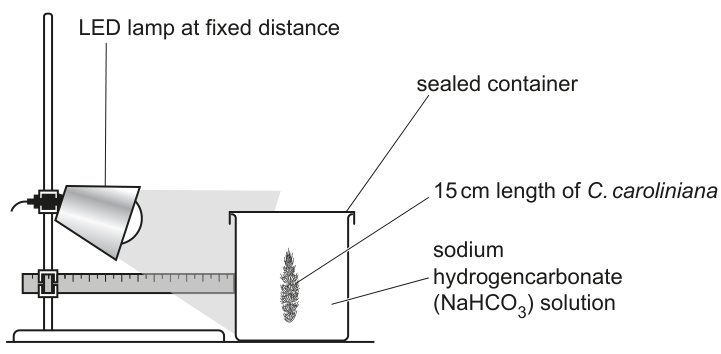
• Sodium hydrogencarbonate solution was used as a source of carbon dioxide.
• The concentration of carbon dioxide was varied using six different concentrations of sodium hydrogencarbonate solution.
• All C. caroliniana plants were kept in the dark before the light was switched on at the start of the experiment.
• Five replicates were carried out at each concentration.
• The rate of photosynthesis was obtained by calculating the percentage change in dissolved oxygen concentration in the solution over five minutes.
Fig. 1.2 shows the results of the investigation.
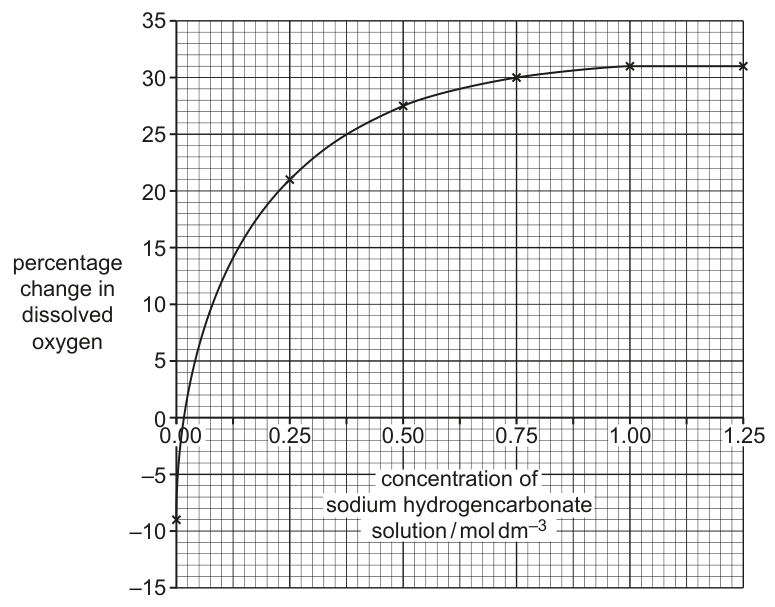
With reference to Fig. 1.2, explain the pattern of results obtained between and of sodium hydrogencarbonate solution.
Answer
- From 0.25 to , CO2 concentration is the limiting factor (rate rises with CO2) ;
- At / above , CO2 is no longer the limiting factor — light intensity / temperature becomes the limiting factor ;
- CO2 is needed for the Calvin cycle (light-independent stage) / CO2 reacts with (is fixed by) RuBP ;
From 0.25 to 1.00 mol dm⁻³ CO2 is limiting; above this CO2 is no longer limiting (light / temperature is) because CO2 is now in excess for the Calvin cycle.
Background Concept
The rate of photosynthesis depends on several environmental variables — light intensity, CO2 concentration and temperature. At any moment, the rate is limited by whichever of these is in shortest supply relative to demand. This is the limiting-factor principle, originally formulated by F. F. Blackman in 1905: as one factor is increased, the rate rises, but only until another factor becomes limiting — at which point further increases in the first factor have no effect and the rate plateaus.
In this experiment the student has deliberately chosen to vary CO2 (by changing the concentration of NaHCO3) while keeping the LED light at a fixed distance (so light intensity is constant) and using an LED (which emits little heat, so temperature stays near-constant). The resulting curve in Fig. 1.2 has the classic shape of a rate-versus-substrate plot: a steeply rising portion followed by a plateau.
Underneath, CO2 is the substrate of the Calvin cycle. In the light-independent stage, the enzyme RuBisCO catalyses the carboxylation of the 5-carbon acceptor molecule ribulose bisphosphate (RuBP) by CO2, producing two molecules of 3-phosphoglycerate (GP). If CO2 is in short supply, this reaction cannot proceed at maximum rate, so the overall rate of photosynthesis is limited by the supply of CO2. When CO2 is plentiful, RuBisCO (and the rest of the cycle) is working as fast as it can given the available ATP and reduced NADP from the light-dependent reactions; further CO2 cannot increase the rate because something else is now limiting.
Understanding the Question
The question requires an explanation (not a description) of the pattern shown in Fig. 1.2 between 0.25 and 1.25 mol dm⁻³. The graph rises steeply from 0.25 to about 1.00 mol dm⁻³ and then levels off. Three marks are available — so the candidate must give a reason, not just describe the trend, and must address both the rising portion and the plateau.
Approach
Identify the two regions of the curve: the rising portion (CO2 is limiting) and the plateau (CO2 is no longer limiting). For each region, name what is happening biologically. Finally, link CO2 to the Calvin cycle so the explanation is grounded in the underlying process, not just the trend.
Step-by-Step Reasoning
- From 0.25 to ~1.00 mol dm⁻³, the percentage change in dissolved O2 rises steeply with CO2 concentration. This means CO2 is the limiting factor: increasing CO2 supplies more substrate for the light-independent stage, so the rate of photosynthesis rises.
- At and above ~1.00 mol dm⁻³, the curve plateaus: further increases in CO2 produce no further rise in rate. CO2 is no longer the limiting factor; some other factor is. In this experiment that is most likely light intensity (the LED is at a fixed distance) or temperature (kept near-constant by using an LED).
- CO2 is needed for the Calvin cycle. It reacts with (is fixed by) the 5-carbon molecule RuBP in a reaction catalysed by RuBisCO, producing two molecules of GP. Without enough CO2, this reaction — and therefore the whole light-independent stage — slows down, limiting the rate of photosynthesis.
Key Takeaways
- The limiting-factor principle: rate is limited by whichever factor is in shortest supply.
- The plateau on a rate-versus-substrate curve indicates the substrate is no longer limiting.
- CO2 is the substrate for the Calvin cycle, fixed onto RuBP by RuBisCO.
Common Mistakes
- Stating only the trend (rate increases then plateaus) without explaining why — the question is "explain", not "describe".
- Naming the wrong stage: students sometimes say "CO2 is used in the light-dependent reactions". It is not — it is used in the light-independent (Calvin cycle) stage.
- Saying "the plant is saturated" without saying what is now limiting. "Saturation" implies another factor is now limiting; the mark scheme requires naming that other factor (light intensity or temperature).
- Confusing CO2 with oxygen, or confusing the Calvin cycle with the Krebs cycle.
Things to Be Careful About
- The question only asks about the pattern between 0.25 and 1.25 mol dm⁻³; do not drift into the region below 0.25 (that is the subject of part ii).
- "Explain" requires a reason: the trend plus the biology underneath, not just a description of the curve.
- Use the precise term "Calvin cycle" or "light-independent stage"; do not write "dark reaction".
The percentage change in dissolved oxygen for C. caroliniana at of sodium hydrogencarbonate solution is negative.
Suggest reasons for this negative value.
Answer
- Little / no photosynthesis (because no CO2 is available for the Calvin cycle) ;
- (Aerobic) respiration continues and consumes O2 ;
- Net change in O2 is therefore negative (respiration > photosynthesis) ;
With no CO2 there is little/no photosynthesis, but respiration still consumes O2, so the net change in dissolved oxygen is negative.
Background Concept
A plant does not only photosynthesise — it also respires, all the time, in every living cell. Aerobic respiration consumes O2 and releases CO2. In the light, photosynthesis also occurs, releasing O2 and consuming CO2. The dissolved-oxygen sensor in this experiment therefore reports not the gross rate of photosynthesis but the net rate — the difference between O2 produced by photosynthesis and O2 consumed by respiration:
At high light intensity and with abundant CO2, photosynthesis greatly exceeds respiration, so the net O2 change is strongly positive (as seen at the higher NaHCO3 concentrations in Fig. 1.2). But if photosynthesis is effectively shut down — for example, by removing the CO2 supply — respiration still proceeds, so O2 continues to be consumed and the net change becomes negative. This is what the student sees at 0 mol dm⁻³ NaHCO3.
Without CO2 the light-independent stage (Calvin cycle) cannot operate. RuBisCO has no substrate to fix onto RuBP, so GP is not produced, no triose phosphate is generated, and no glucose is made. The light-dependent reactions still run and still produce ATP and reduced NADP, but without the Calvin cycle to consume these products the system is rapidly backed up and the photophosphorylation rate falls to near zero. Hence "little or no photosynthesis".
Understanding the Question
The question asks for suggested reasons why the percentage change in dissolved O2 at 0 mol dm⁻³ is negative. Two marks are available. Both a photosynthesis point and a respiration point are required.
Approach
Recognise that the negative value reflects the balance between photosynthesis and respiration, and explain both halves of the balance. State that photosynthesis is essentially zero (because no CO2 is available) and that respiration is still happening (using O2).
Step-by-Step Reasoning
- With no NaHCO3 in the solution, the plant has no source of CO2. The light-independent stage requires CO2, so the rate of photosynthesis falls to almost zero.
- Respiration, however, is unaffected by the absence of CO2 — the plant is still alive and its cells continue to respire aerobically, consuming O2. (Note: the plants were kept in the dark before the light was switched on, so they were respiring only; once the light is on, photosynthesis cannot start in earnest because the Calvin cycle has no substrate.)
- The net effect is that dissolved O2 decreases, giving the negative percentage change observed at 0 mol dm⁻³.
Key Takeaways
- Photosynthesis requires CO2; without it, the light-independent stage halts and the overall rate falls to near zero.
- Respiration is continuous and uses O2, regardless of light or CO2 availability.
- The net O2 reading at any moment is the algebraic sum of photosynthesis (O2 producer) and respiration (O2 consumer).
Common Mistakes
- Saying only "no photosynthesis" without mentioning respiration — the negative value is the consequence of O2 consumption by respiration, so the respiration point is essential for the second mark.
- Saying the plant "dies" — no, the plant does not die over a five-minute experiment; respiration is still happening, so the plant is alive.
- Confusing the direction: "O2 is being produced" or "CO2 is being released" — both wrong; the plant is consuming O2, not producing it.
- Saying "the plant is not photosynthesising because there is no light" — wrong; the LED is on, and the light-dependent reactions can still proceed; the limiting factor here is CO2, not light.
Things to Be Careful About
- Both points are required: (1) little or no photosynthesis, (2) respiration uses O2. Without the respiration point, only one mark is earned.
- "Aerobic respiration" is the precise term — anaerobic respiration in plants is rare and unlikely to be the main consumer of O2 in a short, well-oxygenated experiment.
To minimise temperature changes, the student decided to use an LED lamp as a light source. LED lamps release very little heat energy.
Explain the importance of minimising temperature changes in this experiment.
Answer
- To control a variable / to ensure a fair test / so that CO2 is the only variable that changes ;
- Low temperature decreases kinetic energy / decreases enzyme–substrate collisions, so the rate of photosynthesis (and O2 production) falls ;
- Low temperature could itself become a limiting factor ;
- High temperature decreases the rate of photosynthesis ;
- High temperature denatures enzymes (e.g. RuBisCO) ;
- High temperature causes / increases photorespiration ;
Temperature must be controlled so CO2 is the only variable; if it falls, kinetic energy and enzyme–substrate collisions decrease, and if it rises, enzymes may denature or photorespiration may increase.
Background Concept
Temperature affects the rate of enzyme-catalysed reactions in two opposing ways. As temperature rises, molecules gain kinetic energy, move faster, and collide more often and with more energy; the rate of successful enzyme–substrate complex formation rises, and so does the rate of reaction. Above an optimum, however, the increasing vibrational energy of the polypeptide chain begins to break the weak bonds (hydrogen bonds, ionic interactions, hydrophobic interactions) that hold the enzyme's tertiary structure in its specific 3D shape. The active site loses its complementary shape, the substrate can no longer bind, and the enzyme is said to be denatured. Once denatured, the rate of reaction falls sharply — and unlike a low temperature, this fall is usually irreversible.
Photosynthesis depends on many enzymes, but the most important is RuBisCO, which catalyses the carboxylation of RuBP in the Calvin cycle. RuBisCO has an optimum around 25–30 °C, above which its activity falls. RuBisCO is also unusual in that at high temperatures and high O2 concentrations it increasingly catalyses a wasteful side reaction: the oxygenation of RuBP to give one molecule of GP and one of phosphoglycolate. This is photorespiration — it consumes ATP and releases previously fixed CO2, reducing the net efficiency of photosynthesis. Photorespiration increases markedly at high temperatures because O2 binds more competitively to the active site as the temperature rises.
In any controlled experiment, all variables except the one being tested must be kept constant so that any change in the dependent variable can be confidently attributed to the independent variable. If temperature were allowed to vary, the change in dissolved O2 could be due to temperature rather than to CO2 concentration, and the conclusion that CO2 affects the rate would be undermined.
The student chose an LED lamp precisely because LEDs emit almost all of their energy as light and very little as infrared / heat, so the lamp does not appreciably warm the solution during the five-minute experiment.
Understanding the Question
The question asks for an explanation of why temperature must be minimised (controlled) in this experiment. Three marks are available. The strongest answer combines an experimental-control point with two biological points about the effect of temperature on photosynthesis.
Approach
Two threads to weave together: (1) the experimental-control / fair-test argument, and (2) the biological argument about temperature's effect on the enzymes of photosynthesis. Hit the low-temperature effect and the high-temperature effect separately — both are credit-worthy.
Step-by-Step Reasoning
- Experimental control: temperature must be kept constant so that it does not become a confounding variable. If temperature changed, the change in dissolved O2 could be due to temperature rather than to CO2 concentration, invalidating the conclusion that CO2 is the factor affecting the rate.
- Effect of low temperature: at low temperature, molecules have less kinetic energy, so enzyme–substrate collisions are less frequent and less likely to result in successful complex formation. The rate of photosynthesis decreases, so the rate of O2 production falls. A low temperature could itself become a limiting factor.
- Effect of high temperature: at high temperature, the rate of photosynthesis initially increases (more kinetic energy, more successful collisions) but eventually decreases as the enzymes of photosynthesis — most importantly RuBisCO — denature. The tertiary structure of the enzyme is disrupted, the active site loses its specific shape, and the enzyme can no longer bind its substrate. In addition, at high temperatures, RuBisCO increasingly catalyses the wasteful oxygenation of RuBP instead of carboxylation — this is photorespiration, which consumes ATP and previously fixed CO2, further reducing the net rate of photosynthesis.
Key Takeaways
- Temperature affects the rate of enzyme-catalysed reactions, including photosynthesis.
- Both low and high temperatures reduce the rate (through different mechanisms).
- Controlling temperature is essential to make a fair test of the effect of CO2.
- LEDs emit little heat, so they are a useful way to deliver light without warming the sample.
Common Mistakes
- Vague answers such as "temperature affects photosynthesis" or "high temperature is bad" — these do not earn marks; the mark scheme requires specific mechanisms (kinetic energy, collisions, denaturation, photorespiration).
- Saying only "it would denature enzymes" without explaining the consequence (rate of O2 production falls) — the consequence is what the experiment actually measures.
- Confusing low- and high-temperature effects: low temperature slows the rate without denaturing; high temperature can denature irreversibly.
- Writing "temperature doesn't matter because plants photosynthesise normally" — wrong; temperature is one of the three main limiting factors.
- Forgetting the experimental-control point entirely — the question asks for the importance of minimising temperature changes, which is partly an experimental-design point.
Things to Be Careful About
- Three marks demand three distinct points. The strongest answers combine the experimental-control argument with two biological points (one for low temperature, one for high temperature — denaturation or photorespiration).
- Use the precise term "denature" for the high-temperature effect on enzyme structure.
- "Photorespiration" is a specific bonus point — students who know it can earn a third mark easily without having to think about denaturation in detail.
- A common error is to say "the enzymes will be denatured at low temperature" — wrong; denaturation occurs at high temperature, not low.
The rest of this paper
9 more questions- Q2Energy and Respiration11M
- Q3Classification, Biodiversity and Conservation · Selection and Evolution · Genetic Technology11M
- Q4Genetic Technology12M
- Q5Control and Coordination9M
- Q6Homeostasis12M
- Q7Inheritance9M
- Q8Selection and Evolution9M
- Q9Energy and Respiration15M
- Q10Selection and Evolution · Classification, Biodiversity and Conservation15M