Biology 9700/42 — February/March 2021
Cambridge A-Level · A Level Structured Questions · worked solutions for every part, with the mark scheme
Topics Selection and Evolution · Classification, Biodiversity and Conservation · Genetic Technology · Control and Coordination · Energy and Respiration · Inheritance · +2 more
The European eel, Anguilla anguilla, is a fish. The sizes of eel populations tend to remain relatively stable despite eels producing large numbers of offspring.
Suggest two reasons why the population sizes of eels tend to remain relatively stable.
Explain what is meant by the general theory of evolution.
The generation time of a species is the mean (average) time from one generation (parents) to the next generation (offspring). For example, the generation time of humans is about 25 years.
Fig. 1.1 shows a graph of the relationship between the rate of evolution and the generation time for a wide range of different species.
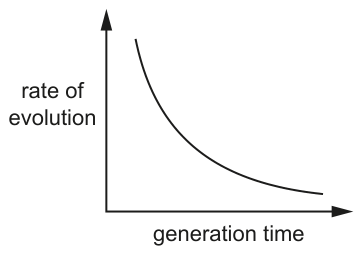
Describe and explain the relationship shown in Fig. 1.1.
The tuatara, Sphenodon punctatus, is a reptile that is native to New Zealand. It is found nowhere else in the wild.
Fig. 1.2 shows a tuatara.
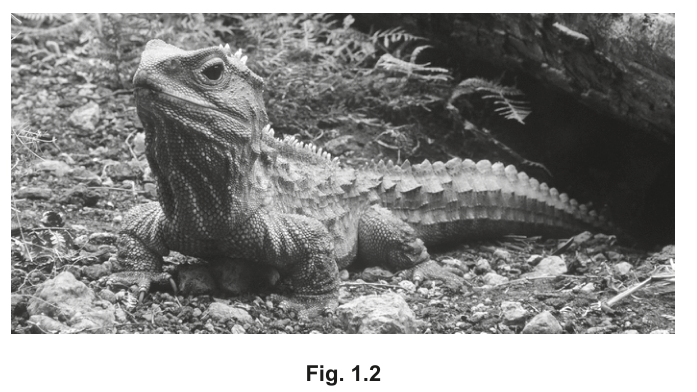
Tuataras have a slow growth rate and can live for over one hundred years. Fossil evidence shows that there has been little morphological change in the tuatara over the last 200 million years. This is a much lower rate of evolution than would be expected from the generation time of this species.
Suggest and explain why the tuatara has remained largely unchanged over the last 200 million years.
The rest of this paper
9 more questions- Q2Classification, Biodiversity and Conservation14M
- Q3Genetic Technology8M
- Q4Photosynthesis9M
- Q5Homeostasis · Control and Coordination · Energy and Respiration10M
- Q6Control and Coordination7M
- Q7Inheritance11M
- Q8Energy and Respiration16M
- Q9Classification, Biodiversity and Conservation15M
- Q10Genetic Technology · Selection and Evolution · Inheritance15M