Biology 9700/42 — October/November 2020
Cambridge A-Level · A Level Structured Questions · worked solutions for every part, with the mark scheme
Topics Selection and Evolution · Inheritance · Genetic Technology · Photosynthesis · Control and Coordination · Homeostasis · +2 more
Fig. 1.1 shows a transmission electron micrograph of a chloroplast.
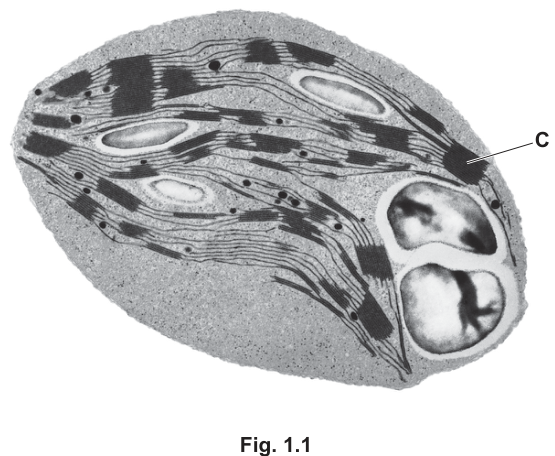
Fig. 1.1
On Fig. 1.1, use label lines and letters to label:
A – the storage site of the carbohydrate product of photosynthesis
B – the site of the light independent stage.
Name the structure labelled C in Fig. 1.1.
C = ______
Explain how the structure of C is linked to its function.
The anatomy of plants is adapted to allow the rate of photosynthesis to remain high at high temperatures.
plants do not have these adaptations and an additional reaction occurs at high temperatures that reduces the rate of photosynthesis.
Explain why the reaction that takes place at high temperatures in plants reduces the rate of photosynthesis.
plants have higher rates of photosynthesis than plants when the ratio of atmospheric oxygen to atmospheric carbon dioxide is high.
Fig. 1.2 shows the atmospheric carbon dioxide concentration in the last 50 million years.
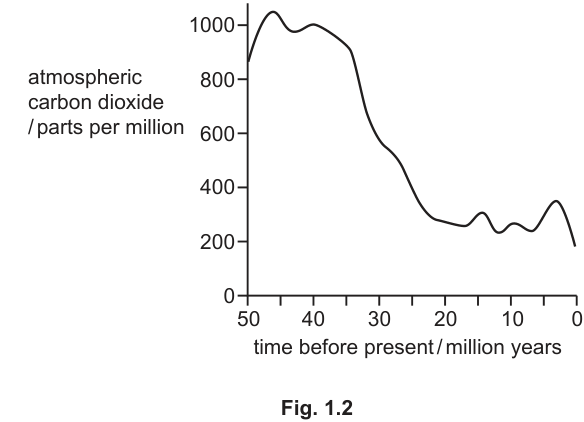
Fig. 1.2
There is evidence that plants first appeared 30 million years ago.
With reference to Fig. 1.2, suggest why plants first appeared 30 million years ago.
The rest of this paper
9 more questions- Q2Selection and Evolution · Genetic Technology13M
- Q3Selection and Evolution7M
- Q4Inheritance · Genetic Technology · Selection and Evolution15M
- Q5Inheritance · Selection and Evolution11M
- Q6Control and Coordination13M
- Q7Homeostasis5M
- Q8Classification, Biodiversity and Conservation9M
- Q9Inheritance15M
- Q10Energy and Respiration15M