Biology 9700/41 — October/November 2020
Cambridge A-Level · A Level Structured Questions · worked solutions for every part, with the mark scheme
Topics Genetic Technology · Inheritance · (outdated) Crop Plants · Selection and Evolution · Classification, Biodiversity and Conservation · Photosynthesis · +2 more
Fig. 1.1 is a transverse section through a leaf from the maize plant, Zea mays.
Maize is a C4 plant.
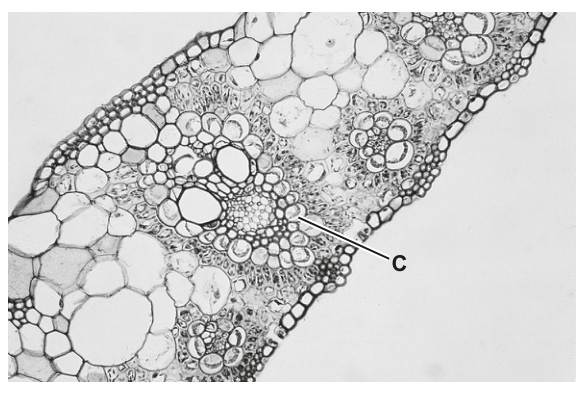
Fig. 1.1
On Fig. 1.1, use label lines and letters to show:
A – a cell in the epidermal layer
B – a cell that contains PEP carboxylase.
Identify the cell type labelled C in Fig. 1.1.
C = ______
Explain how the leaf anatomy shown in Fig. 1.1 adapts the C4 plant to maintain a high rate of photosynthesis at high temperatures.
Fig. 1.2 shows the results of an experiment comparing the rate of carbon dioxide uptake in a C3 plant (Chenopodium album) and a C4 plant (Amaranthus retroflexus) in high and low carbon dioxide () conditions.
The rate of uptake is used to measure the rate of photosynthesis.
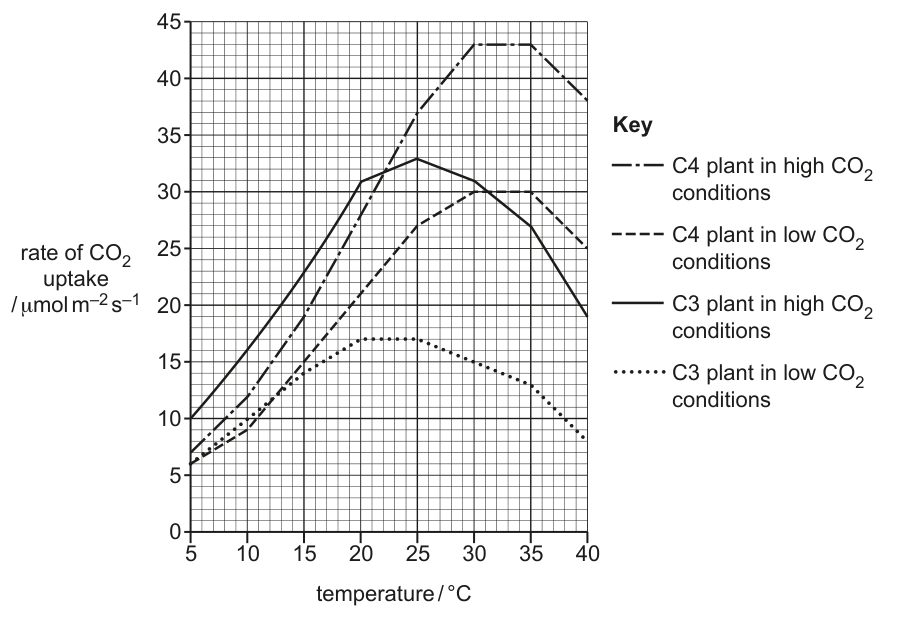
Fig. 1.2
Using Fig. 1.2, compare the rates of photosynthesis in high conditions in the C3 and C4 plants.
Using Fig. 1.2, compare the rates of photosynthesis in low and high conditions in the C4 plant between and and suggest an explanation for this difference.
The rest of this paper
9 more questions- Q2Selection and Evolution · Inheritance · Genetic Technology14M
- Q3Selection and Evolution · Classification, Biodiversity and Conservation · Genetic Technology8M
- Q4Inheritance · Genetic Technology11M
- Q5Inheritance10M
- Q6—12M
- Q7Energy and Respiration8M
- Q8(outdated) Crop Plants · Classification, Biodiversity and Conservation9M
- Q9Genetic Technology15M
- Q10Homeostasis15M