Biology 9700/53 — May/June 2020
Cambridge A-Level · Planning, Analysis and Evaluation · worked solutions for every part, with the mark scheme
Topics Analysis, Conclusions and Evaluation · Planning
Some students decided to find the respiratory quotient (RQ) of germinating pea seeds.
Pea seeds germinate best at temperatures between to .
Table 1.1 shows the main biological molecules in pea seeds that could be used to release energy for seed germination.
Table 1.1
| biological molecule | g per 100g of dry mass |
|---|---|
| carbohydrate | 68 |
| protein | 25 |
| fat | 1 |
Predict the RQ value for these seeds in aerobic conditions.
RQ value = ______
The students used the respirometer shown in Fig. 1.1.
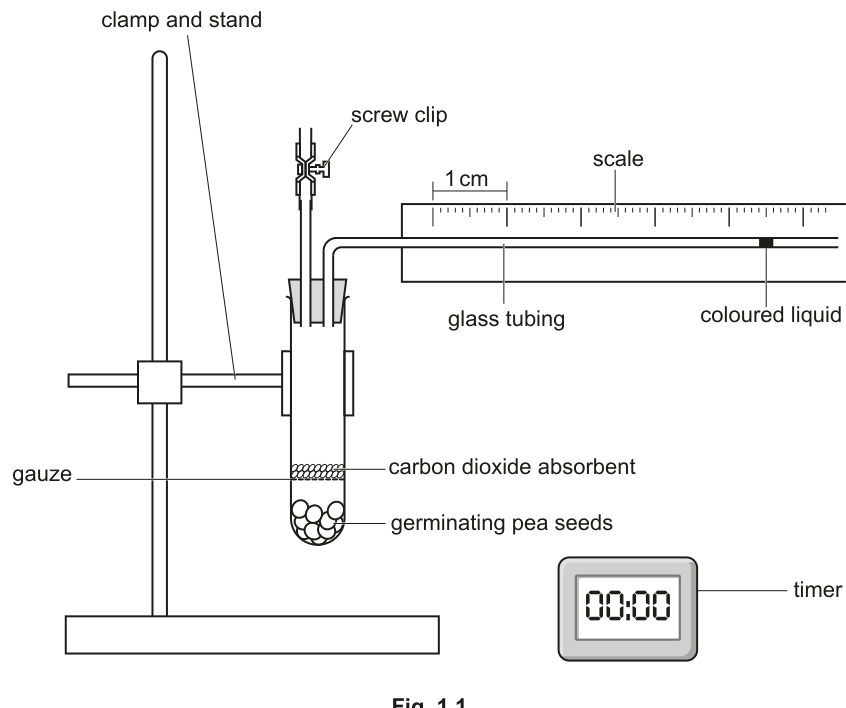
Describe how the students could set up the respirometer and use it to make the measurements needed to calculate the RQ of germinating pea seeds.
Your method should be set out in a logical order and be detailed enough to let another person follow it.
Describe how the students should process their results to find the volumes of gases needed to calculate the RQ of germinating pea seeds.
The students predicted that peas could also respire in anaerobic conditions, producing alcohol and carbon dioxide.
Outline how the students could use the respirometer in Fig. 1.1 in anaerobic conditions to find out if their prediction was correct.
Table 1.2 shows the distance moved by the coloured liquid in anaerobic conditions in five different trials.
Table 1.2
| trial | 1 | 2 | 3 | 4 | 5 |
|---|---|---|---|---|---|
| distance moved / mm | 25 | 38 | 21 | 27 | 23 |
The students calculated a mean from the results in Table 1.2. They did not include one of the results in their calculation.
Identify the result that the students did not use and explain why they did not use it.
The rest of this paper
1 more questions- Q2Analysis, Conclusions and Evaluation · Planning15M