Biology 9700/43 — May/June 2020
Cambridge A-Level · A Level Structured Questions · worked solutions for every part, with the mark scheme
Topics Genetic Technology · Inheritance · Homeostasis · Control and Coordination · Classification, Biodiversity and Conservation · Selection and Evolution · +2 more
The courgette plant, Cucurbita pepo, produces edible fruits that vary in colour and shape.
Fruit colour in courgettes is controlled by the gene A/a.
Fruit shape in courgettes is controlled by the gene B/b.
- A yellow fruit is produced when the dominant allele A is present.
- A round fruit is produced when the dominant allele B is present.
Genes A/a and B/b occur on different chromosomes.
Table 1.1 shows the genotypes and phenotypes of four different varieties of courgette with respect to their fruit colour and shape.
Table 1.1
| name of variety | genotype | fruit colour | fruit shape |
|---|---|---|---|
| Defender | aabb | green | long |
| Floridor | AABB | yellow | round |
| Golden Dawn | AAbb | yellow | long |
| Tondo di Piacenza | aaBB | green | round |
The varieties Golden Dawn and Tondo di Piacenza were grown in the same garden and cross-pollination occurred between them. The gardener grew these cross-pollinated F1 seeds into plants that formed fruits.
The gardener did not know the genotypes of the parent plants and did not know that cross-pollination had occurred.
State the phenotype of the fruits of the F1 plants and explain why it was unexpected for the gardener.
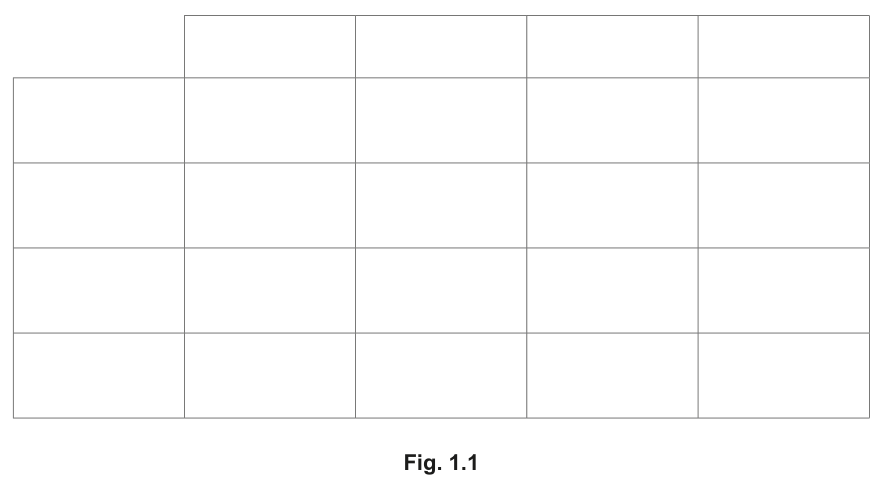
The gardener crossed two of these F1 plants.
Complete Fig. 1.1 with the F1 gametes, F2 genotypes and F2 phenotypes.
State the ratio of fruit phenotypes in the F2 offspring.
ratio of fruit phenotypes ______
Watermelons, Citrullus lanatus, are plants in the same family as courgettes. They produce large round edible fruits that usually contain many hard seeds. Seeds are the structures formed when the male and female gametes fuse at fertilisation.
In the 1990s a triploid () watermelon plant was developed. To produce the triploid watermelon plant, a normal diploid parent plant () was crossed with an artificially created tetraploid plant ().
Triploid watermelon plants develop edible fruits but these are sterile and do not contain seeds, making them more enjoyable to eat.
Explain why the fruits of the triploid plants are sterile and do not contain seeds.
Watermelons are attacked by watermelon mosaic virus (WMV).
In 1965, a WMV-resistant plant in the same family, Cucurbita ecuadorensis (), was found growing wild in South America.
State why a WMV-resistant variety of watermelon cannot be obtained by breeding Cucurbita ecuadorensis with a normal diploid watermelon.
Outline how the WMV-resistant trait of Cucurbita ecuadorensis could be transferred to watermelon plants.
The rest of this paper
9 more questions- Q2Homeostasis · Control and Coordination9M
- Q3Selection and Evolution · Genetic Technology14M
- Q4Inheritance · Genetic Technology8M
- Q5Inheritance · Genetic Technology11M
- Q6Photosynthesis8M
- Q7Energy and Respiration · Homeostasis · Control and Coordination16M
- Q8Classification, Biodiversity and Conservation7M
- Q9Selection and Evolution15M
- Q10Control and Coordination · Homeostasis15M