Biology 9700/43 — May/June 2019
Cambridge A-Level · A Level Structured Questions · worked solutions for every part, with the mark scheme
Topics Genetic Technology · Inheritance · Selection and Evolution · Classification, Biodiversity and Conservation · Energy and Respiration · Control and Coordination · +2 more
Fig. 1.1 shows a cholinergic synapse.
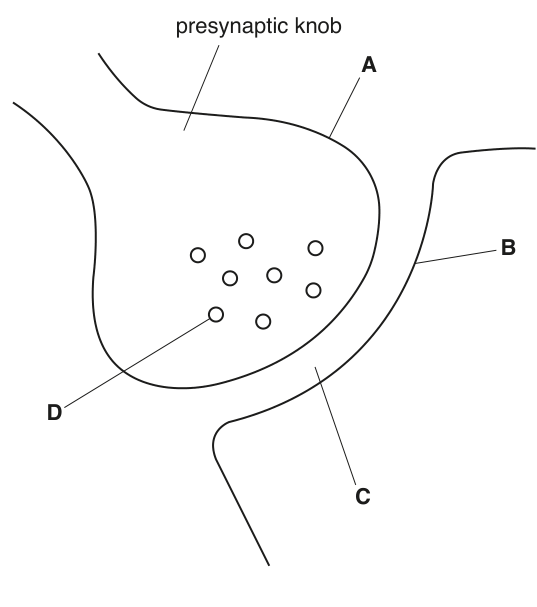
Complete Table 1.1, using the letters A, B, C or D from Fig. 1.1, to show the location of compounds and structures associated with a cholinergic synapse.
You may use A, B, C and D once, more than once, or not at all.
Table 1.1
| compound or structure | location |
|---|---|
| acetylcholine | ______ |
| voltage-gated channel | ______ |
| receptor protein | ______ |
| acetylcholinesterase | ______ |
Answer
| compound or structure | location |
|---|---|
| acetylcholine | C and D |
| voltage-gated channel | A |
| receptor protein | B |
| acetylcholinesterase | C |
acetylcholine = C and D; voltage-gated channel = A; receptor protein = B; acetylcholinesterase = C
Background Concept
A cholinergic synapse is a synapse that uses acetylcholine (ACh) as its neurotransmitter. In Fig. 1.1 the four regions of the synapse are labelled:
- A = presynaptic membrane (the membrane of the presynaptic neurone that faces the synaptic cleft).
- B = postsynaptic membrane (the membrane of the postsynaptic neurone that faces the synaptic cleft).
- C = synaptic cleft (the narrow fluid-filled gap between the two membranes).
- D = synaptic vesicle (a small membrane-bound sac inside the presynaptic knob that stores ACh).
The four molecules/structures in the table each have a fixed location that follows directly from their function:
- ACh is the neurotransmitter, so it is found inside synaptic vesicles (D) before release and in the synaptic cleft (C) after release.
- Voltage-gated Ca²⁺ channels sit on the presynaptic membrane (A); their opening in response to depolarisation is what couples an arriving action potential to ACh release.
- ACh receptor proteins are embedded in the postsynaptic membrane (B); their ACh-binding site is exposed to the synaptic cleft.
- Acetylcholinesterase is located in the synaptic cleft (C), where it hydrolyses ACh once it has acted on the receptor.
Understanding the Question
The question shows a partially labelled diagram of a cholinergic synapse and asks you to complete a table by matching each compound/structure to the correct label (A, B, C or D). Each label may be used more than once or not at all. You must know which molecule lives in which region of the synapse.
Approach
Recall the location of each of the four items in a cholinergic synapse, then match that location to the appropriate letter in Fig. 1.1.
Step-by-Step Reasoning
- Acetylcholine: ACh is synthesised in the presynaptic knob and packaged into synaptic vesicles. When an action potential arrives, the vesicles fuse with the presynaptic membrane and release ACh into the synaptic cleft. ACh is therefore present at C (synaptic cleft, after release) AND D (inside vesicles). → C and D.
- Voltage-gated channel: The voltage-gated Ca²⁺ channels that couple depolarisation to ACh release sit on the presynaptic membrane. → A.
- Receptor protein: The nicotinic/muscarinic ACh receptors are transmembrane proteins of the postsynaptic membrane. ACh binds the receptor on the postsynaptic side, the channel opens and the postsynaptic neurone depolarises. → B.
- Acetylcholinesterase: This hydrolytic enzyme is located in the synaptic cleft (anchored to the basal lamina and to the postsynaptic membrane) and breaks ACh into acetate and choline once ACh has detached from the receptor. → C.
Key Takeaways
- Presynaptic membrane (A): voltage-gated Ca²⁺ channels.
- Synaptic vesicles (D): storage site for ACh.
- Synaptic cleft (C): where ACh is released and broken down by AChE.
- Postsynaptic membrane (B): ACh receptor proteins.
Common Mistakes
- Putting AChE on the postsynaptic membrane: AChE is functionally in the cleft (it is anchored to the postsynaptic membrane but its active site faces the cleft).
- Putting the receptor protein in the cleft: the receptor is on the postsynaptic membrane, with its ACh-binding site projecting into the cleft.
- Forgetting that ACh appears in two places (vesicles AND cleft) and only writing one letter.
- Confusing which letter is the presynaptic and which is the postsynaptic membrane.
Things to Be Careful About
- AChE is anchored to the postsynaptic membrane but its active site faces into the synaptic cleft, so functionally it belongs to the cleft.
- ACh is only briefly in the synaptic cleft — it is released and then rapidly broken down by AChE.
- Voltage-gated channels are also present along the axon (for action-potential propagation), but the ones relevant to synaptic transmission are the voltage-gated Ca²⁺ channels on the presynaptic membrane.
Explain what is meant by a voltage-gated channel.
Answer
A voltage-gated channel is a transmembrane protein that forms a hydrophilic pore through which ions can pass. It opens (and may subsequently close) when the membrane potential changes, e.g., on the depolarisation caused by the arrival of an action potential at the presynaptic membrane.
A transmembrane protein forming an ion-conducting pore that opens in response to a change in membrane potential (e.g., depolarisation on arrival of an action potential).
Background Concept
Neurones use ion channels to propagate electrical signals. There are two broad categories of ion channel relevant to nervous signalling:
- Leak channels: open at rest, contributing to the resting potential.
- Voltage-gated channels: open in response to a change in membrane potential.
Voltage-gated channels are central to action-potential propagation along the axon (voltage-gated Na⁺ and K⁺ channels) and to neurotransmitter release at the presynaptic membrane (voltage-gated Ca²⁺ channels). They differ from ligand-gated channels, which open when a chemical signal (such as ACh) binds to them.
Understanding the Question
The question asks you to explain what is meant by a voltage-gated channel. The command word is "explain", so the answer must capture both what the channel is and how it works. The mark scheme rewards:
- a reference to ion transport;
- a statement that the channel opens/closes when the membrane potential changes (e.g., on arrival of an action potential);
- a supporting detail such as ion specificity, hydrophilic pore, or transmembrane protein.
Approach
State the structure (transmembrane protein with a hydrophilic pore), the function (ion transport) and the trigger (a change in membrane potential), and combine them into a single concise definition.
Step-by-Step Reasoning
- Identify the structure: a voltage-gated channel is a transmembrane protein that forms a hydrophilic pore spanning the membrane. (Mark-scheme point 3, detail.)
- Identify the function: it allows specific ions to pass through the membrane down their electrochemical gradient. (Mark-scheme point 1, ion transport.)
- Identify the trigger: it opens (or closes) when the membrane potential changes — for example, on the depolarisation caused by the arrival of an action potential at the presynaptic membrane. (Mark-scheme point 2, open/closes when voltage changes.)
Key Takeaways
- Voltage-gated channels are transmembrane proteins with a hydrophilic pore.
- They open in response to a change in membrane potential (depolarisation).
- They are ion-selective (e.g., Na⁺-specific, K⁺-specific, Ca²⁺-specific).
Common Mistakes
- Saying "it allows ions through" without specifying the transmembrane protein / pore structure (loses the detail mark).
- Saying "it opens when stimulated" without naming the stimulus as a change in voltage.
- Confusing voltage-gated channels with ligand-gated channels (which open in response to a chemical signal such as ACh).
Things to Be Careful About
- At the synapse, the relevant voltage-gated channels are the voltage-gated Ca²⁺ channels on the presynaptic membrane; their opening triggers ACh release.
- The channel does not actively pump ions; it provides a pore through which ions diffuse down their electrochemical gradient.
Explain the role of acetylcholinesterase in a synapse.
Answer
- Acetylcholinesterase hydrolyses (breaks down) acetylcholine in the synaptic cleft into acetate and choline.
- This causes acetylcholine to detach from the receptor on the postsynaptic membrane, so the receptor channel closes.
- Depolarisation of the postsynaptic membrane stops, preventing continuous / repeated action potentials.
- The breakdown products (acetate and choline) are recycled: choline is taken up into the presynaptic knob and used to synthesise new acetylcholine.
AChE breaks down ACh in the synaptic cleft, causing it to leave the postsynaptic receptor; this stops postsynaptic depolarisation and prevents continuous action potentials, and the breakdown products are recycled to make new ACh.
Background Concept
After acetylcholine (ACh) is released into the synaptic cleft and binds to receptors on the postsynaptic membrane, the synapse must be reset quickly so the next signal can be transmitted faithfully. Two mechanisms operate:
- Diffusion: ACh diffuses away from the receptor.
- Enzymatic breakdown: acetylcholinesterase (AChE) in the synaptic cleft hydrolyses ACh into acetate and choline.
Without AChE, ACh would persist at the receptor and the postsynaptic membrane would stay depolarised, generating continuous action potentials. This is exactly what happens with AChE inhibitors such as the nerve agent sarin and the insecticide malathion, and it is why these substances are toxic.
Understanding the Question
The question asks you to explain the role of acetylcholinesterase in a synapse. The command word is "explain", so the answer must give a mechanism and its consequences. The mark scheme rewards up to five points, of which the first three form the core chain of causation.
Approach
Lay out the chain of events: AChE breaks down ACh → ACh leaves the receptor → depolarisation stops → no continuous action potentials → breakdown products are recycled.
Step-by-Step Reasoning
- Breakdown of ACh: AChE hydrolyses ACh in the synaptic cleft into acetate and choline. This is the primary role of the enzyme. (Mark-scheme point 1.)
- ACh leaves the receptor: Once ACh is broken down it can no longer bind to (or it detaches from) the receptor protein on the postsynaptic membrane, so the receptor channel closes. (Mark-scheme point 2.)
- Depolarisation stops: With the receptor channel closed, Na⁺ no longer flows into the postsynaptic neurone, so depolarisation of the postsynaptic membrane ends. (Mark-scheme point 3.)
- No continuous action potentials: Because depolarisation is no longer sustained, the postsynaptic neurone stops firing repeated action potentials — the synapse resets. (Mark-scheme point 4.)
- Recycling: The choline produced is taken back up into the presynaptic knob, where it is combined with acetyl-CoA (made in mitochondria) to form new ACh, which is then repackaged into vesicles. (Mark-scheme point 5.)
Key Takeaways
- AChE hydrolyses ACh into acetate and choline.
- This terminates ACh's action at the postsynaptic receptor, allowing the synapse to reset.
- The breakdown products are recycled to make new ACh.
Common Mistakes
- Saying AChE "destroys" or "removes" ACh without specifying the hydrolysis reaction (loses the precise terminology).
- Saying AChE "stops the synapse from working" (it actually allows the synapse to reset between signals).
- Forgetting the recycling aspect: AChE does not just dispose of ACh, it produces the raw materials for new ACh.
- Confusing AChE with the receptor — they are different molecules with different roles.
Things to Be Careful About
- AChE is in the synaptic cleft, not on the postsynaptic membrane (although it is anchored to the postsynaptic membrane, its active site faces the cleft).
- The breakdown products are acetate and choline (not ACh + something else).
- In clinical contexts, myasthenia gravis involves antibodies against the ACh receptor, and some treatments (e.g., pyridostigmine) are AChE inhibitors that prolong the action of the limited ACh that does bind.
Outline the roles of synapses in the nervous system.
Answer
- Synapses ensure one-way transmission of nerve impulses — neurotransmitter is only released from the presynaptic membrane and only receptors are present on the postsynaptic membrane, so the impulse can only travel in one direction across a synapse.
- Synapses allow the interconnection of nerve pathways, enabling the integration of impulses from multiple neurones (e.g., summation of several presynaptic inputs at one postsynaptic neurone).
Synapses ensure one-way transmission of impulses and allow the interconnection / integration of nerve pathways.
Background Concept
A synapse is a junction between two neurones (or between a neurone and an effector such as a muscle or gland). It is more than just a physical connection — its structure dictates several important features of nervous-system function:
- Neurotransmitter is stored in vesicles in the presynaptic knob and released by exocytosis into the synaptic cleft.
- Receptor proteins for that neurotransmitter are only on the postsynaptic membrane.
- The chemical signal is then either broken down (e.g., by AChE) or taken back up, so each signal is brief.
This architecture gives synapses several roles that the nervous system as a whole depends on.
Understanding the Question
The question asks you to outline the roles of synapses in the nervous system. The command word is "outline", so the answer should be a brief description of the main roles, not an exhaustive list. The mark scheme accepts any two of: one-way transmission; interconnection of nerve pathways; integration of impulses / memory / learning (AVP).
Approach
Pick the two most fundamental roles — one-way transmission and interconnection / integration — and write a concise point for each.
Step-by-Step Reasoning
- One-way transmission: Because neurotransmitter is only released from the presynaptic membrane and only receptors are present on the postsynaptic membrane, an impulse can cross a synapse in only one direction. This is essential for organised nervous signalling. (Mark-scheme point 1.)
- Interconnection of nerve pathways: A single postsynaptic neurone typically receives synapses from many presynaptic neurones. This allows the nervous system to build complex networks in which multiple inputs are combined. (Mark-scheme point 2.)
- Integration of impulses (AVP): Synapses allow summation of excitatory and inhibitory inputs, so a postsynaptic neurone only fires an action potential when the combined input exceeds a threshold. (Mark-scheme point 3.)
- Memory and learning (AVP): Activity-dependent changes in synaptic strength (synaptic plasticity, e.g., long-term potentiation) underlie learning and memory. (Mark-scheme point 3.)
Key Takeaways
- Synapses ensure one-way transmission of impulses.
- Synapses interconnect neurones, allowing complex networks.
- Synapses integrate multiple inputs (summation).
- Synaptic plasticity underlies memory and learning.
Common Mistakes
- Saying synapses "connect neurones" without specifying the one-way nature of transmission.
- Saying synapses "speed up" or "slow down" nerve impulses (this is not their role).
- Confusing the roles of synapses with the roles of the whole nervous system.
Things to Be Careful About
- One-way transmission depends on the asymmetric distribution of release machinery (presynaptic) and receptors (postsynaptic) — both are required for the property to hold.
- "Interconnection" here means the formation of neural circuits, not just the physical connection itself.
- The question is worth 2 marks, so two well-stated points are sufficient; "memory and learning" is an acceptable alternative if you frame it as a synaptic role.
The rest of this paper
9 more questions- Q2Inheritance · Genetic Technology13M
- Q3Selection and Evolution · Inheritance · Genetic Technology15M
- Q4Genetic Technology8M
- Q5Homeostasis13M
- Q6Selection and Evolution · Classification, Biodiversity and Conservation10M
- Q7Classification, Biodiversity and Conservation6M
- Q8Energy and Respiration9M
- Q9Photosynthesis15M
- Q10Energy and Respiration15M