Biology 9700/42 — February/March 2019
Cambridge A-Level · A Level Structured Questions · worked solutions for every part, with the mark scheme
Topics Inheritance · Selection and Evolution · Genetic Technology · Photosynthesis · Homeostasis · Energy and Respiration · +3 more
The effect of light intensity on the rate of photosynthesis can be investigated using a cut shoot of a pond plant.
The apparatus used in the investigation is shown in Fig. 1.1.
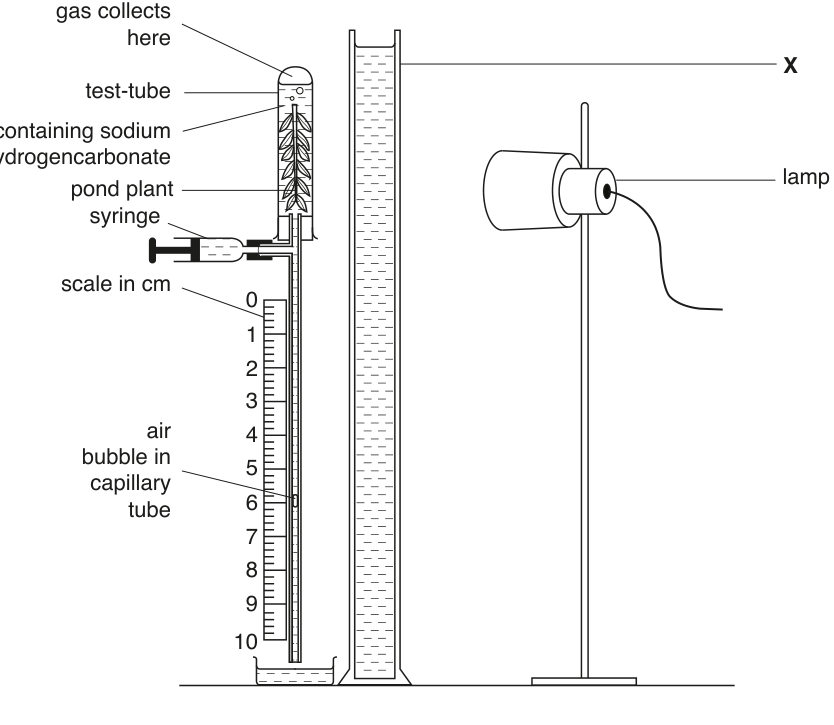
The light intensity can be changed by placing the lamp at different distances from the pond plant.
Apparatus X, shown in Fig. 1.1, is a thin glass container filled with water.
Explain the function of apparatus X.
Before completing the assembly of the apparatus shown in Fig. 1.1, sodium hydrogencarbonate is added to the water surrounding the pond plant in the test-tube.
Explain why sodium hydrogencarbonate is added to the water surrounding the pond plant in the test-tube.
Name the gas collected in the test-tube.
The investigation was carried out with the lamp at distances of 10, 20, 30, 40 and from the pond plant. For each of these distances, the air bubble in the capillary tube was initially positioned at on the scale and, after 5 minutes, the distance moved by the air bubble was measured. The rate of movement of the air bubble was then calculated.
The results are shown in Fig. 1.2.
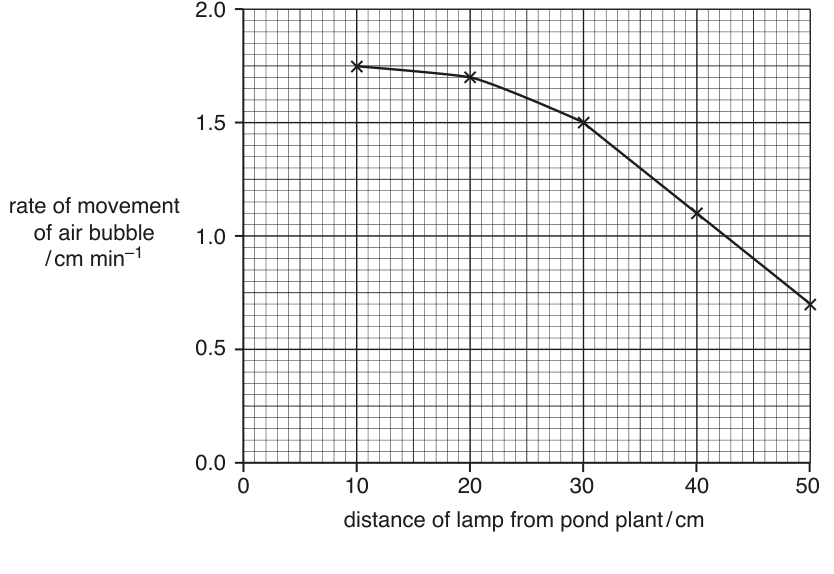
With reference to Fig. 1.2, describe the relationship between the rate of photosynthesis and light intensity.
Further investigations showed that at distances of less than , the rate of movement of the air bubble was the same as at .
Explain why there was no change in the rate of movement of the air bubble at distances less than .
Some of the light energy absorbed by the pond plant is used in cyclic photophosphorylation.
Outline the process of cyclic photophosphorylation.
The rest of this paper
9 more questions- Q2Homeostasis · Energy and Respiration9M
- Q3Inheritance · Genetic Technology17M
- Q4Selection and Evolution10M
- Q5Genetic Technology12M
- Q6Inheritance · Selection and Evolution7M
- Q7—9M
- Q8Classification, Biodiversity and Conservation8M
- Q9Control and Coordination · (outdated) Aspects of Human Reproduction15M
- Q10Selection and Evolution · Inheritance15M