Biology 9700/51 — May/June 2018
Cambridge A-Level · Planning, Analysis and Evaluation · worked solutions for every part, with the mark scheme
Topics Planning · Analysis, Conclusions and Evaluation
(a) Some students were asked to use leaf discs to investigate photosynthesis in leaves of different types.
The students decided to compare the rate of photosynthesis in four different types of leaf in a room kept at a temperature of .
The leaves were taken from:
- ivy, which has a thick waxy cuticle on the upper surface
- geranium, which has a thin cuticle on the upper surface
- spiderwort, which has purple and green stripes and a thin cuticle
- sorghum, which has a thick waxy cuticle on the upper surface.
The students prepared leaf discs of the same diameter from all four types of leaf and placed them onto damp paper in Petri dishes. Each Petri dish was covered by a lid.
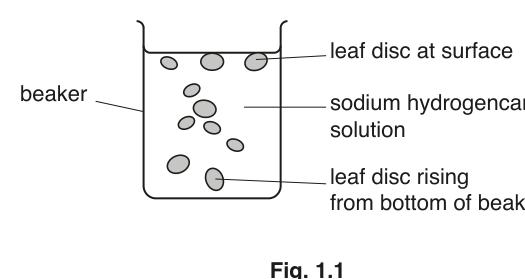
When first placed in a solution, the leaf discs sink. As photosynthesis occurs oxygen is released and the discs rise to the surface. The time taken for the discs to reach the surface allows the rate of photosynthesis to be determined.
Fig. 1.1 shows leaf discs rising to the surface after being placed in a solution of sodium hydrogencarbonate.
State the independent variable and the dependent variable in this investigation.
independent variable = ______
dependent variable = ______
Use the information provided to describe a method by which the students could compare the rate of photosynthesis in discs cut from the four types of leaf.
Your method should be set out in a logical order and be detailed enough to let another person follow it.
Details of the preparation of the leaf discs are not required.
The students' results are shown in Table 1.1.
Table 1.1
| type of leaf | ivy | geranium | spiderwort | sorghum |
|---|---|---|---|---|
| mean time for leaf discs to reach the surface / s | 130 | 75 | 95 | 100 |
Describe how the students could calculate the rate of photosynthesis from their results.
The students made three conclusions.
conclusion 1
Leaves with a thick cuticle absorb less light and photosynthesise more slowly than leaves with a thin cuticle.
conclusion 2
Leaves of spiderwort have a slower rate of photosynthesis because they have less chlorophyll than other plants.
conclusion 3
Sorghum is a C4 plant and so its leaves photosynthesise faster than those of ivy which is a C3 plant.
Each of these conclusions is supported by the evidence, but may not be valid.
Explain why each conclusion may not be valid, using the information in (a) about the leaves and the method used to determine the rate of photosynthesis.
conclusion 1
conclusion 2
conclusion 3
A colorimeter passes a beam of light through a coloured filter into a solution and measures the light absorbance of that solution.
A standard solution is used to set the colorimeter scale to zero (0) before taking any measurements.
Chlorophyll absorbs red light, so the chlorophyll concentration of a leaf extract can be measured using a colorimeter.
Outline how the students could use a colorimeter to obtain further evidence to support the conclusion that leaf discs of spiderwort have a lower chlorophyll content than the leaf discs from the other types of leaf investigated.
Suggest a standard solution that could be used in the colorimeter to ensure that light absorbance is due only to the chlorophyll in a leaf extract.
Table 1.2 shows the students' results from the colorimeter measurements made on 10 samples of each of the four types of leaf.
Table 1.2
| type of leaf | ivy | geranium | spiderwort | sorghum |
|---|---|---|---|---|
| mean absorbance |
The students decided to use the -test to test the hypothesis that:
The difference in the chlorophyll concentration between spiderwort and each of the other plants is significant.
The formula for the -test is shown in Fig. 1.2.

Comment on the use of the -test by:
stating how many values of the students should calculate and explaining your answer
explaining how the students would find out if the results of their -tests were significant.
The rest of this paper
1 more questions- Q2Analysis, Conclusions and Evaluation · Planning9M