Biology 9700/41 — May/June 2018
Cambridge A-Level · A Level Structured Questions · worked solutions for every part, with the mark scheme
Topics Inheritance · Energy and Respiration · Control and Coordination · Classification, Biodiversity and Conservation · Selection and Evolution · Genetic Technology · +2 more
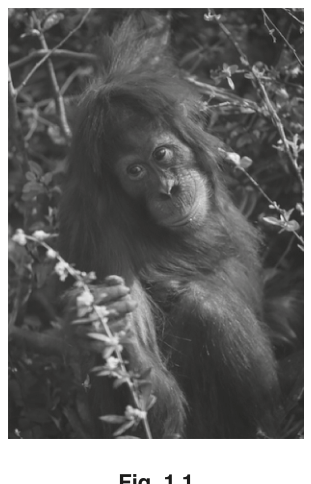
The Sumatran orangutan, Pongo abelii, is found only on the island of Sumatra, Indonesia.
Fig. 1.1 shows a Sumatran orangutan.
The International Union for Conservation of Nature (IUCN) is the world’s largest global environmental organisation. The IUCN Red List of Threatened Species™ evaluates the conservation status of plant and animal species. The Sumatran orangutan is categorised as critically endangered on the IUCN Red List.
The Sumatran orangutan spends most of its time in trees and is very sensitive to habitat destruction.
Table 1.1 shows the area of natural forest of Sumatra and the numbers of orangutans in 1985 and 2016.
Table 1.1
| 1985 | 2016 | |
|---|---|---|
| area of natural forest / million hectares | 25.3 | 12.4 |
| number of orangutans | 25000 | 7300 |
With reference to Table 1.1, state the relationship between area of natural forest and number of orangutans.
Answer
As the area of natural forest increases, the number of orangutans increases (positive correlation).
Positive correlation between area of natural forest and number of orangutans.
Background Concept
When examining two variables measured over time or across samples, one of the simplest patterns to identify is a correlation. A positive correlation exists when both variables change in the same direction: as one increases, the other also increases. A negative correlation is the opposite. Ecologists often look for correlations between population sizes and environmental factors (such as habitat area) to identify possible causes of decline.
Understanding the Question
You are given two columns of paired data in Table 1.1: the area of natural forest (million hectares) and the number of orangutans, both recorded in 1985 and in 2016. The question asks you to describe, in one or two lines, the relationship between these two variables. There are no calculations required — only an interpretation of what the table shows.
Approach
Compare the two rows of the table:
- In 1985: 25.3 million hectares of forest and 25 000 orangutans.
- In 2016: 12.4 million hectares of forest and 7 300 orangutans.
Both variables decreased together between the two years. Therefore, there is a positive correlation: as forest area went down, orangutan numbers also went down.
Step-by-Step Reasoning
The mark scheme accepts any of these equivalent statements:
- "Positive correlation."
- "As area (of forest) increases, number / population / orangutans increase(s)."
- The reverse argument (ORA): "As area of forest decreases, the number of orangutans decreases."
The key idea is to describe the direction of the relationship, not the magnitude. Any wording that conveys "both go up together / both go down together" scores the mark. Avoid describing a causal relationship here — the question asks for the pattern, not the explanation.
Key Takeaways
- A correlation describes a pattern in data; it does not by itself prove causation.
- In conservation biology, habitat area is frequently a strong correlate of population size, especially for habitat-specialist species like the orangutan.
Common Mistakes
- Writing "habitat loss causes orangutan decline" — this is an explanation, not a description of the relationship.
- Confusing correlation with causation in your phrasing.
Things to Be Careful About
Use the words "positive correlation" if you can — it is the precise scientific term and is the first alternative on the mark scheme.
Calculate the mean annual decrease in orangutan numbers between 1985 and 2016.
Show your working.
Give your answer to the nearest whole number.
mean annual decrease = ______
Working
Answer
mean annual decrease = 571 (per year)
571 per year
Background Concept
A mean rate of change is found by dividing the total change in a quantity by the total time over which that change occurred. It tells you, on average, how much the quantity changes per unit of time. For a decreasing population, this gives the average annual loss of individuals.
Understanding the Question
The question gives you the number of orangutans in 1985 (25 000) and in 2016 (7 300). It asks for the average decrease per year across the 31-year interval. The mark scheme rewards both the working (substitution) and the final rounded answer.
Approach
- Subtract the smaller number from the larger to find the total decrease.
- Subtract the years to find the time interval.
- Divide the total decrease by the time interval.
- Round to the nearest whole number, as instructed.
Step-by-Step Reasoning
Total decrease in orangutan numbers:
Time interval:
Mean annual decrease:
Rounded to the nearest whole number: 571 orangutans per year.
The mark scheme accepts both an incorrect-intermediate-value carried-forward answer (ecf) and the precise 570.97 → 571. Watch your significant figures: the question asks for a whole number, so do not write 570.97 as your final answer.
Key Takeaways
- Mean rate = total change ÷ total time.
- Always state the unit (per year, here) with your final answer.
- "To the nearest whole number" means round half-up; 570.97 rounds to 571, not 570.
Common Mistakes
- Dividing the wrong way (e.g. 31 ÷ 17 700).
- Forgetting the time interval and dividing by 1.
- Reporting 570.97 instead of 571.
- Leaving out the unit "per year" — although the mark scheme accepts the bare number with correct units in the answer space.
Things to Be Careful About
Show your working clearly so that any error carried forward (ecf) can still earn the mark for the substitution step.
Use your answer from (a)(ii) to estimate the number of years after 2016 that it will take for the Sumatran orangutan to become extinct in the wild, if conservation work is unsuccessful.
______ years
Working
Answer
13 years (after 2016, so approximately the year 2029)
13 years
Background Concept
Extinction in the wild is reached when the last individual of a species dies in its natural habitat (a species may still survive in captivity). When a population is declining at a roughly constant rate, we can extrapolate: if we know how many individuals are lost per year and how many remain, we can estimate how many years it will take for the population to reach zero. This is a linear extrapolation and assumes the rate of loss stays constant — a major simplification.
Understanding the Question
You have just calculated the mean annual loss (571 orangutans per year). The 2016 population is 7 300. The question wants the number of years after 2016 before the population is predicted to reach zero, assuming the same rate of loss continues.
Approach
Divide the 2016 population by the mean annual decrease to find how many years of losses would deplete it entirely. Round appropriately. The mark scheme accepts 12.78, 12.8 or 13 (years).
Step-by-Step Reasoning
If you used 570 (rather than 571) from a rounded intermediate answer, ecf gives , which still rounds to 13.
If you used 571 exactly: , which rounds up to 13 (you cannot have "part of a year after" an extinction event — you need a full year for the last individual to die).
Key Takeaways
- A linear extrapolation is a simple but very rough model — real populations rarely decline at a constant rate.
- "Years to extinction" requires understanding that extinction is when N = 0, so divide current N by annual loss.
- This type of estimate is a prediction, not a certainty; conservation efforts may slow or reverse the trend.
Common Mistakes
- Dividing 571 by 7 300 instead of 7 300 by 571.
- Reporting 12 or 12.7 without recognising the mark scheme accepts these as well — but the safest whole-number answer is 13.
Things to Be Careful About
The mark scheme accepts 12.78, 12.8 and 13. If you write "12 years" (rounded down), you may lose the mark because extinction is not yet reached after 12 years — the population would still be ~100. Always round up when estimating time to zero.
Suggest two reasons for the decrease in numbers of Sumatran orangutans, other than habitat loss.
Answer
Any two from:
- Hunting / poaching for bushmeat, traditional medicine or to protect crops.
- Hunting or live capture for the pet / illegal wildlife trade.
- Disease (e.g. outbreaks in small, fragmented populations).
- Inbreeding / reproductive problems because mates are inaccessible in small, isolated populations.
Any two valid threats other than habitat loss, e.g. hunting for bushmeat and the pet trade.
Background Concept
A species' decline is rarely due to a single cause. Conservation biologists distinguish between:
- Habitat loss (already covered in part (a)).
- Direct exploitation — hunting, poaching, collection for trade.
- Invasive species / disease.
- Small-population effects — inbreeding depression, genetic drift, demographic stochasticity, inability to find mates.
- Climate change / pollution (often secondary).
The Sumatran orangutan faces several of these pressures simultaneously, which is why it is classified as critically endangered.
Understanding the Question
Part (a) explained why habitat loss matters. Part (b) explicitly excludes habitat loss and asks for two other reasons for the decrease in orangutan numbers. The mark scheme offers four valid answers; you need to give any two.
Approach
Think about what human activities or biological pressures could affect a large, slow-breeding primate in a fragmented Sumatran forest:
- Are orangutans hunted? Yes — for meat, for traditional medicine and occasionally as crop pests.
- Are they captured alive? Yes — the illegal pet trade targets baby orangutans (often after the mother has been killed).
- Do they suffer disease? Yes — small isolated populations are vulnerable to epidemics.
- Do they have breeding problems? Yes — males and females in fragmented forest patches cannot easily find each other; in small populations inbreeding reduces fertility.
Step-by-Step Reasoning
The mark scheme credits four distinct reasons:
- Hunting / poaching for bushmeat, traditional medicine or crop protection — local people may kill orangutans seen as pests, or hunt them for food or folk remedies.
- Hunting or live capture for the pet trade — infant orangutans are valuable in the illegal wildlife trade; capturing them usually involves killing the mother.
- Disease — small, stressed populations can be wiped out by epidemics.
- Breeding problems due to isolation / inaccessibility of mates / inbreeding in small populations.
Pick any two. Each must be a distinct reason — repeating "hunting" in two different guises scores only one mark.
Key Takeaways
- Critically endangered species typically face multiple, interacting threats.
- Orangutans are particularly vulnerable because they reproduce slowly (one offspring every ~7–9 years), so any additional mortality has a large demographic impact.
- The pet trade is a major, often overlooked, driver of primate declines.
Common Mistakes
- Re-stating habitat loss in different words ("loss of habitat due to deforestation" again) — this does not score.
- Vague answers such as "pollution" or "climate change" without linking them specifically to orangutans.
- Repeating the same point twice (e.g. "poaching for meat" and "poaching for food").
Things to Be Careful About
Make sure each point names a distinct mechanism. If in doubt, prefer concrete, species-relevant threats (hunting for bushmeat or pet trade) over generic global threats.
Outline the role zoos can take in the protection of the Sumatran orangutan.
Answer
Any three from:
- Run captive breeding programmes to maintain / increase numbers.
- Reintroduce captive-bred individuals to the wild (Sumatra or protected reserves).
- Educate the public / raise awareness of conservation issues.
- Carry out research on diet, breeding, behaviour or genetic diversity.
- Raise money for reserves and for protecting wild populations.
- Cooperate with governments (or other valid point) in conservation efforts.
Zoos can run breeding programmes, reintroduce animals to the wild, and educate the public / raise funds for in-situ conservation.
Background Concept
Zoos contribute to conservation in two complementary ways:
- Ex-situ conservation — actions taken outside the species' natural habitat, principally captive breeding and research.
- In-situ conservation — actions taken within the species' natural habitat, such as supporting reserves, anti-poaching patrols and habitat protection.
Modern zoos increasingly combine both, often through partnerships with field projects in range states (countries where the species naturally occurs).
The Sumatran orangutan is a flagship species for several zoo-based conservation programmes worldwide (e.g. the Sumatran Orangutan Conservation Programme, with whom many European and North American zoos cooperate).
Understanding the Question
Part (c) asks you to outline (give the main points of) the role zoos can play in protecting Pongo abelii. Three marks are available, so you must give at least three distinct points.
Approach
Brainstorm the categories of activity that a modern zoo can offer an endangered species:
- What can zoos do that the wild cannot? → controlled breeding, veterinary care, public visibility.
- How does this feed back into wild populations? → reintroduction, fund-raising, research informing field work, education changing consumer behaviour.
Step-by-Step Reasoning
The mark scheme credits six possible points; any three score full marks:
- Breeding programmes — coordinated, pedigree-managed breeding to maintain or grow a captive population. For Sumatran orangutans, studbooks track every individual to avoid inbreeding.
- Release / reintroduction — returning captive-bred individuals to the wild, ideally into secure reserves in Sumatra. This requires extensive rehabilitation; orangutans must learn to forage, build nests and avoid predators.
- Education / raising public awareness — visitors learn about the species' plight and the threats it faces; well-designed exhibits change behaviour (e.g. choosing sustainable palm oil).
- Research — zoos can study diet, breeding biology, behaviour and genetic diversity in a controlled setting, generating data useful for wild population management.
- Fund-raising — entry fees and donations support in-situ projects such as anti-poaching patrols, reserve management and habitat restoration.
- Cooperation with governments / AVP — zoos can work alongside national agencies, supply expertise, or contribute to international policy.
Any three distinct points gain full marks.
Key Takeaways
- Effective zoo conservation is both ex-situ (breeding, research) and in-situ (funding reserves, reintroduction, education).
- For long-lived, slow-breeding species like orangutans, captive breeding is a long-term commitment spanning decades.
- Education is increasingly recognised as one of the most cost-effective zoo conservation outputs.
Common Mistakes
- Repeating the same idea in different words (e.g. "breeding them" and "increasing their numbers") — only counts as one mark.
- Vague answers such as "zoos help orangutans" or "zoos are useful" — too unspecific to score.
- Confusing zoo roles with general threats (the question is about what zoos do, not what harms the species).
Things to Be Careful About
Read the command word: outline means give the main points — a short bullet list, not an essay. Three crisp points, each a distinct mechanism, will earn all three marks.
The rest of this paper
9 more questions- Q2Selection and Evolution15M
- Q3Inheritance9M
- Q4Inheritance8M
- Q5Genetic Technology · Inheritance15M
- Q6Energy and Respiration7M
- Q7Photosynthesis9M
- Q8Control and Coordination · (outdated) Aspects of Human Reproduction13M
- Q9Energy and Respiration15M
- Q10Control and Coordination15M