Biology 9700/42 — February/March 2018
Cambridge A-Level · A Level Structured Questions · worked solutions for every part, with the mark scheme
Topics Selection and Evolution · Control and Coordination · Photosynthesis · Classification, Biodiversity and Conservation · Genetic Technology · Homeostasis · +2 more
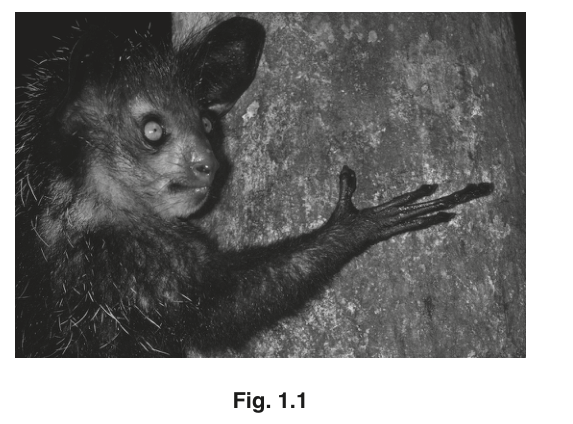
The aye-aye, Daubentonia madagascariensis, is a primate native to Madagascar. Aye-ayes are nocturnal (active at night) and make their nests high up in trees. They feed on insect larvae in the trunks of trees.
Fig. 1.1 shows an aye-aye.
The International Union for Conservation of Nature (IUCN) is the world’s largest global environmental organisation. The IUCN Red List of Threatened Species™ evaluates the conservation status of plant and animal species.
The aye-aye is categorised as endangered on the IUCN Red List, which means that it faces a very high risk of becoming extinct in the wild.
Name the domain to which the aye-aye belongs.
Suggest one reason why aye-ayes have become endangered.
Suggest ways in which zoos may help to protect this species from extinction.
There are two main aye-aye populations on the island of Madagascar, one in the west and one in the east.
Fig. 1.2 is a map of Madagascar showing the location of the two main populations.
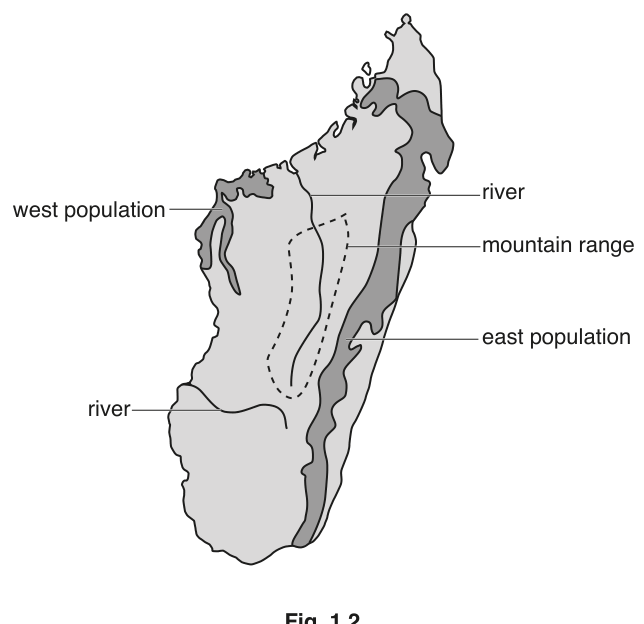
A study into the variation in the DNA nucleotide sequence of aye-ayes showed that there is a large genetic difference between the west and east populations. The two populations of aye-ayes may be evolving into separate species.
With reference to Fig. 1.2, suggest why there is a large genetic difference between the two populations.
Name the type of speciation that may be occurring.
Suggest and explain a pre-zygotic isolating mechanism that could prevent successful reproduction between aye-ayes of the two populations.
The rest of this paper
9 more questions- Q2Control and Coordination10M
- Q3Genetic Technology15M
- Q4Photosynthesis10M
- Q5Control and Coordination · Homeostasis12M
- Q6Inheritance11M
- Q7Selection and Evolution9M
- Q8Energy and Respiration6M
- Q9Photosynthesis15M
- Q10Control and Coordination · Selection and Evolution15M