Biology 9700/43 — October/November 2017
Cambridge A-Level · A Level Structured Questions · worked solutions for every part, with the mark scheme
Topics Selection and Evolution · Control and Coordination · Classification, Biodiversity and Conservation · Photosynthesis · Genetic Technology · Energy and Respiration · +3 more
The St. Lawrence river in Canada has been identified as an area with very high biodiversity.
Explain how the term biodiversity can be considered at different levels.
The St. Lawrence river is rich in species of aquatic mammals, especially whales.
In spring, thousands of whales swim from the Atlantic ocean up the St. Lawrence river. Thirteen different species of whale have been recorded. One of these is the blue whale, Balaenoptera musculus.
Fig. 1.1 is a diagram of a blue whale.
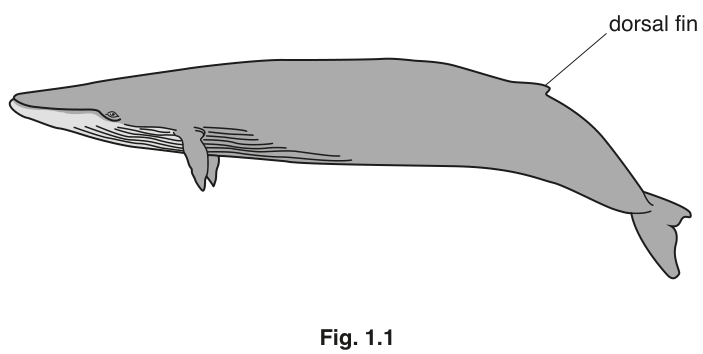
Photographs of blue whales are analysed by computer so that individual whales can be identified and population abundance can be estimated. Each blue whale is different in colour and in the shape of dorsal fin. Different whales also have different patterns of scarring.
State the two sources of phenotypic variation in the blue whale population.
Suggest one reason why it is difficult to measure the actual population size of the blue whale.
The St. Lawrence river runs through very busy industrial areas. It has many ports for cargo ships, a good fishing trade and many whale-watching boat trips for tourists.
Decades of whale hunting has caused a large decrease in whale population sizes. Since whale hunting was banned, whale populations have not recovered.
Seven of the thirteen whale species in the St. Lawrence river have been rated as endangered species.
Suggest two reasons why the populations of whales have not recovered since the ban on whale hunting.
Fat samples from under the skin of individual whales of several different species were taken. These were analysed and the concentrations of the toxins DDT and PCBs were measured.
Suggest why whales were found to have accumulated very high concentrations of DDT and PCBs in their fatty tissues.
Algal blooms sometimes occur in the area of the Atlantic ocean near the St. Lawrence river. These result from rapid population growth of unicellular algae such as Alexandrium tamarense.
A. tamarense produces saxitoxin, a neurotoxin that causes muscle paralysis by acting on voltage-gated sodium ion channels in neurones. Saxitoxin can kill whales.
Suggest how saxitoxin results in the death of a whale.
Algae, such as A. tamarense, used to belong to the kingdom Plantae but are now classified in the kingdom Protoctista.
State one reason why A. tamarense is classified in the kingdom Protoctista and not in the kingdom Plantae.
The rest of this paper
9 more questions- Q2Photosynthesis13M
- Q3Classification, Biodiversity and Conservation · Selection and Evolution8M
- Q4Genetic Technology · Selection and Evolution13M
- Q5Control and Coordination9M
- Q6Energy and Respiration10M
- Q7Inheritance · Genetic Technology9M
- Q8Homeostasis · Control and Coordination12M
- Q9Energy and Respiration · (outdated) Crop Plants · Photosynthesis15M
- Q10Inheritance15M