Biology 9700/42 — October/November 2017
Cambridge A-Level · A Level Structured Questions · worked solutions for every part, with the mark scheme
Topics Inheritance · Classification, Biodiversity and Conservation · Selection and Evolution · Genetic Technology · Energy and Respiration · Photosynthesis · +2 more
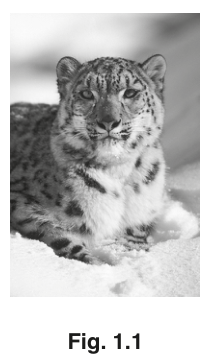
Fig. 1.1 shows a snow leopard, Panthera uncia. The habitat of the snow leopard is the high mountains of Central Asia.
Snow leopards usually live and hunt alone. Their main prey is grazing herbivores, such as wild sheep and wild goats. They will also hunt domesticated animals and livestock.
The number of snow leopards has decreased dramatically in the last 40 years.
Predict the consequences to the ecosystem if the number of snow leopards continues to decrease.
In 2003, the total number of snow leopards was estimated to be between 4080 and 6590.
Suggest one reason why the actual number of snow leopards in 2003 may have been higher than the estimated number.
The Convention on International Trade in Endangered Species of Wild Fauna and Flora (CITES) is an agreement between the governments of most countries.
The snow leopard is endangered and is listed on this agreement.
Describe the actions taken by participating governments that help to conserve endangered animals, such as the snow leopard.
State how a decrease in the number of snow leopards will affect the genetic diversity of the species.
Outline the possible future consequences of this change in genetic diversity.
In 1775 the snow leopard was classified as the only species in the genus Uncia and was known as Uncia uncia.
More recently, new techniques showed similarities to the tiger, Panthera tigris, and so in 2006 the snow leopard was reclassified in the genus Panthera.
Suggest the type of evidence used to classify the snow leopard in 1775.
The rest of this paper
9 more questions- Q2Photosynthesis15M
- Q3Classification, Biodiversity and Conservation · Selection and Evolution · Genetic Technology8M
- Q4Homeostasis12M
- Q5Inheritance · Genetic Technology13M
- Q6Control and Coordination8M
- Q7Energy and Respiration9M
- Q8Inheritance9M
- Q9Energy and Respiration15M
- Q10Inheritance15M