Biology 9700/52 — May/June 2017
Cambridge A-Level · Planning, Analysis and Evaluation · worked solutions for every part, with the mark scheme
Topics Analysis, Conclusions and Evaluation · Planning
Fig. 1.1 shows an aquatic crustacean belonging to the genus Daphnia. These animals usually measure between in length. They have a two-chambered heart which can be seen through the exoskeleton when viewed using a low-powered microscope.
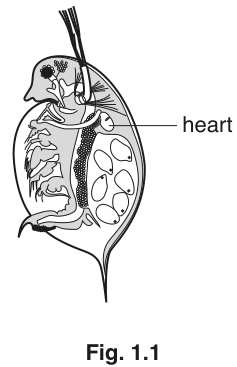
A biology teacher told a class that caffeine can temporarily relieve tiredness in people by increasing heart rate.
Table 1.1 shows the caffeine content of various products.
Table 1.1
| product | caffeine per serving/ |
|---|---|
| 1 cup of strong coffee | 100 |
| dark chocolate | 45 |
| 1 caffeine tablet | 50 |
| 1 can of cola drink | 20 |
One group of students in the class used Daphnia to test the hypothesis:
Heart rate increases when caffeine concentration increases.
Identify the independent and dependent variable in this investigation.
independent ..............................................................................................................................
dependent ............................................................................................................................
The group of students decided to use the caffeine tablets to make a caffeine solution.
Describe a procedure that the students should use to prepare the caffeine solution.
A culture of healthy Daphnia was supplied to the students in a tank containing fresh water and a suitable food source.
Each student followed the same basic procedure.
• A Daphnia was placed on some cotton wool fibres in a cavity microscope slide as shown in Fig. 1.2.
• A few drops of caffeine solution were immediately added to the slide.
• The Daphnia was observed using the low power objective lens of a microscope.
• The number of heart beats of the Daphnia was counted.
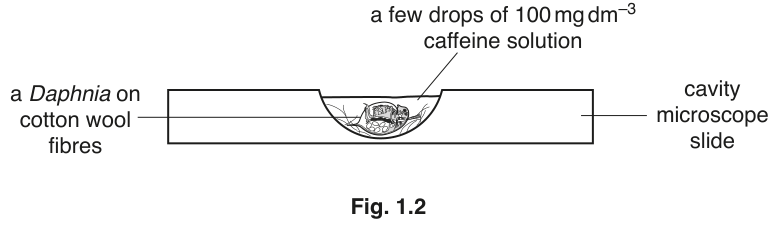
Suggest one reason why the Daphnia was placed on cotton wool fibres.
The students decided to adapt their basic procedure to test their hypothesis that:
Heart rate increases when caffeine concentration increases.
Describe a method which the students could use to test this hypothesis.
Your method should be detailed enough for another person to follow.
Suggest one feature of the procedure which may have added a source of error and suggest how the students could have reduced its effect.
The data the students obtained showed that as the concentration of caffeine increased, the heart rate of the Daphnia also increased.
The students concluded:
To relieve tiredness, people should increase their caffeine intake so that their heart rate will increase.
Suggest why the students' conclusion was not valid.
Another group of students decided to use cola as their source of caffeine. They diluted the cola to give a range of caffeine concentrations. They counted the heart rates of Daphnia in each of these concentrations.
Table 1.2 shows their results.
Table 1.2
| concentration of caffeine/ | heart rate of Daphnia/beats per minute: 1 | heart rate of Daphnia/beats per minute: 2 | heart rate of Daphnia/beats per minute: 3 | heart rate of Daphnia/beats per minute: 4 | heart rate of Daphnia/beats per minute: 5 | heart rate of Daphnia/beats per minute: mean |
|---|---|---|---|---|---|---|
| 2.4 | 307 | 284 | 228 | 275 | 301 | 279 |
| 3.6 | 325 | 331 | 319 | 328 | 322 | 325 |
| 4.8 | 361 | 355 | 349 | 358 | 362 | 357 |
| 6.0 | 377 | 365 | 357 | 360 | 363 | 364 |
On Table 1.2 indicate, by placing a circle around the value, one result that may be anomalous.
These students concluded that:
The heart rate of Daphnia increased proportionally to the concentration of caffeine.
Suggest two reasons why the data collected was not sufficient to make this conclusion.
The rest of this paper
2 more questions- Q2Analysis, Conclusions and Evaluation7M
- Q3Planning · Analysis, Conclusions and Evaluation6M