Biology 9700/42 — February/March 2017
Cambridge A-Level · A Level Structured Questions · worked solutions for every part, with the mark scheme
Topics Homeostasis · Control and Coordination · Selection and Evolution · Classification, Biodiversity and Conservation · Energy and Respiration · Photosynthesis · +3 more
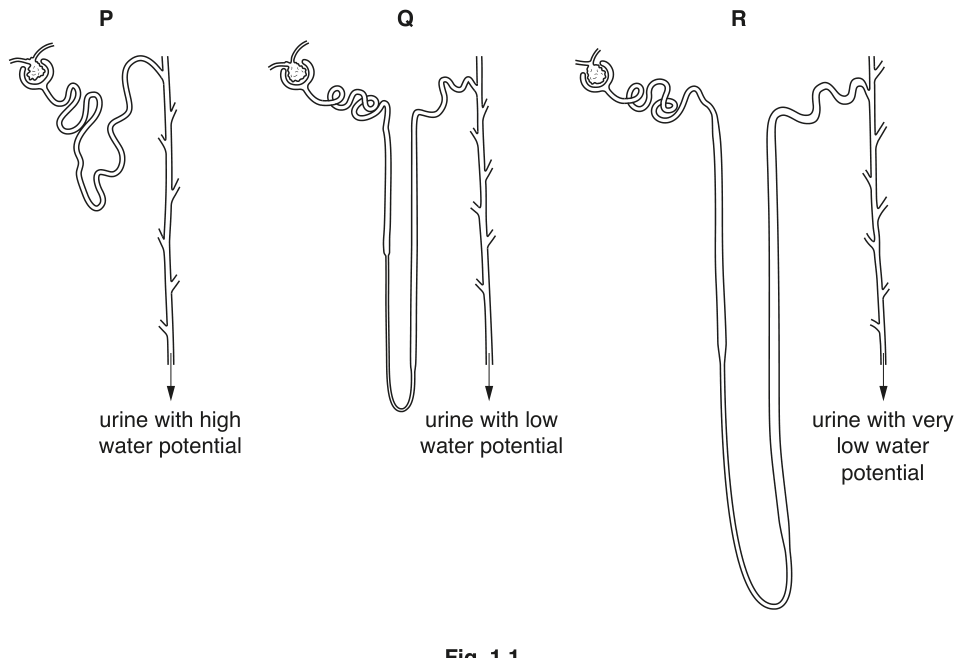
Fig. 1.1 shows diagrams of nephrons from the kidneys of three different mammals, P, Q and R. These are all drawn to the same scale.
State the relationship between the length of the loop of Henle and the water potential of the urine of the three mammals.
The nephron of a camel is similar to that of mammal R.
Suggest why it is important that the camel produces urine with a very low water potential.
The epithelial cells of the proximal convoluted tubule are adapted to carry out selective reabsorption.
Table 1.1 lists three features of epithelial cells of the proximal convoluted tubule.
For each feature, explain how it helps the process of selective reabsorption.
Table 1.1
| feature | explanation |
|---|---|
| microvilli | |
| many mitochondria | |
| tight junctions between cells |
The rest of this paper
9 more questions- Q2Energy and Respiration12M
- Q3Control and Coordination16M
- Q4Photosynthesis · (outdated) Crop Plants · Homeostasis13M
- Q5Inheritance8M
- Q6Selection and Evolution7M
- Q7Control and Coordination9M
- Q8Classification, Biodiversity and Conservation · Selection and Evolution11M
- Q9Classification, Biodiversity and Conservation15M
- Q10Genetic Technology15M