Biology 9700/51 — October/November 2016
Cambridge A-Level · Planning, Analysis and Evaluation · worked solutions for every part, with the mark scheme
Topics Planning · Analysis, Conclusions and Evaluation
(a) The opening and closing of stomata involves the movement of potassium ions into and out of guard cells. Opening and closing of stomata is influenced by a number of environmental factors, for example light and temperature.
A student investigated the effect of potassium chloride () on the opening of stomata.
The student was provided with:
- of solution
- freshly picked leaves from a plant that had been kept in the dark and a high concentration of carbon dioxide for an hour. This ensured that all the stomata were closed.
Strips of leaf tissue were obtained by cutting a leaf into sections as shown in Fig. 1.1.
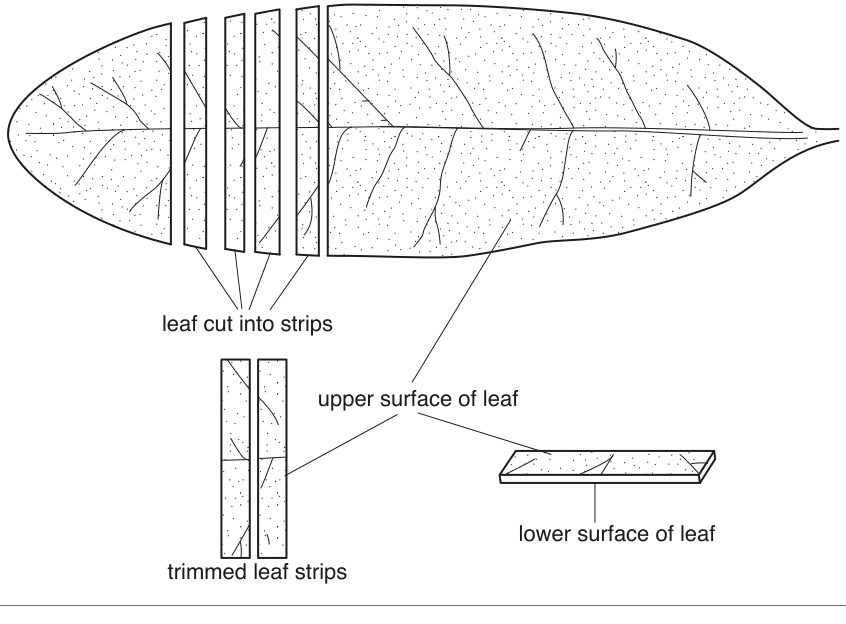
The student floated three strips of leaf tissue in each of a range of buffered potassium chloride solutions for 2 hours and then recorded the number of open stomata.
Identify the independent and dependent variables in this investigation.
independent variable = ______
dependent variable = ______
The student used the solution to make of four other concentrations by reducing the concentration by each time.
Describe a procedure that the student could use to prepare these four concentrations.
Suggest a hypothesis that the student could test about the effect of on the opening and closing of stomata.
Describe a method that the student could use to investigate the effect of different concentrations of on the opening of stomata.
The description of your method should be detailed enough for another person to follow and should not repeat the details from (a)(ii) of how to dilute the solution of .
The student also tested the hypothesis:
The more light the wider the stomata open.
- Eight leaves from young plants that had been kept in the dark for 24 hours were covered by metal foil.
- A fluorescent lamp of fixed intensity was placed from the plant. The metal foil was removed from the leaves.
- Two leaves were removed at the start of the experiment and three epidermal strips were made from each leaf. An epidermal strip is made by peeling the epidermis from a leaf as a single layer.
- The diameter of the stomatal aperture of five of the stomata with the widest aperture on each strip was measured.
- At one hour intervals two more leaves were removed and the same procedure repeated.
Fig. 1.2 shows stomata at different stages of opening.
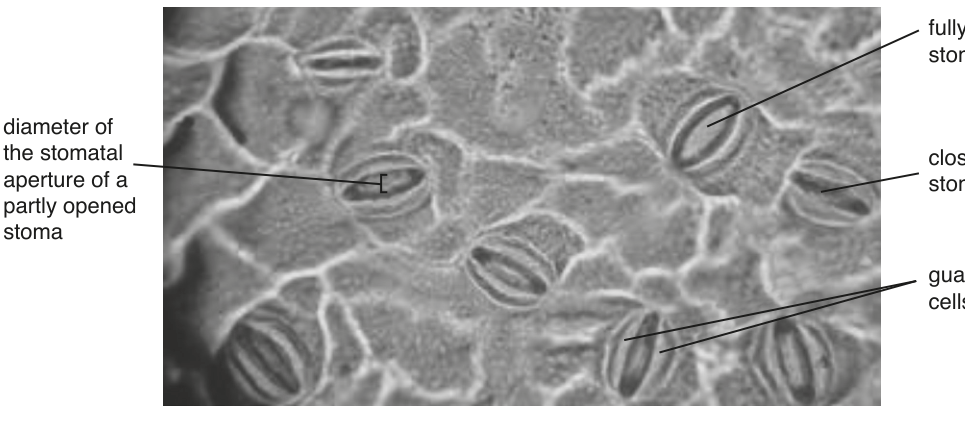
Outline how the student could find the actual diameter of a stomatal aperture.
Table 1.1 shows the results of the student’s experiment.
Table 1.1
| time / min | diameter of stomatal aperture / | ||||||||||||||
|---|---|---|---|---|---|---|---|---|---|---|---|---|---|---|---|
| 0 (control) | 0.5 | 0.1 | 0.2 | 0.3 | 0.4 | 0.1 | 0.5 | 0.2 | 0.3 | 0.3 | 0.1 | 0.2 | 0.2 | 0.2 | 0.4 |
| 60 | 0.9 | 1.1 | 1.0 | 1.3 | 1.2 | 1.8 | 1.5 | 0.8 | 0.2 | 1.3 | 1.1 | 0.8 | 1.0 | 1.9 | 0.9 |
| 120 | 1.9 | 2.4 | 2.6 | 2.6 | 2.5 | 2.2 | 2.8 | 2.4 | 2.4 | 3.9 | 2.6 | 2.3 | 2.5 | 2.2 | 2.7 |
| 180 | 4.1 | 4.8 | 4.2 | 4.0 | 5.7 | 4.7 | 3.9 | 4.1 | 5.5 | 4.5 | 4.3 | 4.0 | 3.1 | 4.1 | 4.3 |
On Table 1.1, draw circles around two values that are anomalous.
The student calculated the mean diameter of the stomatal apertures and the rate at which the diameter of the stomatal apertures increased.
Table 1.2 shows some of these calculations.
Table 1.2
| time/min | mean diameter of stomatal apertures / | rate of increase of diameter of stomatal apertures / |
|---|---|---|
| 0 | 0.3 | |
| 60 | 1.2 | 0.015 |
| 120 | 2.5 | 0.022 |
| 180 | 4.6 |
Complete Table 1.2 by calculating the rate of increase of the diameter of the stomatal apertures between 120 minutes and 180 minutes.
Space for working
The experimental procedure described in (c) could be criticised for poor technique in obtaining results.
Suggest how the procedure could be modified to improve the quality of these results.
The experimental procedure used in (c) is not completely valid for the stated hypothesis:
The more light the wider the stomata open.
Suggest how this hypothesis could be modified to match the procedure described in (c).
The rest of this paper
1 more questions- Q2Planning · Analysis, Conclusions and Evaluation11M