Biology 9700/42 — February/March 2016
Cambridge A-Level · A Level Structured Questions · worked solutions for every part, with the mark scheme
Topics Inheritance · Selection and Evolution · Control and Coordination · Homeostasis · Genetic Technology · Photosynthesis · +3 more
The rate of photosynthesis is affected by a number of environmental factors.
Fig. 1.1 shows the effect of light intensity on the rate of photosynthesis.
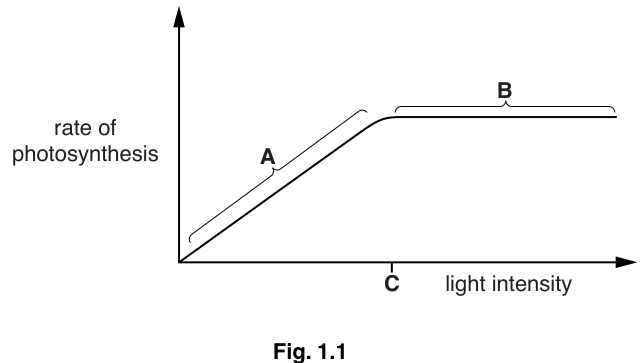
State the limiting factor in region A of the graph.
Answer
Light (intensity).
Light (intensity)
Background Concept
The rate of photosynthesis depends on several environmental factors — most importantly light intensity, carbon dioxide concentration and temperature. A graph of rate against light intensity has a characteristic shape: a linear rising portion at low light, followed by a plateau at higher light. On the linear portion, the rate is directly proportional to light intensity, which means light itself is the factor holding the rate back; every extra photon delivered to the chloroplasts allows another small increment in the rate of the light-dependent reactions. Once light is saturating, some other factor — usually CO₂ or temperature — takes over as the limit.
Understanding the Question
Fig. 1.1 shows a graph of rate of photosynthesis (y-axis) against light intensity (x-axis). Region A sits on the linear, rising part of the curve. Because the y-axis value changes in direct proportion to the x-axis value here, the candidate must identify which factor is responsible for the rate continuing to rise — i.e. which factor is limiting in region A.
Approach
On a rate-versus-light curve, the variable plotted on the x-axis is, by definition, the limiting factor wherever the curve is still rising. So the answer is the x-axis variable.
Step-by-Step Reasoning
- The x-axis is light intensity and the curve is rising in region A.
- When rate increases in direct proportion to light, it means more photons = more light-dependent reactions, so light is the constraint.
- Therefore, the limiting factor in region A is light (intensity).
Key Takeaways
- A factor is 'limiting' when an increase in it causes an increase in the rate of the process.
- The x-axis of a rate-vs-factor graph is the limiting factor on the rising portion.
Common Mistakes
- Writing 'sunlight' instead of 'light intensity' — the question requires the measurable variable.
- Naming CO₂ or temperature — these would be limiting only on the plateau (region B), not on the rising portion.
Things to Be Careful About
Accept 'light' on its own (the mark scheme allows it), but 'light intensity' is the most precise answer.
Explain what is meant by the term limiting factor.
Answer
When a process is affected by more than one factor, the factor that prevents any further increase in the rate of the process is the limiting factor.
When a process is affected by more than one factor, the factor that prevents any further increase in the rate of the process is the limiting factor.
Background Concept
'Limiting factor' is a generic idea in biology that applies wherever a process is driven by more than one ingredient. Photosynthesis needs light, CO₂, water, suitable temperature, and intact enzymes/chlorophyll. If any one of these is in short supply, it caps the overall rate, even when the others are abundant. The same idea applies to enzyme-catalysed reactions (substrate concentration is often limiting), to population growth (food, space, disease), and to the rate at which a person can do work (oxygen supply, glucose supply, etc.).
Understanding the Question
This is a 2-mark 'explain what is meant by' question on the term 'limiting factor'. Two distinct marking points are credited: (1) the situation (more than one factor affects the rate) and (2) the specific role of the limiting factor (it is the one that prevents any further increase). Both are required for full marks.
Approach
Construct a definition that names the multi-factor context first, then states the role of the limiting factor within that context. This mirrors the mark scheme's two points.
Step-by-Step Reasoning
- Photosynthesis (and most biological processes) are simultaneously affected by several factors — light, CO₂, temperature, water, etc.
- The factor that is in shortest supply, relative to need, is the one that determines how fast the process can run at that moment.
- So a limiting factor is the factor that, if increased, would raise the rate, but which currently prevents the rate from being any higher.
Key Takeaways
- A limiting factor is always identified relative to a process; you can only name it once you know what is in shortest supply.
- More than one factor must be capable of affecting the rate, otherwise there is nothing for the 'limit' to be a limit of.
Common Mistakes
- Giving only the second half ('the factor that prevents any further increase in rate') and missing the multi-factor context — loses one mark.
- Saying 'a factor that limits the rate' without specifying that an increase in it would raise the rate — too vague.
- Confusing 'limiting' with 'stopping' — the process is not halted, just held at a particular rate.
Things to Be Careful About
The two marks are independent; the candidate should not assume that one general statement covers both.
Explain why there is no further increase in the rate of photosynthesis beyond point C.
Answer
Beyond point C, some other factor becomes the limiting factor, for example carbon dioxide concentration (or temperature). This factor is now in shorter supply (relative to need) than light, so increasing light further cannot raise the rate.
Some other factor, e.g. carbon dioxide concentration or temperature, becomes limiting beyond point C.
Background Concept
The rate of photosynthesis is the result of two coupled stages: the light-dependent reactions in the thylakoid membranes and the light-independent reactions (Calvin cycle) in the stroma. The light-dependent reactions cannot run faster than the rate at which light is absorbed, but they also cannot run faster than the rate at which their products (ATP and reduced NADP) are consumed in the Calvin cycle. Likewise, the Calvin cycle is limited by the supply of CO₂, by rubisco activity (set by temperature), and by the supply of ATP and reduced NADP from the thylakoids. So the overall rate is set by whichever link in the chain is currently slowest.
Understanding the Question
Point C in Fig. 1.1 marks the light intensity at which the curve first reaches the plateau. From C onwards, raising the light intensity no longer raises the rate. The candidate has to explain, using the limiting-factor concept, why this happens and name an alternative factor that now governs the rate.
Approach
Recognise that on the plateau light is no longer the bottleneck — extra photons are arriving but cannot be used. Therefore some other factor in the system must now be the constraint. Give a specific, biologically reasonable example.
Step-by-Step Reasoning
- On the plateau, light is saturating — the light-dependent reactions have all the photons they can use.
- If light is no longer limiting, then something else in the system must be — otherwise the rate would keep rising.
- The most common other limiting factors under laboratory/field conditions are CO₂ concentration and temperature; both are biologically sensible and the mark scheme accepts either.
- Therefore: beyond C, another factor (e.g. CO₂ or temperature) becomes the limiting factor, and further increases in light intensity have no effect on the rate.
Key Takeaways
- A plateau on a rate-vs-factor graph means the plotted factor is no longer the limiting one.
- The two most commonly cited alternative limiting factors for photosynthesis are CO₂ concentration and temperature.
Common Mistakes
- Restating the limiting-factor definition without applying it to the graph — loses a mark.
- Naming a factor that is clearly not the bottleneck (e.g. 'water', without context — the candidate is rarely short of water in a standard experiment).
- Saying 'chlorophyll' — chlorophyll is a feature of the plant, not an environmental factor that is being varied.
Things to Be Careful About
The mark scheme requires both a general statement (some other factor becomes limiting) AND a named example. Either on its own scores one mark.
For many plants living in temperate regions, the optimum temperature for photosynthesis is approximately .
Suggest reasons why the rate of photosynthesis decreases at temperatures above .
Answer
- At temperatures above 25 °C, rubisco and other enzymes in the chloroplast begin to denature — their tertiary structure and active site are lost, so they can no longer bind substrate efficiently.
- This means less photolysis, less ATP (and reduced NADP) is produced in the light-dependent stage, and the Calvin cycle also slows because its enzymes (including rubisco) are denatured.
- Less carbon dioxide is therefore fixed into GP / triose phosphate, and the overall rate of photosynthesis falls.
- At the same time, high temperature increases transpiration, so the plant closes its stomata to conserve water; this reduces CO₂ uptake into the leaf, further lowering the rate of photosynthesis and causing loss of turgor (wilting). Photorespiration also increases at higher temperatures, wasting fixed carbon.
Enzymes/rubisco denature, so less ATP is made and less CO2 is fixed; stomata close to reduce transpiration, lowering CO2 uptake; photorespiration increases.
Background Concept
Photosynthesis depends on enzymes at several points: rubisco in the Calvin cycle, the ATP synthase and electron transport chain in the thylakoid membrane, and rubisco in oxygenation (photorespiration) versus carboxylation. All of these enzymes have a tertiary structure held by relatively weak bonds (hydrogen bonds, ionic interactions, hydrophobic interactions) that begin to break at high temperatures, distorting the active site so substrate can no longer bind — this is denaturation. Above the optimum (about 25 °C for temperate plants), the rise in kinetic energy is outweighed by the loss of functional enzyme. In addition, hot dry conditions force the plant to close its stomata to limit water loss, which simultaneously cuts off CO₂ supply to the mesophyll.
Understanding the Question
Part (b) gives the optimum (25 °C) and asks the candidate to suggest reasons why the rate falls above this. This is a 4-mark 'suggest' question with the mark scheme supplying eight distinct creditable points and a max of 4. The candidate must pick the most coherent chain (or strongest four independent points) and write them clearly. The instruction is 'suggest', so biological reasoning rather than experimental observation is required.
Approach
Start from the molecular cause (denaturation of the enzymes that run photosynthesis), then follow the consequences through both stages of photosynthesis, and finally add the stomatal/CO₂-uptake side-effect that compounds the problem.
Step-by-Step Reasoning
- Molecular cause: Above 25 °C, rubisco and other photosynthetic enzymes start to denature. Their tertiary structure is disrupted, the active-site shape is lost, and substrate can no longer bind effectively.
- Light-dependent stage: With denatured enzymes and (at extreme heat) damage to thylakoid membranes, photolysis produces less O₂ and the electron-transport chain makes less ATP and reduced NADP.
- Light-independent stage: Rubisco, which fixes CO₂ into GP, is also denatured; the Calvin cycle therefore fixes less CO₂ and produces less triose phosphate.
- Photorespiration: At higher temperatures, the oxygenase activity of rubisco increases relative to its carboxylase activity, so more glycolate is formed and CO₂ is released — net photosynthesis falls further.
- Stomatal side-effect: High temperature increases the rate of transpiration. To conserve water, the plant closes its stomata (via abscisic acid signalling). This reduces CO₂ diffusion into the leaf, lowering the substrate supply to the Calvin cycle and further reducing the rate.
- Wilting: Sustained stomatal closure and water loss lead to loss of turgor in the mesophyll, which lowers surface area for gas exchange and exacerbates the fall in photosynthesis.
The 4-mark solution should pick the most coherent chain. The combination shown in the solution (denaturation → less ATP/less CO₂ fixed; stomatal closure → less CO₂ uptake; photorespiration) covers the mark scheme's eight points using only four sentences.
Key Takeaways
- 'Above optimum' problems are usually enzyme-denaturation problems, not just kinetic ones.
- Photosynthesis has two stages linked by ATP and reduced NADP — damage to either drags the other down.
- Stomatal closure is a water-saving strategy with a photosynthetic cost; hot, dry weather is doubly bad for plants because both heat and water stress limit photosynthesis at once.
- Photorespiration is a temperature-dependent 'leak' in photosynthesis that becomes significant above ~25 °C in C3 plants.
Common Mistakes
- Saying only 'enzymes are denatured' without naming an enzyme or explaining the downstream effect on ATP production and CO₂ fixation.
- Confusing the high-temperature decrease with the low-temperature increase (which is purely kinetic — more collisions, more energy).
- Stating 'the stomata close because of low CO₂' — stomata close in response to water loss / abscisic acid, not because of CO₂.
- Forgetting that high temperature also leads to photorespiration; the O₂-using oxygenase activity of rubisco rises with temperature.
- Saying 'chlorophyll is destroyed' — chlorophyll is more heat-stable than enzymes, and this is not the principal reason for the fall.
Things to Be Careful About
- 'Suggest' questions accept any biologically valid reasoning; the candidate is not limited to the points on the mark scheme but should aim to hit the strongest ones.
- The mark scheme credits any four independent ideas from the list of eight; chaining ideas together (e.g. stomata close → less CO₂ uptake → less fixation) is an efficient way to score several marks at once.
- 'Photorespiration' (or the older term 'photo-respiration') is the specific term and is preferred to vague 'wasteful reaction'.
The rest of this paper
9 more questions- Q2Classification, Biodiversity and Conservation · Selection and Evolution16M
- Q3Control and Coordination8M
- Q4(outdated) Aspects of Human Reproduction · Inheritance · Selection and Evolution14M
- Q5Homeostasis7M
- Q6Control and Coordination · Homeostasis · Inheritance8M
- Q7Energy and Respiration15M
- Q8Inheritance8M
- Q9Genetic Technology15M
- Q10Genetic Technology15M