Biology 9700/53 — October/November 2015
Cambridge A-Level · Planning, Analysis and Evaluation · worked solutions for every part, with the mark scheme
Topics Planning · Analysis, Conclusions and Evaluation
Amylases are enzymes that hydrolyse starch. There are three types of amylase:
- -amylase hydrolyses glycosidic bonds randomly within amylose and amylopectin chains. It has an optimum pH of .
Hydrolysis releases saccharides made of varying numbers of glucose molecules, for example the disaccharide maltose, the trisaccharide maltotriose and short chain polymers made of eight to ten glucose units. - -amylase hydrolyses glycosidic bonds of both amylose and amylopectin releasing maltose. It has an optimum pH of .
- -amylase hydrolyses glycosidic bonds in amylopectin. It has an optimum pH of .
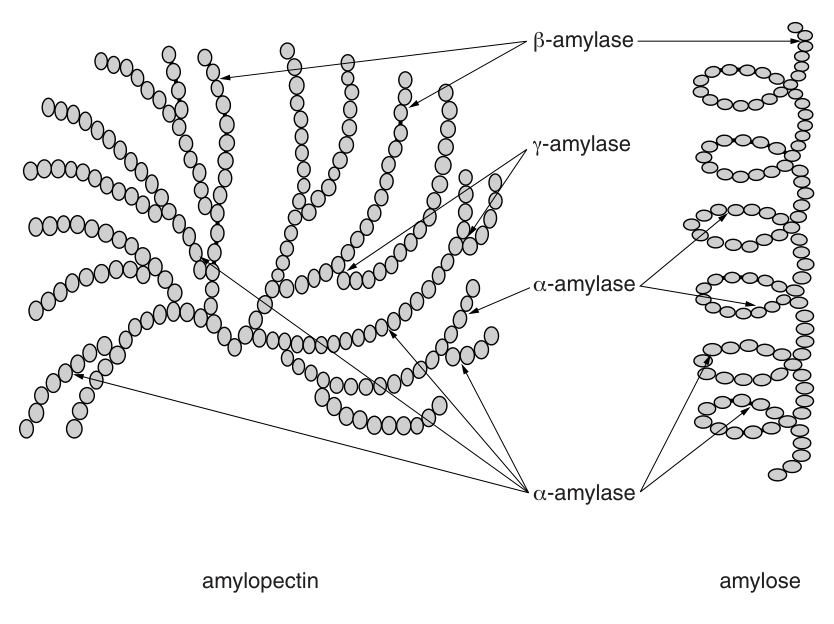
Fig. 1.1 shows some of the possible hydrolysis points of these enzymes in molecules of amylopectin and amylose.
A student investigated the effect of these enzymes on the hydrolysis of starch by incubating a starch suspension separately with each of the enzymes.
The mixtures were incubated for minutes to allow all the reactions to be completed.
- Each mixture of enzyme and starch was incubated at and at the optimum pH of each enzyme.
- After minutes, samples of each mixture were removed using a capillary tube.
- The products of hydrolysis of each mixture were separated by chromatography using the same solvent.
- The products of hydrolysis were located by spraying the chromatogram with the same specific dye.
Identify the independent variable in this investigation.
Identify three variables, other than the chromatography solvent and the specific dye, that the student has standardised in their investigation.
Describe how the student might have standardised two of these variables.
Suggest a control that the students could use for this investigation.
Describe a method that the student could use to prepare and use chromatograms to compare the changes in the products of hydrolysis of starch by the three different amylases over time.
Your method should be detailed enough for another person to follow.
Fig. 1.2 shows the chromatograms produced from each of the starch enzyme mixtures after minutes incubation.
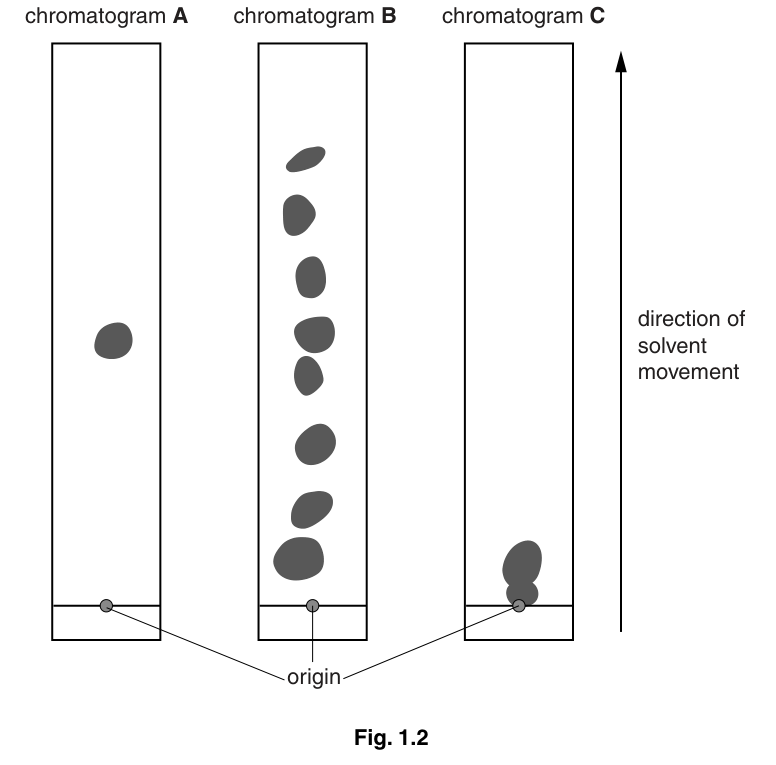
Use the information on page 2 to identify which type of amylase gave each of the results shown in chromatograms, A, B and C. Write your answers in Table 1.1.
Table 1.1
| chromatogram | A | B | C |
|---|---|---|---|
| type of amylase |
Explain how you decided which chromatogram showed the results of hydrolysing starch with each type of amylase.
The rest of this paper
1 more questions- Q2Planning · Analysis, Conclusions and Evaluation14M