Biology 9700/52 — October/November 2015
Cambridge A-Level · Planning, Analysis and Evaluation · worked solutions for every part, with the mark scheme
Topics Planning · Analysis, Conclusions and Evaluation
Protease enzymes catalyse the hydrolysis of protein. There are a number of different types of protease enzyme.
A student was provided with two proteases that hydrolyse the amino acid chains of protein in different ways, producing mixtures of single amino acids and peptides of varying lengths.
- An endoprotease that hydrolyses peptide bonds between specific amino acids within the protein molecule. The enzyme only functions if there is a minimum of two amino acids on each side of the hydrolysis site.
- An exoprotease that hydrolyses the terminal peptide bond of a molecule. The enzyme only functions if the substrate molecule has a minimum of three amino acids.
The student used these enzymes to hydrolyse a protein formed by the linking of two polypeptides.
Fig. 1.1 shows the possible hydrolysis sites of these two enzymes on this protein.
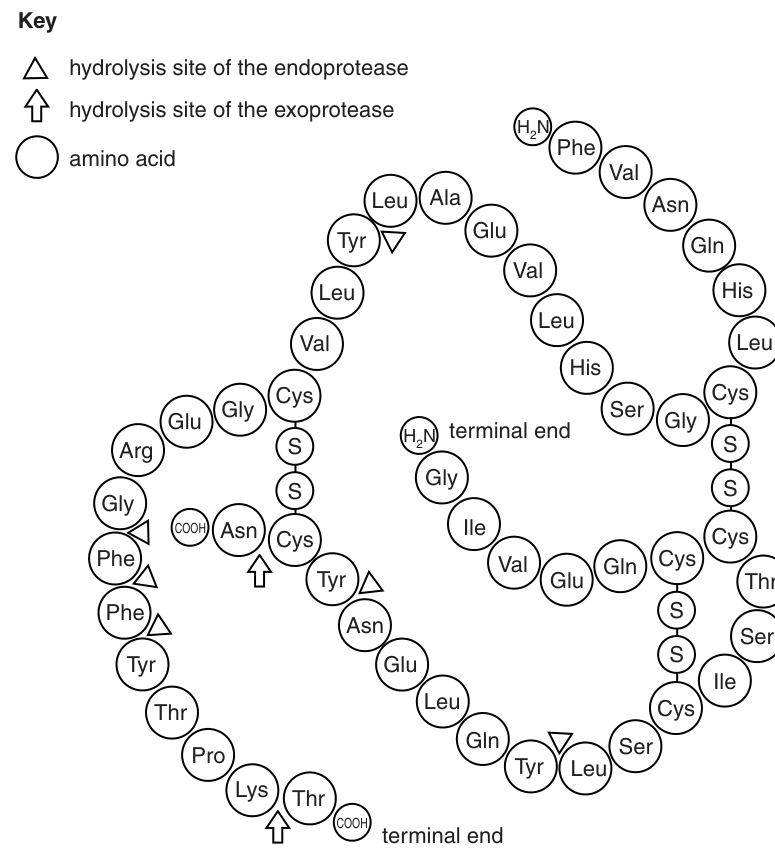
The student investigated the effect of these two enzymes on the hydrolysis of this protein by incubating the protein separately with each of the enzymes.
- Each mixture of enzyme and protein was incubated at and at a pH of 7.6.
- At intervals of 5 minutes, samples of each mixture were removed using a capillary tube.
- The products of hydrolysis of each mixture were separated by chromatography using the same solvent.
- The products of hydrolysis were located by spraying the chromatogram with the same specific dye.
- The student continued sampling every 5 minutes and running chromatograms for each mixture until hydrolysis of the protein was completed by each enzyme.
Identify the independent variable in this investigation.
Identify three variables, other than the chromatography solvent and the specific dye, that the student has standardised in this investigation.
Describe how the student might have standardised two of these variables.
Suggest how the student determined when the hydrolysis was complete.
Describe a method that the student could use to prepare and use chromatograms to compare the changes in the products of hydrolysis of the protein by the two different proteases over time.
Your method should be detailed enough for another person to follow.
Fig. 1.2 shows the appearance of the chromatograms at the times when hydrolysis by the different enzymes was complete.
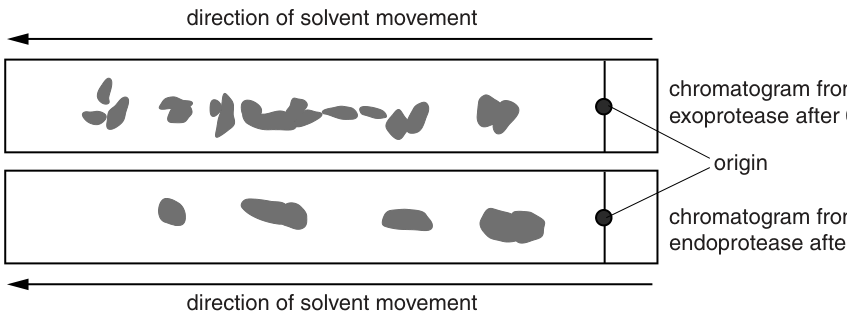
The student concluded that:
- The endoprotease worked faster than the exoprotease because fewer bonds were hydrolysed.
- The products of hydrolysis of the exoprotease were all single amino acids giving more spots on the chromatogram.
- The larger peptides released by the endoprotease have fewer charges and moved more slowly than single amino acids and small peptides.
- Hydrolysing the protein with a mixture of endoprotease and exoprotease would give the same results as for the exoprotease more quickly.
State and explain whether each of these conclusions about the hydrolysis of protein is supported or not supported by the evidence in Fig. 1.2 and the information in the question about these two enzymes.
conclusion 1 ______
conclusion 2 ______
conclusion 3 ______
conclusion 4 ______
Using an internet search the student found that:
- electrophoresis can also be used to separate the products of enzyme hydrolysis of proteins
- a combination of electrophoresis and chromatography was used to study haemoglobin from people with sickle cell anaemia (SCA).
In an investigation, the haemoglobin from people with SCA and people without the disease was hydrolysed by an endoprotease. The resulting mixture was placed centrally on one side of chromatography paper and separated by electrophoresis.
Negatively charged peptides moved to the anode (+) and positively charged peptides moved to the cathode (–). The paper was turned through and chromatography used to separate the mixture.
Fig. 1.3 shows the main stages of this experiment.
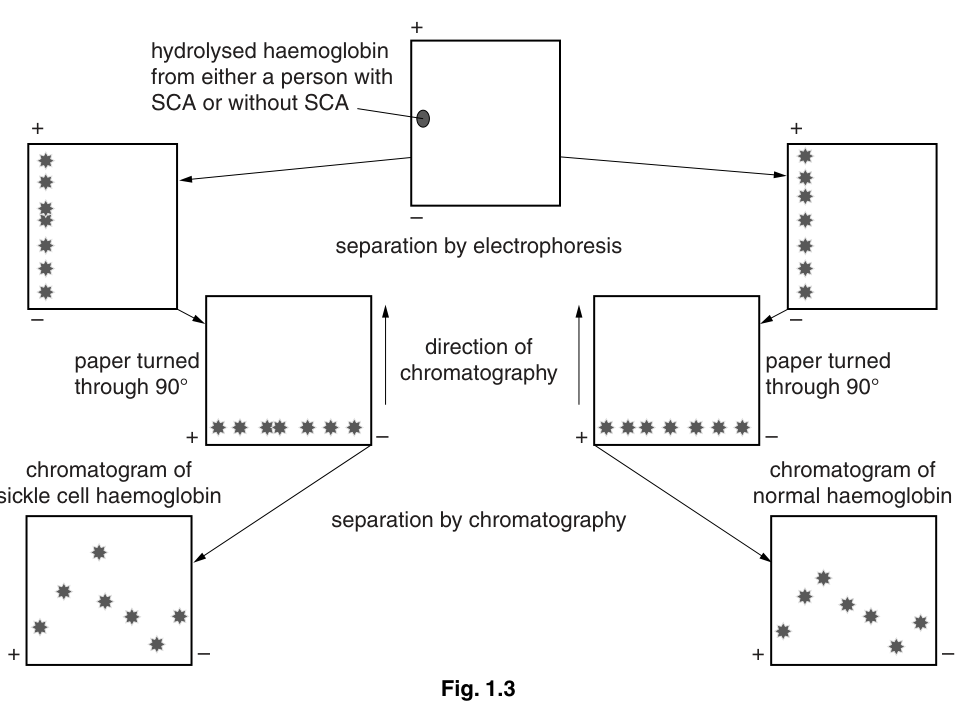
Sickle cell haemoglobin and normal haemoglobin have a difference in amino acid sequence.
On Fig. 1.3, draw a circle around the spot in each chromatogram that shows that the two types of haemoglobin have different amino acid sequences.
Explain your answer to (i).
The rest of this paper
1 more questions- Q2Planning · Analysis, Conclusions and Evaluation11M