Biology 9700/43 — October/November 2015
Cambridge A-Level · A Level Structured Questions · worked solutions for every part, with the mark scheme
Topics Inheritance · Genetic Technology · Homeostasis · Energy and Respiration · (outdated) Biotechnology · Selection and Evolution · +4 more
Yeast cells sometimes carry out anaerobic respiration.
Fig. 1.1 outlines the process of anaerobic respiration in yeast cells.
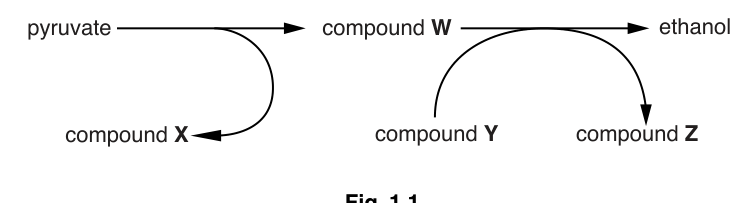
Identify compounds W, X and Y.
W = ______
X = ______
Y = ______
State two differences between anaerobic respiration in yeast cells and anaerobic respiration in human muscle cells.
Dinitrophenol (DNP) is a compound used as a herbicide. DNP inhibits respiration by interfering with the formation of the proton gradient between mitochondrial membranes.
When DNP was added to isolated mitochondria the following observations were made:
- fewer ATP molecules were produced
- more heat energy was released
- the uptake of oxygen remained constant.
Suggest explanations for these observations.
fewer ATP molecules produced
more heat energy released
constant oxygen uptake
The rest of this paper
9 more questions- Q2(outdated) Biotechnology15M
- Q3Selection and Evolution · Inheritance10M
- Q4Genetic Technology10M
- Q5Classification, Biodiversity and Conservation10M
- Q6Homeostasis8M
- Q7Photosynthesis · Homeostasis15M
- Q8Inheritance9M
- Q9(outdated) Aspects of Human Reproduction15M
- Q10(outdated) Crop Plants · Genetic Technology15M