Biology 9700/42 — October/November 2015
Cambridge A-Level · A Level Structured Questions · worked solutions for every part, with the mark scheme
Topics Selection and Evolution · Control and Coordination · Inheritance · Energy and Respiration · (outdated) Biotechnology · Genetic Technology · +4 more
The molecules listed below are all associated with respiration.
| ATP synthase | glucose | ATP | NAD |
| oxaloacetate | pyruvate | citrate | oxygen |
From these molecules identify:
a phosphorylated nucleotide ______
a 3-carbon compound ______
a coenzyme ______
an enzyme ______
Answer
- A phosphorylated nucleotide: ATP
- A 3-carbon compound: pyruvate
- A coenzyme: NAD
- An enzyme: ATP synthase
ATP; pyruvate; NAD; ATP synthase
Background Concept
Respiration (aerobic and anaerobic) involves a defined set of molecules, each with a specific role. ATP is the universal energy currency of the cell — it is a ribonucleotide whose sugar (ribose) carries three phosphate groups, two of which are high-energy phosphoanhydride bonds. When the terminal phosphate is hydrolysed, the energy released drives endergonic cellular work, so ATP is correctly described as a phosphorylated nucleotide.
Glycolysis splits the 6-carbon glucose into two molecules of pyruvate (CH3-CO-COO⁻), a 3-carbon compound that is the link between glycolysis in the cytoplasm and the aerobic stages in the mitochondrion.
NAD (nicotinamide adenine dinucleotide) is a coenzyme — a small, non-protein organic molecule that carries electrons (and a hydrogen) from one reaction to another. During glycolysis, the link reaction and the Krebs cycle, NAD is reduced to NADH (or written as reduced NAD). Coenzymes are not consumed: they cycle between oxidised and reduced forms.
ATP synthase is a large, membrane-bound enzyme complex (in the inner mitochondrial membrane in eukaryotes, in the plasma membrane of respiring bacteria and in the thylakoid membrane in chloroplasts) that uses the proton gradient generated by the electron transport chain to phosphorylate ADP + Pi to ATP. The suffix "-ase" marks it as an enzyme.
Understanding the Question
The question provides a list of eight respiration-related molecules and asks for four categorisations: a phosphorylated nucleotide, a 3-carbon compound, a coenzyme and an enzyme. Only one molecule from the list fits each category, so the task is single-match selection.
Approach
Mentally classify each listed molecule:
- ATP — ribonucleotide with three phosphates ⇒ phosphorylated nucleotide.
- Glucose — a 6-carbon sugar, not phosphorylated in the nucleotide sense (and is a substrate, not a nucleotide).
- ATP is also high-energy, but it cannot double up with the coenzyme slot.
- NAD — a dinucleotide that carries H/electrons ⇒ coenzyme.
- Oxaloacetate — a 4-carbon Krebs-cycle intermediate; not asked for here.
- Pyruvate — CH3-CO-COO⁻, 3 carbons ⇒ 3-carbon compound.
- Citrate — a 6-carbon Krebs-cycle intermediate.
- Oxygen — the terminal electron acceptor of the electron transport chain; not asked for here.
- ATP synthase — protein catalyst with the enzyme suffix ⇒ enzyme.
Step-by-Step Reasoning
- Phosphorylated nucleotide — the only nucleotide in the list is ATP, which has three phosphate groups attached to its ribose sugar. ATP.
- 3-carbon compound — pyruvate has 3 carbons; oxaloacetate has 4, citrate has 6 and glucose has 6. Pyruvate.
- Coenzyme — NAD is the only coenzyme in the list (the others are substrates, intermediates or the terminal electron acceptor). NAD.
- Enzyme — ATP synthase is the only enzyme (its name ends in -ase). ATP synthase.
Key Takeaways
- ATP is a phosphorylated ribonucleotide and the immediate energy currency of the cell.
- Pyruvate is the 3-carbon product of glycolysis and the gateway to aerobic (or anaerobic) pathways.
- NAD is a coenzyme that shuttles reducing equivalents (H + e⁻) between reactions.
- ATP synthase is an enzyme that makes ATP using a proton-motive force (chemiosmosis).
- The ending "-ase" is a strong clue that a molecule name refers to an enzyme.
Common Mistakes
- Naming glucose as a phosphorylated nucleotide — glucose is a phosphorylated sugar in metabolism, but it is not a nucleotide at all.
- Naming NAD as an enzyme — NAD is a coenzyme, not a protein catalyst.
- Naming oxaloacetate as the 3-carbon compound — it has 4 carbons; only pyruvate (3 C) fits.
- Confusing ATP (a nucleotide) with ATP synthase (the enzyme that makes it).
Things to Be Careful About
The mark scheme awards one mark per correct identification, so each must be matched precisely. Do not write "ADP" or "NADP" instead of ATP/NAD — they are not in the list. Be careful that "pyruvate" is spelt in full (not "pyruvic acid" or "pyruvate ion") as the mark scheme accepts "pyruvate".
A sample of tree sap, rich in sugars, was found to be contaminated with yeast. This sample was tested for the concentration of ethanol at regular intervals.
The results are shown in Fig. 1.1.
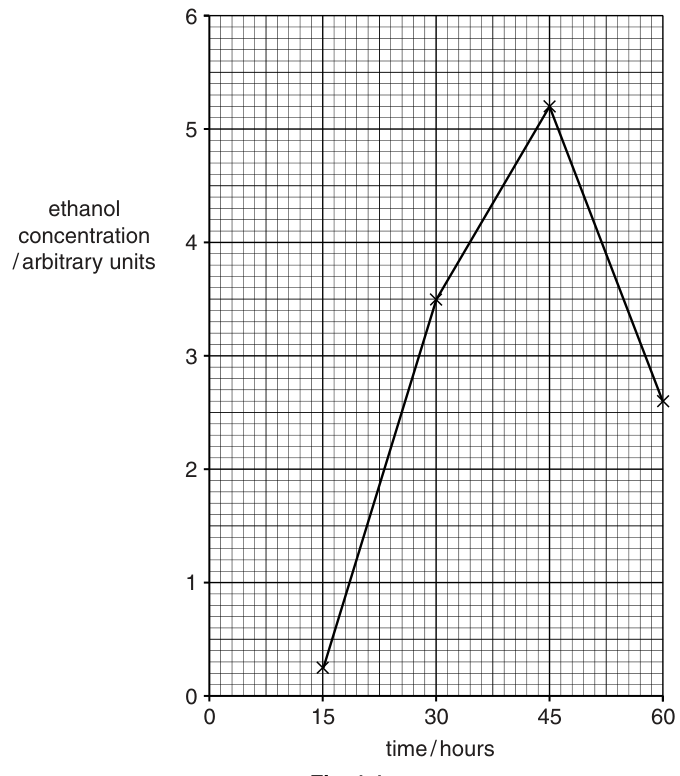
Calculate the percentage increase in ethanol concentration between 15 and 45 hours.
Show your working.
answer = ______
Working
Read the y-values from Fig. 1.1:
- at 15 h: ethanol concentration = arbitrary units
- at 45 h: ethanol concentration = arbitrary units
Answer
1980 %
1980%
Background Concept
Percentage change expresses the difference between two values as a fraction of the starting (initial) value, then multiplies by 100 to convert to a percentage. The formula is:
The result is positive for an increase and negative for a decrease. This kind of calculation is common in respiration and photosynthesis data-handling questions where rates of gas exchange or product formation are tracked over time.
Understanding the Question
A line graph (Fig. 1.1) plots ethanol concentration in a yeast-contaminated sugar sample against time, with data points at 15, 30, 45 and 60 hours. The candidate must read the y-values at 15 h and 45 h, then compute the percentage rise in ethanol between those two times. The answer must be expressed as a percentage.
Approach
- Read the y-value of the data point at 15 h — the lowest "x" mark, just above the x-axis, at approximately arbitrary units.
- Read the y-value of the data point at 45 h — the highest point of the curve, at arbitrary units.
- Substitute into the percentage-change formula and evaluate.
Step-by-Step Reasoning
- At 15 h: the data point lies between gridlines 0.2 and 0.3, very close to 0.25. The mark scheme uses as the accepted reading.
- At 45 h: the data point is plotted exactly on the gridline at (between 5.0 and 5.5, on the 0.2 subdivision).
- Difference: arbitrary units.
- Divide by initial value: .
- Multiply by 100: %.
The mark scheme awards 1 mark for correctly setting up the calculation (or equivalently ) and a second mark for the final answer 1980. Error carried forward (ecf) applies if a candidate misreads the 15 h value but then substitutes it consistently.
Key Takeaways
- Always read graph values against the y-axis gridlines carefully — here, the 0.25 is a sub-gridline reading rather than a major line.
- Percentage change uses the original (initial) value as the denominator, not the new value or the mean.
- Always quote the unit (%) with a percentage answer.
- CIE accepts ecf: an incorrect graph read is forgiven if the rest of the working is consistent.
Common Mistakes
- Reading 15 h as 0.2 (the nearest major gridline) and so getting % — close, but not what the gridline subdivisions give.
- Dividing by the final value (5.2) instead of the initial value (0.25) — a wrong formula.
- Forgetting to multiply by 100, giving the answer as 19.8.
- Not including the % sign.
Things to Be Careful About
- The y-axis is labelled "arbitrary units" — the answer is therefore still expressed as a percentage, because the initial and final values are in the same units and cancel.
- The 15 h data point is slightly above the 0.2 gridline; reading it requires looking at the small subdivisions. A common acceptable reading is 0.2–0.3; the mark scheme uses 0.25 specifically.
Suggest why the concentration of ethanol decreased after 45 hours.
Answer
Ethanol evaporated (from the sample) ;
or
(Another) microorganism metabolised / used up the ethanol as a substrate .
ethanol evaporated (or other microorganism metabolises ethanol)
Background Concept
Ethanol (CH3CH2OH) is a small, volatile, polar molecule. It has a relatively low boiling point (78 °C) and a high vapour pressure at room temperature, so an open or partially open aqueous solution loses ethanol to the atmosphere by evaporation. Many microorganisms — including some bacteria (e.g. Acetobacter) and certain yeasts themselves — can use ethanol as a respiratory substrate, oxidising it first to acetaldehyde and then to acetate, which enters the Krebs cycle.
Understanding the Question
The graph shows ethanol concentration peaking at 45 h and then falling sharply to 60 h. The candidate must give one plausible biological or chemical reason for this decrease.
Approach
Think of two broad categories of explanation:
- Physical loss of ethanol from the system (evaporation into the air).
- Biological consumption of ethanol by another organism in the sample (e.g. ethanol-oxidising bacteria, or other yeasts switching back to aerobic respiration once the sugar runs out).
Either earns the mark. Avoid vague answers such as "the reaction stopped" (which is wrong — the reaction is still occurring, but the rate of loss now exceeds the rate of production) or "the yeast died" (which is too specific without evidence).
Step-by-Step Reasoning
- After 45 h the sugar in the sap is largely depleted, so yeast fermentation slows and ethanol is no longer being made as fast.
- Meanwhile ethanol continues to leave the system: it evaporates because it is volatile, and/or it is consumed by other microbes (e.g. bacteria that can respire ethanol) that were present in the contaminated sample.
- Net effect: the ethanol concentration falls.
Key Takeaways
- A decrease in product concentration on a time graph needs a loss route (physical or biological), not just a halt in production.
- Ethanol is volatile — it can leave an aqueous solution at room temperature.
- Many microorganisms can use ethanol as a respiratory substrate.
- "Suggest" questions accept any biologically plausible reason, but each reason must be specific.
Common Mistakes
- "The yeast died" — possible, but without evidence; the mark scheme prefers an explicit loss mechanism.
- "The reaction stopped" — the reaction is continuing; the concentration is just falling because loss now exceeds production.
- "The ethanol turned back into sugar" — reverse reaction does not occur; the pathway is essentially irreversible under cellular conditions.
- Vague answers such as "because of the time" or "the concentration changed" — these are not biological explanations.
Things to Be Careful About
- Only one mark is available, so the candidate needs just one clear, specific reason. Either "ethanol evaporated" or "another microorganism metabolises ethanol" is sufficient.
The rest of this paper
9 more questions- Q2(outdated) Biotechnology15M
- Q3Genetic Technology · Selection and Evolution8M
- Q4Selection and Evolution · Control and Coordination · Inheritance16M
- Q5Classification, Biodiversity and Conservation8M
- Q6Control and Coordination8M
- Q7Photosynthesis14M
- Q8Inheritance · Selection and Evolution9M
- Q9(outdated) Aspects of Human Reproduction15M
- Q10(outdated) Crop Plants15M