Biology 9700/53 — May/June 2015
Cambridge A-Level · Planning, Analysis and Evaluation · worked solutions for every part, with the mark scheme
Topics Analysis, Conclusions and Evaluation · Planning
The information on the label of a bottle of one brand of cleaning solution for contact lenses states that it contains enzymes which remove protein from contact lenses.
The instructions for using the solution state that:
- The cleaning solution should be poured into the cleaning pot provided up to the marked level.
- The contact lenses should be left in the cleaning solution for a minimum of four hours.
- Before using the lenses, they should be washed in a sterile saline (sodium chloride) solution.
The contents of the solution are:
- Subtilisin A, a protease with an optimum temperature of and an optimum pH of .
- Buffered saline, a physiological solution with the same 'balance of ions' as body fluids.
- Disodium EDTA, a preservative.
A student was asked to find out the actual concentration of the protease present in the contact lens cleaning solution.
The student found a web site that gave the concentration of subtilisin A in different brands of contact lens cleaning solutions. These range between and .
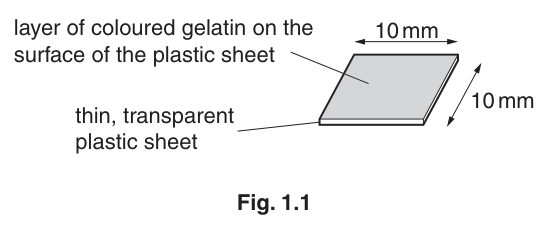
The student simulated a dirty contact lens using the protein gelatin and a thin transparent plastic sheet. One side of the plastic sheet was dipped into melted gelatin containing a dye. The gelatin was then allowed to set.
Fig. 1.1 shows a simulated contact lens.
The student tested the activity of subtilisin A by recording the time taken for the coloured gelatin to be removed, leaving the transparent plastic sheet.
Fig. 1.2 shows the apparatus the student used.
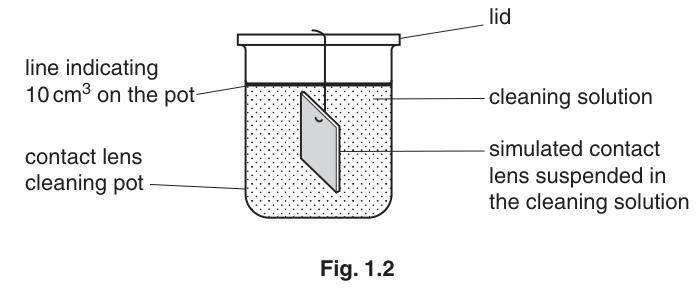
Table 1.1 shows the results of trials to find the time taken for the coloured gelatin to be removed by the cleaning solution at .
Table 1.1
| trial | 1 | 2 | 3 |
|---|---|---|---|
| time / minutes | 35 | 50 | 40 |
The student noticed that there was a large variation in the results. This may be because it was difficult to know when to stop the stopwatch.
Suggest two problems in deciding when to stop the stopwatch in this investigation.
-
______
-
______
The student made a stock cleaning solution containing of subtilisin A, disodium EDTA and a buffered saline solution. The disodium EDTA and the buffered saline solution were the same concentrations as used in the trials.
This solution was used to make a range of concentrations that could be used to find the concentration of subtilisin A in the contact lens cleaning solution.
Describe how the student could dilute the stock solution to make a range of concentrations to use in their investigation. The student decided to make of each concentration.
State a solution the student should use as a control. Give a reason for your answer.
control solution = ______
reason = ______
The student used the apparatus shown in Fig. 1.2 to investigate the effect of different concentrations of subtilisin A on the rate of removal of coloured gelatin from the simulated lenses at .
Identify the independent and dependent variables in this investigation.
independent variable = ______
dependent variable = ______
Describe a method the student could use to find the effect of different concentrations of subtilisin A on the removal of protein from the simulated lenses.
Your method should be detailed enough for another person to follow and should not repeat any details from (b) (i) of how to dilute the stock cleaning solution.
The student plotted a graph of the results.
Complete Fig. 1.3 by adding labels for the axes, including units, and by showing the expected shape of the curve.
Describe how the student would use this graph to find the actual concentration of subtilisin A in the contact lens cleaning solution.
The rest of this paper
1 more questions- Q2Planning · Analysis, Conclusions and Evaluation11M