Biology 9700/42 — May/June 2015
Cambridge A-Level · A Level Structured Questions · worked solutions for every part, with the mark scheme
Topics Energy and Respiration · Genetic Technology · Inheritance · Classification, Biodiversity and Conservation · Selection and Evolution · Photosynthesis · +4 more
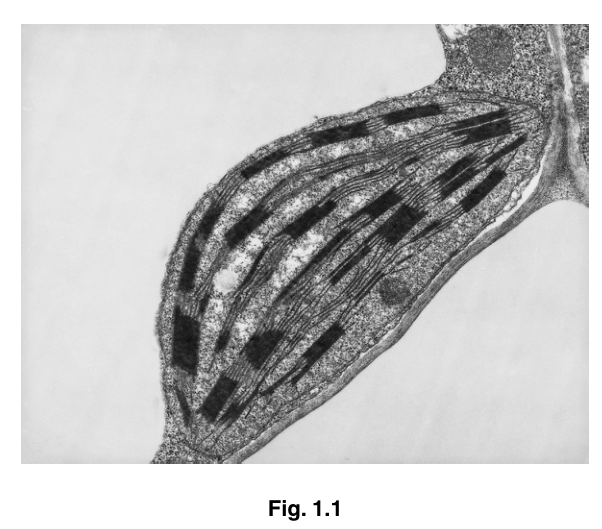
Fig. 1.1 shows an electronmicrograph of a chloroplast.
On Fig. 1.1, use label lines and letters to label one place where:
L – the light-dependent stage takes place
R – the enzyme rubisco is found.
Chloroplasts can move within palisade cells.
Suggest two advantages of chloroplast movement within palisade cells.
Complete the following paragraph by naming the most suitable compounds to fill in the gaps.
Rubisco is involved in the fixation of ______ by RuBP (ribulose bisphosphate) in the Calvin cycle. The resulting six carbon compound immediately splits to give two molecules of glycerate-3-phosphate (GP). GP is converted to triose phosphate (TP) using ______ and ______ produced in the light-dependent stage. Some of the TP produced is used to regenerate ribulose bisphosphate so that the Calvin cycle can continue. The remaining TP may be used to synthesise other compounds including ______ which can directly enter the Krebs cycle.
The rest of this paper
9 more questions- Q2(outdated) Aspects of Human Reproduction · Genetic Technology · Inheritance14M
- Q3(outdated) Crop Plants · Classification, Biodiversity and Conservation9M
- Q4Selection and Evolution · Classification, Biodiversity and Conservation14M
- Q5Control and Coordination9M
- Q6Selection and Evolution8M
- Q7Energy and Respiration15M
- Q8Inheritance8M
- Q9Genetic Technology15M
- Q10(outdated) Biotechnology15M