Biology 9700/41 — May/June 2015
Cambridge A-Level · A Level Structured Questions · worked solutions for every part, with the mark scheme
Topics Control and Coordination · Inheritance · Photosynthesis · (outdated) Biotechnology · Genetic Technology · Selection and Evolution · +4 more
Fig. 1.1 shows a section through part of a dicotyledonous leaf of the tea plant Camellia sinensis.
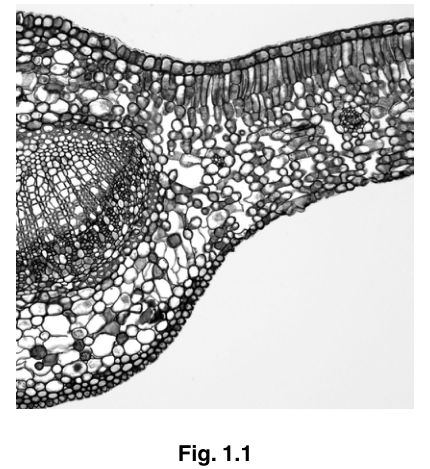
On Fig. 1.1, use label lines and letters to label each of the following parts:
X – xylem tissue
P – palisade mesophyll tissue.
The leaves of C. sinensis have a large surface area and are thin.
Explain how each of these two features help the leaf to carry out photosynthesis.
The lower epidermis contains stomata.
State one structural difference between a guard cell and other lower epidermal cells.
Abscisic acid has an important role in the closure of a stoma. It promotes the loss of potassium ions from guard cells.
Outline how the loss of potassium ions from guard cells will lead to the closure of a stoma.
The rest of this paper
9 more questions- Q2Control and Coordination · (outdated) Biotechnology · Genetic Technology · (outdated) Aspects of Human Reproduction · Selection and Evolution14M
- Q3Selection and Evolution · Inheritance9M
- Q4Classification, Biodiversity and Conservation · Control and Coordination15M
- Q5Inheritance · Classification, Biodiversity and Conservation8M
- Q6Control and Coordination8M
- Q7Energy and Respiration · Photosynthesis15M
- Q8Inheritance8M
- Q9Genetic Technology15M
- Q10(outdated) Biotechnology15M