Biology 9700/53 — October/November 2014
Cambridge A-Level · Planning, Analysis and Evaluation · worked solutions for every part, with the mark scheme
Topics Planning · Analysis, Conclusions and Evaluation
Many people are intolerant to the disaccharide lactose, which is found in milk.
The enzyme lactase is used commercially to catalyse the breakdown of lactose to the monosaccharides glucose and galactose. These sugars taste sweeter and are easier to digest than lactose.
Enzymes can be immobilised in a number of different ways, using different materials.
Fig. 1.1 shows three ways of immobilisation of enzymes.
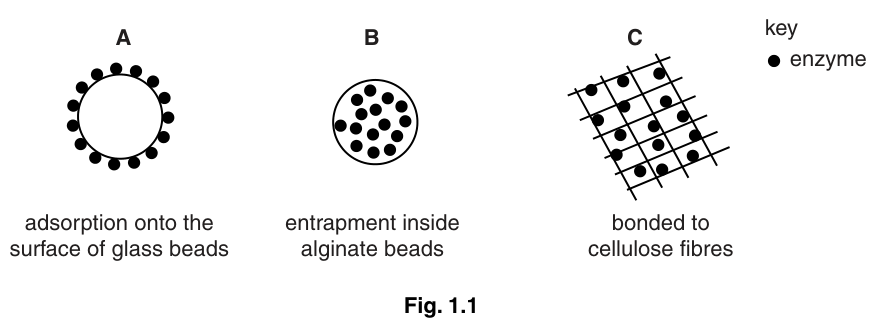
A student carried out an investigation to compare the activity of the enzyme lactase that had been immobilised in the three different ways shown in Fig. 1.1.
- A solution containing of lactose was poured through a column containing the immobilised enzyme.
- The solution containing the products was collected and the concentration of glucose measured.
State a null hypothesis that the student could make for this investigation.
State the independent variable in this investigation.
Suggest how the dependent variable might be measured.
Outline a procedure the student could use to compare the activity of lactase that has been immobilised in different ways.
Your method should be detailed enough for another person to use.
Table 1.1 shows the student’s results.
Table 1.1
| way of immobilisation | |||
|---|---|---|---|
| A: adsorption onto the surface of glass beads | B: entrapment inside alginate beads | C: bonded to cellulose fibres | |
| mean volume of solution containing product / | 21 | 25 | 20 |
| mean glucose concentration / | 15 | 10 | 12 |
| mean total glucose collected / | 250 |
Complete Table 1.1 by calculating the mean total glucose collected for A and C.
State the other two pieces of information that are required to calculate the rate of hydrolysis of lactose by these immobilised enzymes.
Table 1.2 shows the results of a number of statistical tests to find out if the differences in the rates of reaction were significant.
Table 1.2
| statistical tests carried out between different ways of immobilisation | ||
|---|---|---|
| A and B | A and C | B and C |
| significant at | significant at | not significant at |
State what is meant by ‘significant at ’.
The student concluded that immobilising lactase by adsorption onto the surface of glass beads (A) has a greater activity than either of the other ways of immobilising the enzyme.
With reference to Table 1.1 and Table 1.2, state the evidence that supports this conclusion.
The rest of this paper
1 more questions- Q2Analysis, Conclusions and Evaluation · Planning13M