Biology 9700/52 — October/November 2014
Cambridge A-Level · Planning, Analysis and Evaluation · worked solutions for every part, with the mark scheme
Topics Planning · Analysis, Conclusions and Evaluation
The enzyme ethanol dehydrogenase occurs in a wide variety of organisms. It is able to catalyse a reversible reaction that converts ethanol to ethanal or ethanal to ethanol.
Ethanol is toxic and in some tissues the ethanol can be converted to ethanal and then to ethanoate (acetate) which is used as an energy source.
Fig. 1.1 shows these reactions.
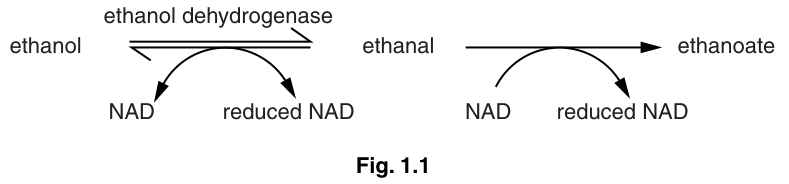
In industry ethanol is converted to ethanal, which is used to make a variety of compounds, such as dyes, flavourings and perfumes.
A student carried out an investigation to find out if the activity of immobilised ethanol dehydrogenase differed from that of non-immobilised (free) ethanol dehydrogenase.
The student:
- immobilised a ethanol dehydrogenase solution
- used both the and the ethanol at concentrations of
- used methylene blue as an indicator of enzyme activity. Methylene blue becomes colourless when oxidised
- measured the time for methylene blue to become colourless.
Identify the independent and dependent variables in this investigation.
independent = ______
dependent = ______
Outline how the student could immobilise the enzyme ethanol dehydrogenase.
Suggest a suitable control for this investigation.
Describe a method the student could use to find the activity of the immobilised and free ethanol dehydrogenase.
Assume that the immobilisation traps all of the available enzyme from the solution.
Your method should be detailed enough for another person to use.
The results of the student’s investigation are shown in Table 1.1.
Table 1.1
| rate of reaction / arbitrary units | ||||
|---|---|---|---|---|
| experimental | control | |||
| free enzyme | immobilised enzyme | free enzyme | immobilised enzyme | |
Describe how the student could calculate the rate of reaction, taking into account the results of the control experiments.
State what standard deviation () shows about the results of this investigation.
The student carried out a statistical test to find out if the difference in the rate of reaction between the immobilised and free enzyme was significant.
The results were significant at . Explain what this means.
The rest of this paper
1 more questions- Q2Planning · Analysis, Conclusions and Evaluation11M