Biology 9700/51 — October/November 2014
Cambridge A-Level · Planning, Analysis and Evaluation · worked solutions for every part, with the mark scheme
Topics Planning · Analysis, Conclusions and Evaluation
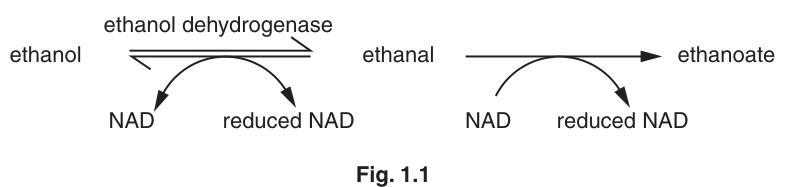
The enzyme ethanol dehydrogenase occurs in a wide variety of organisms. It is able to catalyse a reversible reaction that converts ethanol to ethanal or ethanal to ethanol.
Ethanol is toxic and in some tissues the ethanol can be converted to ethanal and then to ethanoate (acetate) which is used as an energy source.
Fig. 1.1 shows these reactions.
In industry ethanol is converted to ethanal, which is used to make a variety of compounds, such as dyes, flavourings and perfumes.
A student carried out an investigation to find out if the activity of immobilised ethanol dehydrogenase differed from that of non-immobilised (free) ethanol dehydrogenase.
The student:
- immobilised a ethanol dehydrogenase solution
- used both the and the ethanol at concentrations of
- used methylene blue as an indicator of enzyme activity. Methylene blue becomes colourless when oxidised
- measured the time for methylene blue to become colourless.
Identify the independent and dependent variables in this investigation.
independent = ______
dependent = ______
Answer
independent = (type of enzyme) free or immobilised (ethanol dehydrogenase)
dependent = time for methylene blue to decolourise (become colourless)
independent = free or immobilised enzyme; dependent = time for methylene blue to become colourless
Background Concept
In any experiment the independent variable is the one the experimenter deliberately changes between trials, while the dependent variable is the one that is measured to record the effect of that change. Every other factor (concentrations, volumes, temperature, pH) must be held constant so that any difference in the dependent variable can be attributed to the independent variable.
In this investigation the student is comparing two physical forms of the same enzyme, so the independent variable is the physical state of the enzyme. The measurement they take is the time taken for the methylene blue indicator to lose its colour, which is the dependent variable. Note that time (not rate) is what is actually measured; rate is then derived from it.
Understanding the Question
The student has set up a comparison between free and immobilised ethanol dehydrogenase. Everything else (NAD concentration, ethanol concentration, methylene blue concentration, enzyme concentration before immobilisation) has been fixed by the procedure described in the stem. The question asks you to name what is varied (independent) and what is measured (dependent).
Approach
Read the stem and identify: (1) the one factor that is deliberately different between the two trials — that is the independent variable; (2) the quantity that the student records with the stop clock — that is the dependent variable.
Step-by-Step Reasoning
- The two conditions being compared are "free enzyme" vs. "immobilised enzyme", so the independent variable is the type/state of the enzyme.
- The student uses a stop clock/timer to record when methylene blue turns colourless; this is a measurement of time. Time is the dependent variable.
- The mark scheme specifically rejects "rate" as a description of the dependent variable, because rate is a derived quantity (1/time) and the student does not directly measure rate.
Key Takeaways
- The independent variable is what you change; the dependent variable is what you measure.
- Time is a directly measured quantity; rate is derived from it.
- Vague phrasings such as "amount of enzyme" or "enzyme concentration" are wrong here because these were not varied — the same 1 mg dm⁻³ solution was used to make both preparations.
Common Mistakes
- Writing "amount of enzyme" — the concentration was the same; only the form (free vs immobilised) differed.
- Writing "rate of reaction" as the dependent variable — rejected by the mark scheme because rate is calculated, not measured.
- Writing "colour change" without specifying that it is the time taken for the colour to change that is being recorded.
Things to Be Careful About
- Use the CIE wording: "decolourise" (or "become colourless") for what methylene blue does; "time" must be explicit.
- The independent variable must refer to the form of the enzyme (free/immobilised), not to the enzyme itself.
Outline how the student could immobilise the enzyme ethanol dehydrogenase.
Answer
- Mix the (1 mg dm⁻³) ethanol dehydrogenase solution with (sodium) alginate.
- Add the alginate–enzyme mixture dropwise into calcium chloride (solution), e.g. using a syringe or pipette, so that beads form.
- The beads contain the trapped enzyme and can be collected and rinsed.
Mix enzyme with alginate; add (dropwise) to calcium chloride to form beads (e.g. using a syringe/pipette).
Background Concept
Enzymes can be immobilised by trapping them inside an insoluble, porous matrix. One common CIE method uses sodium alginate: when a solution of sodium alginate is dropped into a solution of calcium chloride, the calcium ions replace the sodium ions and cross-link the alginate polymer, forming insoluble calcium alginate beads. Enzyme molecules inside the droplets become trapped in the gel lattice while substrates and products can still diffuse in and out, so the enzyme remains catalytically active and can be reused.
Understanding the Question
The stem says the student "immobilised" the ethanol dehydrogenase solution. You are asked to outline how this is done in enough detail that another person could repeat it. Three marks are available for the key procedural points.
Approach
Identify the three essential steps that the mark scheme rewards: (1) mixing with alginate, (2) contacting with calcium chloride, (3) a method of producing the droplets (beads).
Step-by-Step Reasoning
- Step 1 — Make a sodium alginate solution (typically 2–3 %) and mix it with the enzyme solution so that the enzyme is uniformly distributed.
- Step 2 — Prepare a calcium chloride solution (typically around 1–3 %) in a beaker.
- Step 3 — Draw the alginate/enzyme mixture into a syringe (or pipette) and squeeze/drop it into the calcium chloride. Each drop forms a bead as the calcium ions cross-link the alginate. After a few minutes the beads harden and can be collected and rinsed.
The mark scheme credits these three points and accepts Ca²⁺/calcium ions for calcium chloride and "syringe or pipette" (or even "dropper") for the method of forming beads. Specific concentrations are not required and are ignored if given.
Key Takeaways
- The standard CIE immobilisation technique is alginate beads set in calcium chloride.
- Only three key ideas are needed: alginate, calcium chloride, a method of producing droplets.
- The beads are porous: substrates/products can diffuse in and out, but the enzyme stays trapped.
Common Mistakes
- Writing "add calcium chloride to alginate" without specifying dropwise — the beads only form if the alginate enters the calcium chloride as discrete droplets.
- Omitting the mixing step and going straight to "add to calcium chloride".
- Suggesting a different method (e.g. adsorption on to a surface, entrapment in gelatine, covalent bonding) — these are valid but the question's wording "immobilise a 1 mg dm⁻³ solution" and the mark scheme both expect the alginate/calcium chloride route.
- Including glass beads as an immobilisation method — glass beads alone are not an immobilisation technique in this context.
Things to Be Careful About
- "Dropwise" / "using a syringe or pipette" is the credit-worthy detail that turns the method from "add to CaCl₂" into "form beads".
- Do not give specific concentrations — the mark scheme ignores them.
Suggest a suitable control for this investigation.
Answer
Repeat the procedure replacing the ethanol dehydrogenase with boiled (denatured) enzyme or with water, while keeping the ethanol, NAD and methylene blue the same.
Replace the ethanol dehydrogenase with boiled (denatured) enzyme or with water.
Background Concept
A control is a trial that is identical to the experimental trial except for the factor being tested; it tells you what would happen in the absence of the active enzyme. For an enzyme-catalysed reaction, the enzyme must be present and active for the reaction to proceed at a meaningful rate. Anything that destroys enzyme activity (boiling denatures the protein) or removes the enzyme entirely (water) acts as a control for any non-enzymic changes that might occur — for instance slow spontaneous oxidation of methylene blue by air, or a chemical reaction between ethanol and methylene blue that does not depend on the enzyme.
Understanding the Question
The student is measuring how quickly methylene blue decolourises in the presence of ethanol dehydrogenase. We need to know how much of that decolourisation is actually due to the enzyme and how much is due to other factors. A control answers that question by running everything else the same but with no active enzyme.
Approach
The mark scheme credits the simple idea of replacing the active enzyme with something that has no enzyme activity (boiled enzyme, denatured enzyme, water). One mark is enough.
Step-by-Step Reasoning
- A suitable control = same volume of liquid in place of the enzyme solution, but containing no active enzyme.
- Boiled enzyme satisfies this — boiling denatures the protein so it can no longer catalyse the reaction, but all the other components are still present.
- Water is the other accepted answer; it provides no enzyme at all.
- The mark scheme explicitly rejects "without enzyme" unqualified (because it is not specific enough), "glass beads", and "NAD/ethanol" as controls.
Key Takeaways
- The control must be identical to the experimental tube in every respect except the presence of active enzyme.
- Boiled enzyme and water are the two standard CIE-accepted controls for an enzyme experiment.
- The control allows the non-enzymic background rate (e.g. spontaneous decolourisation) to be measured and subtracted later.
Common Mistakes
- Writing "without enzyme" alone — this is too vague; the mark scheme requires the specific replacement (boiled enzyme or water).
- Writing "use glass beads" — glass beads are not a control here; they are sometimes used as an immobilisation matrix but they do not, by themselves, control the experiment.
- Writing "use a different concentration of enzyme" — that would be a different experimental variable, not a control.
Things to Be Careful About
- A control is not the same as a repeat; a control varies what is being tested, a repeat does not.
- Be specific about what replaces the enzyme (boiled enzyme or water).
Describe a method the student could use to find the activity of the immobilised and free ethanol dehydrogenase.
Assume that the immobilisation traps all of the available enzyme from the solution.
Your method should be detailed enough for another person to use.
Answer
Independent variable
- Use the same volume of the 1 mg dm⁻³ ethanol dehydrogenase solution to make the alginate beads and to test as the free enzyme (e.g. 1 cm³ or stated volume).
Dependent variable
- Measure the time taken for the methylene blue to decolourise using a stop clock / stopwatch / timer.
Standardised variables
- Same volume of methylene blue solution in each tube.
- Same volume of ethanol (10⁻³ mol dm⁻³).
- Same volume of NAD (10⁻³ mol dm⁻³).
- Temperature kept constant, e.g. in a water bath at ≤ 40 °C.
- Buffer used to maintain a constant pH.
Procedure
- Set up two identical test tubes.
- Add the same volume of ethanol and the same volume of NAD to each tube.
- Add the same volume of methylene blue to each tube.
- Place both tubes (and a beaker of water if temperature equilibration is needed) in the water bath and leave until they reach the same temperature.
- Add the same volume of enzyme (the alginate beads to one tube, the free enzyme solution to the other) last, start the stop clock immediately, and record the time for the methylene blue to become colourless.
- Repeat each trial at least three times and calculate a mean time; identify any anomalous results.
Safety
- Ethanol is flammable — keep away from naked flames (e.g. use a water bath rather than a Bunsen burner to control temperature).
- Methylene blue / enzyme solutions may be irritant — wear gloves and avoid skin contact.
See working — a detailed method covering independent/dependent variables, standardised variables, ordered procedure, replication and safety.
Background Concept
A good Paper 5 method has a recognisable structure: state the independent variable (what you vary), the dependent variable (what you measure) and how, the standardised (controlled) variables (what you keep the same), the procedure (in a logical order, with the enzyme or substrate added last so that all tubes start the reaction at the same moment), replication (repeats to give a reliable mean), and safety. Anything that could differ between the two enzyme preparations must be identical so that any difference in time can be attributed to immobilisation alone.
Understanding the Question
You are asked to write a method detailed enough for another person to use. The question explicitly tells you to assume that all the enzyme from the solution becomes trapped in the beads, so equal volumes of starting solution give equal amounts of active enzyme in each trial. The activity is signalled by methylene blue turning colourless, and you must specify how this signal will be timed.
Approach
Work through the mark-scheme list:
- Independent variable: same volume of enzyme for both forms (1 mark).
- Dependent variable: equipment for timing the decolourisation (1 mark).
- Standardised variables: same methylene blue volume, same ethanol volume, same NAD volume, constant temperature, buffer for pH (up to 3 marks).
- Procedure: same apparatus for both, temperature equilibration, enzyme/substrate added last (3 marks).
- Reliability: at least three repeats and a mean / anomaly check (1 mark).
- Safety: a specific hazard with a specific precaution (1 mark).
Step-by-Step Reasoning
- Independent variable. Because the question says all the enzyme is trapped in the beads, the comparison is fair only if you start from the same volume of the 1 mg dm⁻³ enzyme solution for both. State a volume (e.g. 1 cm³) or refer to "same volume".
- Dependent variable. The student records the time for methylene blue to lose its colour. A stop clock/stopwatch/timer is the appropriate instrument.
- Standardised variables. Every other quantity must be the same:
- same volume of methylene blue;
- same volume of ethanol (at the given 10⁻³ mol dm⁻³);
- same volume of NAD (at 10⁻³ mol dm⁻³);
- constant temperature, e.g. water bath at no more than 40 °C (the mark scheme ignores "room temperature" / "air conditioning"); if a value is quoted, it must be ≤ 40 °C;
- buffer to keep pH constant — enzymes have a narrow optimum pH and activity falls away on either side.
- Procedure. Use the same apparatus (e.g. test tubes / boiling tubes / beakers) for both the immobilised and free enzyme — do not "pour substrate through" the beads in one set and "mix in a beaker" for the other, because that would introduce a second variable. Allow both tubes to reach the chosen temperature before starting the reaction (temperature equilibration). Add the enzyme (or substrate) last so both reactions start at the same instant; the mark scheme specifically rejects adding methylene blue last.
- Reliability. Repeat each trial at least three times; calculate a mean; identify (and if appropriate repeat) any anomalous readings.
- Safety.
- Ethanol is flammable → no naked flames (use a water bath rather than a Bunsen burner).
- Methylene blue / enzyme solution may be irritant/allergenic → wear gloves, avoid skin/eye contact.
- The mark scheme ignores claims that NAD or ethanol are toxic/irritant.
Key Takeaways
- A complete method lists variables, procedure, replication and safety in that order.
- "Same volume of enzyme" is the key fairness point because the question tells you all the enzyme is trapped.
- The enzyme (or substrate) is added last so the timing starts cleanly.
- Temperature control must be specific (water bath, ≤ 40 °C) and safety must pair a hazard with a precaution.
Common Mistakes
- Letting different apparatus be used for the two enzyme forms (e.g. beaker for one, pouring substrate through the beads for the other) — this confounds the comparison.
- Adding methylene blue last — the mark scheme specifically rejects this because the indicator is what is being watched.
- Forgetting a buffer / pH control.
- Quoting "room temperature" or "air conditioning" for temperature control — both are ignored.
- Quoting a temperature above 40 °C — risk of denaturing the enzyme.
- Writing "human error" or "accuracy" as a safety point — the mark scheme requires a specific hazard and a specific precaution.
- Saying NAD or ethanol is an allergen/irritant — the mark scheme ignores these.
Things to Be Careful About
- Volumes must be specified ("same volume" or a stated value); "same number of drops" is also accepted as an alternative way to standardise.
- The method must work for both the free and the immobilised enzyme; avoid describing two completely separate procedures.
- A "control" is not the same as a repeat — repeats improve reliability; the control was specified in part (a)(iii).
The results of the student’s investigation are shown in Table 1.1.
Table 1.1
| rate of reaction / arbitrary units | ||||
|---|---|---|---|---|
| experimental | control | |||
| free enzyme | immobilised enzyme | free enzyme | immobilised enzyme | |
Describe how the student could calculate the rate of reaction, taking into account the results of the control experiments.
Working
Rate of reaction is calculated as the reciprocal of the time taken for the methylene blue to decolourise:
To obtain the true enzyme-catalysed rate, subtract the control rate from the experimental rate:
Answer
Calculate 1/time for each tube, then subtract the control rate (1/time of the control) from the experimental rate (1/time of the experimental tube) for the free enzyme and for the immobilised enzyme separately.
Subtract control values from raw data; divide 1 by the time taken for methylene blue to become colourless.
Background Concept
Methylene blue is blue when oxidised and colourless when reduced. In this enzyme reaction NAD is reduced, and the reduced NAD then reduces methylene blue; the enzyme itself is not consumed. The faster the enzyme works, the quicker methylene blue is reduced and the sooner the blue colour disappears. Because the time taken is inversely proportional to the speed of the reaction, the rate is calculated as .
A control tube (no active enzyme) is included because methylene blue can also decolourise slowly by other routes — for example by reaction with atmospheric oxygen or by slow spontaneous reduction by ethanol. Subtracting the control rate removes this background and leaves only the enzyme-catalysed component.
Understanding the Question
Table 1.1 gives four already-processed rates (with standard deviations), but the question is about how those rates were obtained. You must explain the two operations that turn the raw time readings into the figures in the table.
Approach
- Convert time to rate by taking the reciprocal of the time taken for the indicator to turn colourless.
- Subtract the corresponding control rate from the experimental rate so that only the enzyme-catalysed reaction is recorded.
Step-by-Step Reasoning
- For each tube, divide 1 by the time taken for the methylene blue to become colourless. This gives a rate in arbitrary units (the mark scheme accepts "arbitrary units").
- Do this for both the experimental tubes (free and immobilised enzyme + ethanol + NAD + methylene blue) and the control tubes (no active enzyme + ethanol + NAD + methylene blue).
- Subtract the control rate from the experimental rate for the free enzyme, and similarly for the immobilised enzyme. The two values that result are the true enzyme-catalysed rates, which is what is shown in Table 1.1.
A compact way to write this is:
The mark scheme's extra guidance gives exactly this algebraic form as an acceptable single-sentence answer: "" — meaning the control-corrected rate equals this difference.
Key Takeaways
- Time decolourised → rate by taking 1/time.
- Subtract the control to remove non-enzymic background.
- The two operations together give the true enzyme-catalysed rate.
Common Mistakes
- Writing rate as "1 ÷ time" for the experimental tube only and forgetting to subtract the control — the data in the table are already corrected for the control.
- Writing rate as "time⁻¹" without explaining the reciprocal step.
- Dividing instead by the control: the mark-scheme form is (1/t experimental) − (1/t control), not the other way round.
Things to Be Careful About
- The units in Table 1.1 are "arbitrary units", because 1/time has units of time⁻¹ (e.g. s⁻¹) but the absolute number depends on the volumes used. The mark scheme does not require a specific unit.
- Apply the correction separately to the free enzyme pair and to the immobilised enzyme pair; do not subtract controls across columns.
State what standard deviation () shows about the results of this investigation.
Answer
- Standard deviation () shows the spread (or dispersion) of the data about the mean.
- Because the values of in Table 1.1 are small (e.g. 0.0024 compared with a mean of 0.0333), the data are reliable (the replicates are close to the mean).
Standard deviation shows the spread of the data about the mean; the small values of s indicate that the results are reliable.
Background Concept
Standard deviation () is a statistic that summarises how far individual replicate measurements lie from their mean. A small means the replicates cluster tightly around the mean; a large means they are widely scattered. In practical terms, is a measure of repeatability/reliability of the data — the smaller it is, the more confidence you have that another repeat would give a similar value.
Understanding the Question
Table 1.1 gives rates with their standard deviations, e.g. for the free enzyme. The student wants to know what those "±" figures tell the reader about the quality of the investigation.
Approach
There are two distinct ideas to credit:
- describes the spread of the values around the mean.
- That spread is an indicator of reliability — and the small numerical values in the table (relative to the means) show the data are reliable.
Step-by-Step Reasoning
- Spread of the data: Standard deviation tells you how much individual repeat readings deviate from the mean; the larger the , the more variable the repeats.
- Reliability: Reliability refers to whether you would get similar results if you repeated the experiment. A small implies high reliability because the repeats were tightly clustered.
- Concrete interpretation of Table 1.1: For the free enzyme, on a mean of — the standard deviation is roughly 7 % of the mean. For the immobilised enzyme, on a mean of — about 10 %. Both are small in absolute and relative terms, so the data can be regarded as reliable.
The mark scheme explicitly rejects "reliability of the mean" (you cannot assess the mean's reliability from alone — that is what the standard error does) and rejects "accuracy" or "validity". It also ignores "standard deviation is less than one" as a stand-alone point. It accepts quoted numerical support for the smallness of .
Key Takeaways
- Standard deviation = spread of data about the mean.
- Small → reliable (repeated measurements agree closely).
- does not tell you about accuracy (closeness to the true value) or about the reliability of the mean.
Common Mistakes
- Writing " shows the reliability of the mean" — that describes the standard error of the mean, not the standard deviation.
- Writing " shows accuracy / validity" — cannot tell you how close the mean is to the true value.
- Writing " is small" without saying what small implies (spread of data; reliability).
Things to Be Careful About
- Quote a numerical value if you can — e.g. " is much smaller than the mean of " — to support the reliability point.
The student carried out a statistical test to find out if the difference in the rate of reaction between the immobilised and free enzyme was significant.
The results were significant at . Explain what this means.
Answer
- Significant means that the observed difference in rate between the free and immobilised enzyme is due to a factor other than chance — most plausibly the immobilisation itself.
- P < 0.05 means there is less than a 5 % probability (a 1-in-20 chance) that a difference this large would occur by chance if there were really no effect of immobilisation. Equivalently, there is more than 95 % confidence that the difference is real.
The difference is caused by a factor other than chance (immobilisation); P < 0.05 means there is less than a 5 % probability that the difference is due to chance.
Background Concept
A statistical test (here, almost certainly a t-test because two means are being compared) returns a probability — the p-value — that you would see a difference at least as large as the one observed if the null hypothesis were true. The null hypothesis in this experiment is "immobilisation has no effect on enzyme activity", i.e. any observed difference between the free and immobilised enzyme rates is purely due to random variation between replicates.
- A small p-value means the observed difference is unlikely under the null hypothesis.
- The conventional threshold in biology is p = 0.05: if p < 0.05 we reject the null hypothesis and call the result "significant".
- p = 0.05 corresponds to a 5 % (1-in-20) probability of obtaining the observed difference by chance alone.
Understanding the Question
The student used a statistical test on the rates in Table 1.1 and got "significant at P < 0.05". You must explain what "significant" means and what "P < 0.05" means in terms of chance. There are two marks — one for each idea.
Approach
Two distinct statements are required:
- "Significant" = the observed difference is unlikely to be due to chance / is caused by something other than chance (here, immobilisation).
- "P < 0.05" = the probability that such a difference would arise by chance is less than 5 % (or, equivalently, the probability that it is real/meaningful is greater than 95 %).
Step-by-Step Reasoning
- Mark 1 — "significant": A result is called significant when the difference observed is too large to be reasonably explained by random variation. Therefore the difference between the free and immobilised enzyme rates must have been caused by something other than chance — most plausibly, the immobilisation of the enzyme.
- Mark 2 — "P < 0.05": This is the probability threshold. It means there is less than 5 % probability (equivalently, less than a 1-in-20 chance) that the observed difference arose by chance if immobilisation really had no effect. Or, restated positively: there is more than 95 % confidence that the difference between free and immobilised enzyme rates is real.
The mark scheme accepts either the negative wording ("less than 5 % chance the result is not significant / is due to chance") or the positive wording ("more than 95 % chance the result is significant").
Key Takeaways
- "Significant" in statistics does not mean "important"; it means "unlikely to be due to chance".
- P < 0.05 is the conventional biological threshold for significance.
- It can be phrased as "less than 5 % probability that the difference is due to chance" or "more than 95 % confidence that the difference is real".
Common Mistakes
- Saying "P < 0.05 means the results are 95 % accurate" — accuracy is not what significance measures.
- Saying "there is a 5 % chance the result is wrong" — close, but the precise statement is "there is a 5 % (or less) chance of obtaining a difference this large if there is no real difference" (i.e. type I error rate).
- Confusing significance with the size of the difference — a tiny difference can be significant with many repeats; significance is about the probability of the observed difference under the null hypothesis, not about magnitude.
- Saying "P < 0.05 means there is a 95 % chance immobilisation caused the difference" — that overstates what the p-value tells you; it is a probability about the data given the null, not about the null given the data.
Things to Be Careful About
- Be precise: "less than 5 % probability that the result/difference is due to chance" is the cleanest statement.
- The two marks are independent — you can score one without the other.
The rest of this paper
1 more questions- Q2Planning · Analysis, Conclusions and Evaluation11M