Biology 9700/53 — May/June 2014
Cambridge A-Level · Planning, Analysis and Evaluation · worked solutions for every part, with the mark scheme
Topics Planning · Analysis, Conclusions and Evaluation
In an investigation to study genetic variation, DNA was obtained from four varieties of the same invertebrate species.
The following technique was used:
- DNA was digested using a number of different restriction enzymes to obtain fragments of between base pairs in length, each of which have sticky ends.
- Known RNA sequences (RNA probes) were used to select DNA fragments with specific sticky ends and to separate them from the rest of the DNA.
- Multiple copies of the DNA fragments that hybridised with the DNA were made (DNA amplification).
- The fragments were separated by gel electrophoresis to give a genetic fingerprint called an amplified fragment length polymorphism (AFLP).
Explain how RNA probes, used in this technique, select fragments of DNA.
This technique is able to separate small DNA fragments that may differ by only one nucleotide. Suggest why this technique is used to study genetic variation within species.
Describe the main stages used in gel electrophoresis to separate and locate the amplified DNA fragments.
Three groups of students used gel electrophoresis to separate a set of DNA fragments from each of the four varieties.
State two variables that the students should standardise to ensure that their results from gel electrophoresis can be compared.
-
______
-
______
Three different groups of RNA probes, A, B and C, were used to select different DNA fragments from all four varieties of the invertebrate species, 1, 2, 3 and 4.
Gel electrophoresis was then used to separate the fragments.
Fig. 1.1 shows the results.
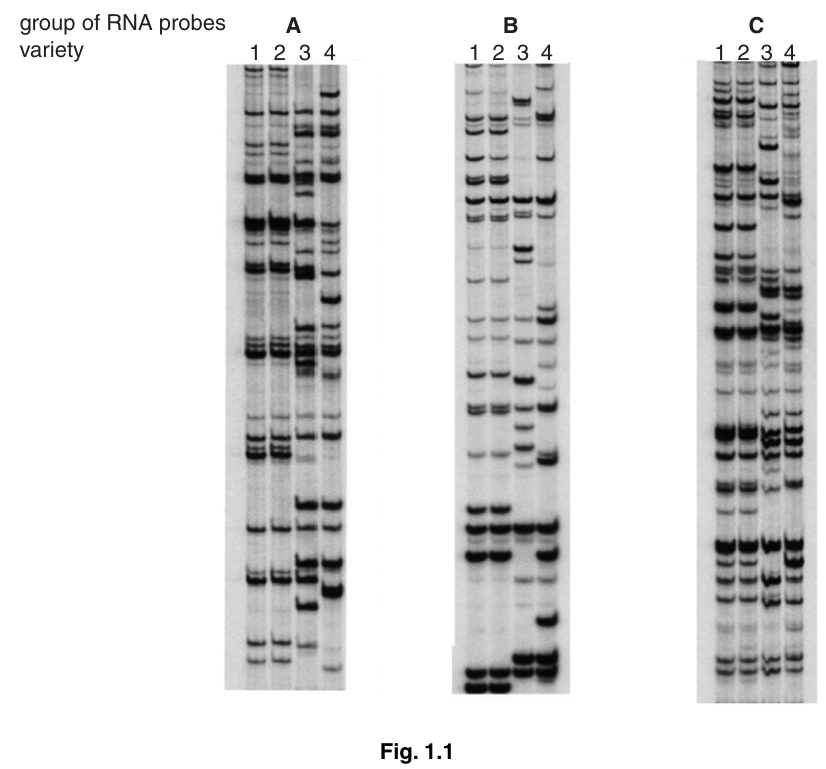
Fig. 1.1 shows that some DNA fragments are present in the genetic fingerprints of all four varieties, 1, 2, 3 and 4, when the different groups of RNA probes, A, B and C, are used.
On Fig. 1.1:
- draw an arrow () to indicate one DNA fragment found in all four varieties when RNA probes in group A were used.
- draw a second arrow for the RNA probes used in group B
- draw a third arrow for the RNA probes used in group C.
State the varieties that appear to have the same genetic fingerprint. Give the evidence for your answer.
The rest of this paper
1 more questions- Q2—16M