Biology 9700/43 — May/June 2014
Cambridge A-Level · A Level Structured Questions · worked solutions for every part, with the mark scheme
Topics Inheritance · Selection and Evolution · Genetic Technology · Classification, Biodiversity and Conservation · Photosynthesis · (outdated) Aspects of Human Reproduction · +3 more
(a) The unicellular green alga, Chlorella, a photosynthetic protoctist, was originally studied for its potential as a food source. Although large-scale production proved to be uneconomic, the many health benefits provided by Chlorella mean that it is now mass produced and harvested for use as a health food supplement.
Fig. 1.1 shows cells of Chlorella.
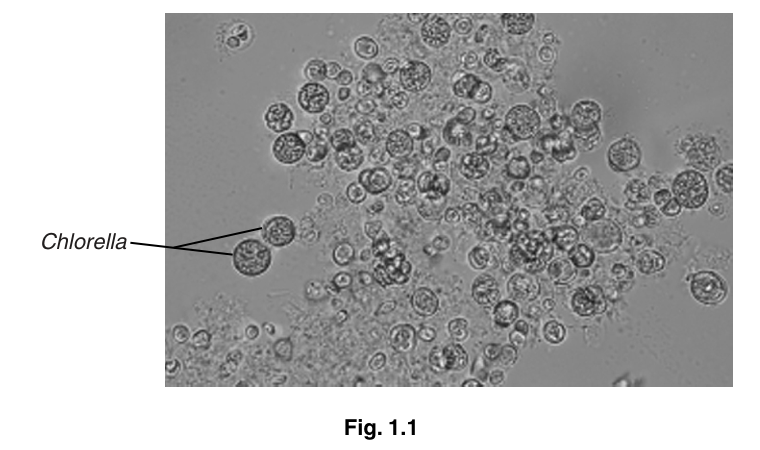
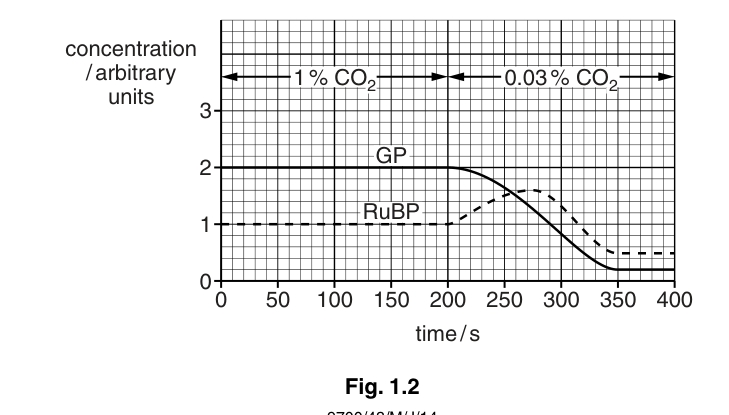
In one study into the productivity of Chlorella, carbon dioxide concentration was altered to investigate its effects on the light-independent stage of photosynthesis.
- A cell suspension of Chlorella was illuminated using a bench lamp.
- The suspension was supplied with carbon dioxide at a concentration of for 200 seconds.
- The concentration of carbon dioxide was then reduced to for a further 200 seconds.
- The concentrations of RuBP and GP (PGA) were measured at regular intervals.
- Throughout the investigation the temperature of the suspension was maintained at .
The results are shown in Fig. 1.2.
State precisely where in the chloroplast RuBP and GP are located.
Explain why the concentration of RuBP changed between 200 and 275 seconds.
Calculate the rate of decrease per second in the concentration of GP between 200 and 350 seconds.
Show your working and give your answer to two decimal places.
answer = ______ arbitrary units per second
Explain how the decrease in the concentration of GP leads to a decreased harvest for commercial suppliers of Chlorella.
The rest of this paper
9 more questions- Q2Selection and Evolution · Genetic Technology · Classification, Biodiversity and Conservation9M
- Q3Inheritance · Genetic Technology15M
- Q4(outdated) Aspects of Human Reproduction16M
- Q5Inheritance · Selection and Evolution8M
- Q6Control and Coordination10M
- Q7Inheritance7M
- Q8Energy and Respiration13M
- Q9Classification, Biodiversity and Conservation15M
- Q10(outdated) Biotechnology15M