Biology 9700/41 — May/June 2014
Cambridge A-Level · A Level Structured Questions · worked solutions for every part, with the mark scheme
Topics Inheritance · Genetic Technology · Classification, Biodiversity and Conservation · Photosynthesis · (outdated) Crop Plants · (outdated) Aspects of Human Reproduction · +4 more
(a) The unicellular green alga, Chlorella, a photosynthetic protoctist, was originally studied for its potential as a food source. Although large-scale production proved to be uneconomic, the many health benefits provided by Chlorella mean that it is now mass produced and harvested for use as a health food supplement.
Fig. 1.1 shows cells of Chlorella.
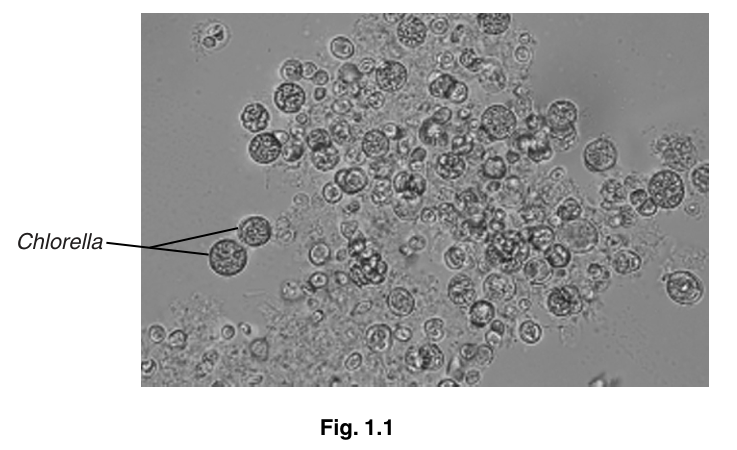
In one study into the productivity of Chlorella, carbon dioxide concentration was altered to investigate its effects on the light-independent stage of photosynthesis.
- A cell suspension of Chlorella was illuminated using a bench lamp.
- The suspension was supplied with carbon dioxide at a concentration of 1% for 200 seconds.
- The concentration of carbon dioxide was then reduced to 0.03% for a further 200 seconds.
- The concentrations of RuBP and GP (PGA) were measured at regular intervals.
- Throughout the investigation the temperature of the suspension was maintained at .
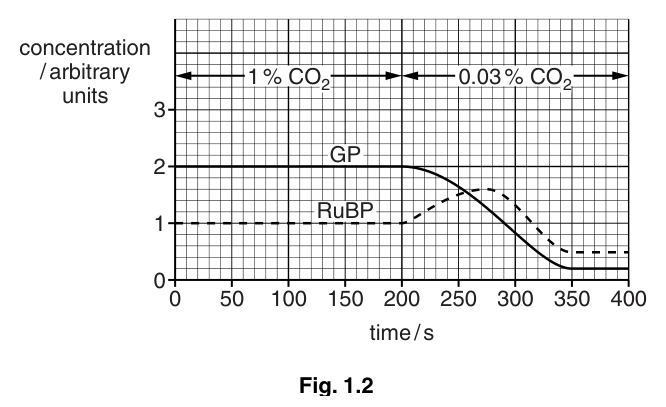
The results are shown in Fig. 1.2.
State precisely where in the chloroplast RuBP and GP are located.
Answer
RuBP and GP are located in the stroma of the chloroplast (i.e. outside the thylakoids, in the fluid surrounding the grana).
Stroma
Background Concept
The chloroplast has two distinct regions in which the two stages of photosynthesis occur:
- The light-dependent reactions take place on the thylakoid membranes (inside the grana). Here, chlorophyll absorbs light energy, water is split (photolysis) and ATP + reduced NADP are generated by electron transport and chemiosmosis.
- The light-independent reactions (the Calvin cycle) take place in the stroma — the enzyme-rich fluid that surrounds the thylakoids.
The reason for this separation is functional: the Calvin cycle needs a steady supply of ATP and reduced NADP from the thylakoids, but the enzymes involved (notably rubisco, which fixes CO₂) work in an aqueous, enzyme-friendly environment. RuBP, GP (PGA) and TP (triose phosphate) are all soluble intermediates that remain dissolved in the stroma as the cycle turns.
Understanding the Question
This is a one-mark "state precisely" question asking for the precise sub-compartment of the chloroplast in which RuBP and GP are found. The mark scheme rejects general answers such as "chloroplast" or "the Calvin cycle" because they do not pin the answer down to the stroma.
Approach
Identify the location of the light-independent reactions. State it as "stroma" — this is the only word the mark scheme credits.
Step-by-Step Reasoning
- Light-independent reactions occur in the stroma.
- RuBP and GP are both intermediates of the Calvin cycle, so both are located in the stroma.
- A single word — "stroma" — earns the mark.
Key Takeaways
- Thylakoid membranes = light-dependent reactions.
- Stroma = light-independent reactions (Calvin cycle).
- RuBP, GP, TP, rubisco and the other Calvin-cycle enzymes are all stromal.
Common Mistakes
- Writing "chloroplast" alone — too vague, the mark scheme requires the specific compartment.
- Writing "grana" — that is where the light-dependent reactions happen, not the Calvin cycle.
- Writing "matrix" — this is the mitochondrial term, not chloroplast.
Things to Be Careful About
Cambridge mark schemes are unforgiving on locational precision: state "stroma", not "inside the chloroplast" or "the Calvin cycle".
Explain why the concentration of RuBP changed between 200 and 275 seconds.
Answer
- At 200 s, the CO₂ concentration was lowered from 1% to 0.03%, so less carbon fixation occurred (less CO₂ combined with RuBP via rubisco).
- This means less RuBP was converted to GP.
- However, RuBP was still being regenerated from TP (and other Calvin-cycle intermediates) by ATP from the light-dependent reactions.
- RuBP was therefore being made faster than it was being used, so its concentration rose between 200 and 275 s.
Less CO₂ reduced carbon fixation (RuBP → GP) while RuBP continued to be regenerated from TP, so RuBP accumulated.
Background Concept
The Calvin cycle has three linked stages:
- Carbon fixation – CO₂ combines with the 5-carbon acceptor RuBP, catalysed by rubisco, giving two molecules of the 3-carbon compound GP (also written PGA or 3-phosphoglycerate).
- Reduction of GP to TP – GP is phosphorylated by ATP and then reduced by NADPH (both supplied by the light-dependent reactions), forming triose phosphate (TP).
- Regeneration of RuBP – five out of every six TP molecules are rearranged (using more ATP) to rebuild RuBP. The sixth TP leaves the cycle to make sugars, lipids, amino acids, etc.
Crucially, CO₂ is only required in stage 1; stages 2 and 3 continue as long as ATP, NADPH and existing GP/TP are available.
Understanding the Question
At 200 s the experimenter lowered the CO₂ supply from 1% to 0.03%. The graph (Fig. 1.2) shows that during the following period the RuBP concentration rises (from ~1.0 to a peak of ~1.5 by 250 s), then later falls again. The question asks specifically about the 200–275 s window, which corresponds to the rising phase of RuBP. The student must explain why RuBP goes up during this period.
Approach
Decouple the cycle into the step that needs CO₂ (carbon fixation, RuBP → GP) and the steps that don't (reduction of GP to TP; regeneration of RuBP from TP). Ask: what happens to each when CO₂ falls? Then work out the net effect on RuBP concentration.
Step-by-Step Reasoning
- Lower CO₂ → carbon fixation slows (less CO₂ + RuBP → GP).
- So RuBP is being used more slowly.
- Meanwhile, ATP and NADPH from the light-dependent reactions are still plentiful, so GP → TP and TP → RuBP continue at much the same rate as before.
- RuBP is therefore being regenerated faster than it is being consumed, and so its concentration rises between 200 and 275 s.
- (Later, after about 275 s, RuBP starts to fall because the GP pool itself has been depleted: with less GP coming in, less TP is made, and so less RuBP can be regenerated. But that later fall is outside the window the question asks about.)
Key Takeaways
- CO₂ is the substrate only for the carbon-fixation step.
- Lower CO₂ → RuBP accumulates initially because regeneration outpaces consumption.
- Eventually GP also falls, and with it the rate of RuBP regeneration, so RuBP later falls too.
Common Mistakes
- Stating that "RuBP is not used" — it is still used (some carbon fixation continues at 0.03% CO₂), just more slowly. The key contrast is with regeneration.
- Saying "more RuBP is made" — RuBP regeneration continues at a similar rate; what has changed is that it is no longer being consumed as quickly.
- Confusing this with the later fall in RuBP — the question is about 200–275 s only.
- Failing to mention the role of rubisco or to identify the carbon-fixation step as the CO₂-dependent one.
Things to Be Careful About
- Use the precise terms "carbon fixation", "rubisco", "RuBP", "GP" and "TP" — these are the technical words the mark scheme credits.
- Frame the answer as a contrast: less use vs unchanged regeneration. Avoid vague language such as "CO₂ affects the Calvin cycle".
Calculate the rate of decrease per second in the concentration of GP between 200 and 350 seconds.
Show your working and give your answer to two decimal places.
answer = ______ arbitrary units per second
Working
Read the GP concentration at the two times from Fig. 1.2:
Rate of decrease:
Rounded to two decimal places: 0.01.
Answer
answer = 0.01 arbitrary units per second
0.01 arbitrary units per second
Background Concept
Any rate of change from a graph is calculated as the change in the y-quantity divided by the change in the x-quantity:
For a concentration–time graph, the gradient gives the rate at which the concentration is changing, with units of "concentration units per second". Because this is a "rate of decrease" question, the answer is positive once the sign of the change is accounted for (the concentration falls).
Understanding the Question
From Fig. 1.2, between 200 s and 350 s the GP curve (solid line) falls from its plateau of ~2.0 to a new plateau near 0.2 arbitrary units. The question asks for the average rate of decrease of GP over that interval, quoted to two decimal places.
Approach
- Read the two GP concentrations at the start (200 s) and end (350 s) of the interval from Fig. 1.2.
- Compute (2.0 − 0.2) = 1.8.
- Compute the time interval (350 − 200) = 150 s.
- Divide 1.8 by 150.
- Round the result to two decimal places.
Step-by-Step Reasoning
- GP = 2.0 − 0.2 = 1.8 arbitrary units (this is the total fall).
- = 350 − 200 = 150 s.
- Rate = 1.8 / 150 = 0.012 arbitrary units per second.
- To two decimal places: 0.012 → 0.01 (the third decimal is 2, so round down).
The mark scheme accepts intermediate values such as 0.012 for one mark and the rounded answer 0.01 for the second mark.
Key Takeaways
- Reading endpoints accurately is crucial — small errors in either GP reading can change the answer substantially.
- Always include the units in the final answer.
- Watch the "to two decimal places" instruction: 0.012 is the unrounded rate, but the demanded final form is 0.01.
Common Mistakes
- Reading the GP plateau at 350 s as 0.5 (a common misread) — this gives 1.5/150 = 0.01 exactly, which can accidentally score both marks, but is not the value the graph actually shows.
- Using 200 s as 0 (e.g. starting the clock from the very start of the experiment).
- Using 200 s for both endpoints (forgetting to subtract 200 from 350).
- Forgetting the units in the final answer.
- Reporting 0.012 without rounding — this scores 1 mark, not 2.
Things to Be Careful About
- The mark scheme rewards 0.01 as the final answer; 0.012 alone (3 d.p.) earns only one mark because the question explicitly says "two decimal places".
- Use a large triangle for the gradient (here the interval is 150 s wide, which minimises reading error) rather than measuring a tiny tangent.
Explain how the decrease in the concentration of GP leads to a decreased harvest for commercial suppliers of Chlorella.
Answer
- Less GP means less TP is formed (because GP is reduced to TP using NADPH and ATP from the light-dependent reactions).
- With less TP available, less conversion to (other) carbohydrates, lipids, amino acids and proteins occurs — these are the molecules that make up new cytoplasm and cell walls.
- Consequently, the rate of growth and cell division of Chlorella slows, so less biomass is produced per unit time, and there is less Chlorella available for commercial suppliers to harvest.
Less GP means less TP, so less synthesis of carbohydrates / lipids / amino acids / proteins, reducing growth and biomass for harvest.
Background Concept
TP (triose phosphate, sometimes written as GALP, glyceraldehyde-3-phosphate) is the "fork in the road" of the Calvin cycle:
- Five out of every six TP molecules are recycled to regenerate RuBP.
- One out of every six TP molecules leaves the cycle to be used as the raw material for everything else the cell needs:
- Carbohydrates (glucose, sucrose, starch, cellulose)
- Lipids (fats and oils, from glycerol and fatty acids)
- Amino acids and hence proteins (when nitrate or ammonium is added to the carbon skeleton)
- Nucleic acids, chlorophyll, and many other cell constituents.
These products are what cells actually are — cytoplasm, membranes, organelles, cell walls. So the rate at which TP exits the cycle directly determines the rate at which new biomass can be built.
Understanding the Question
Part (a) showed that lowering CO₂ drops the GP concentration to a new, lower steady state. Part (b) asks the candidate to take this biochemical change and follow it through to a commercial consequence: less Chlorella to harvest. The challenge is to bridge the gap between biochemistry and business.
Approach
Follow the carbon skeleton out of the cycle:
- Low CO₂ → less carbon fixation → less GP.
- Less GP → less substrate for the reduction step → less TP.
- Less TP leaving the cycle → less synthesis of the molecules that build new cells.
- Less cell-building material → slower growth and cell division → less biomass to harvest.
Step-by-Step Reasoning
- Less TP. GP is the substrate that is reduced (using NADPH and ATP) to TP. With the GP pool depleted, less TP is produced. Mark point 1.
- Less conversion to other molecules. The TP that leaves the cycle is the starting point for synthesis of carbohydrates (e.g. glucose, sucrose, starch), lipids, amino acids and proteins (after addition of nitrogen). With less TP available, the rate of all these syntheses falls. Mark point 2.
- AVP — impact on growth and harvest. Carbohydrates, lipids and proteins are the building blocks and energy stores of new cells. Amino acids are needed to make proteins for growth and cell division; carbohydrates and lipids are needed both as building materials (e.g. cellulose in cell walls) and as respiratory substrates to power that growth. With less of all of these, Chlorella cells grow and divide more slowly, so the mass of cells the commercial supplier can harvest per unit time falls. Mark point 3.
Key Takeaways
- TP is the universal feedstock of the cell: every other organic molecule the cell makes comes from it.
- A bottleneck anywhere in the Calvin cycle quickly propagates through the whole metabolism of the cell.
- For a commercial Chlorella producer, anything that throttles the Calvin cycle (here, low CO₂) directly throttles yield.
Common Mistakes
- Only saying "less photosynthesis means less growth" — too vague; the mark scheme requires the specific intermediates (TP, carbohydrates, lipids, amino acids, proteins).
- Saying "no GP means no growth" — there is still some GP and some TP, just less. The wording should reflect a quantitative fall, not a complete cessation.
- Failing to mention the commercial angle — the question specifically asks how the change affects commercial harvesting. Tie the biochemistry to biomass production for the second mark.
- Confusing starch with cellulose — starch is a Chlorella storage carbohydrate; cellulose is also relevant because algal cell walls contain it. Either is acceptable, but be clear about which is which.
Things to Be Careful About
- Mark points are: (i) less TP, (ii) less conversion to other molecules (with named examples), and (iii) AVP (e.g. growth, cell division). Two clear, distinct points earn the two marks.
- Use the precise word "biomass" or the phrase "growth / cell division" to make the commercial link explicit.
The rest of this paper
9 more questions- Q2(outdated) Crop Plants · Genetic Technology · Classification, Biodiversity and Conservation9M
- Q3Inheritance · Genetic Technology15M
- Q4(outdated) Aspects of Human Reproduction16M
- Q5Inheritance · Selection and Evolution8M
- Q6Control and Coordination10M
- Q7Inheritance7M
- Q8Energy and Respiration13M
- Q9Classification, Biodiversity and Conservation15M
- Q10(outdated) Biotechnology15M