Biology 9700/52 — October/November 2013
Cambridge A-Level · Planning, Analysis and Evaluation · worked solutions for every part, with the mark scheme
Topics Analysis, Conclusions and Evaluation · Planning
A student used the respirometer shown in Fig. 1.1 to compare the rate of respiration in:
• germinating seeds
• insect larvae
• single celled green algae living in water.
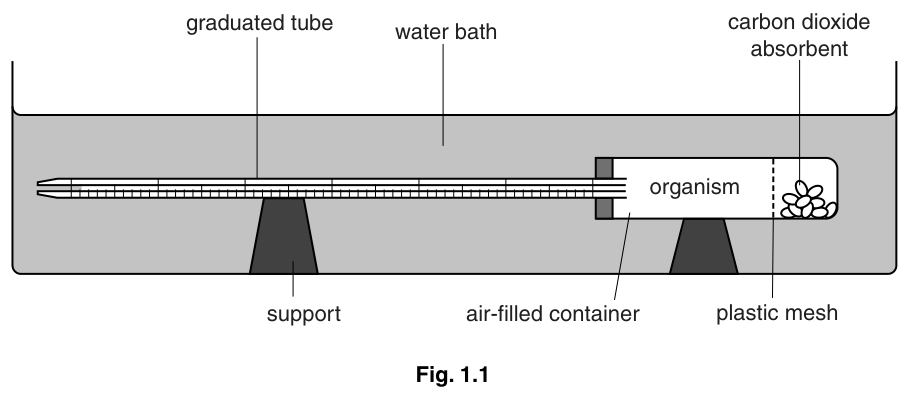
After putting the germinating seeds into the air-filled container and attaching the graduated tube, the respirometer was lowered into a water bath. The seeds respired using oxygen and water moved into the graduated tube. The procedure was repeated for the other two organisms.
Suggest a hypothesis about the respiration of the different organisms that the student could test using this apparatus.
Identify the independent and dependent variables in this investigation.
independent variable = ______
dependent variable = ______
Describe a method, using the respirometer in Fig. 1.1, that the student could use to compare the rates of respiration of germinating seeds, insect larvae and a single celled green algae living in water.
Your method should be detailed enough for another person to use.
The student calculated the rate of respiration as oxygen used per unit mass of the organisms.
Explain how this rate of respiration was calculated.
The student determined the respiratory quotient (RQ) for each of the organisms. To do this the student needed to measure the rate of carbon dioxide production.
Outline how the student should use the respirometer to find the rate of carbon dioxide production.
Table 1.1 shows the student’s results.
Table 1.1
| mean volume of oxygen used per unit mass per unit time | mean volume of carbon dioxide produced per unit mass per unit time | RQ | |
|---|---|---|---|
| germinating seeds | 0.74 | 0.53 | 0.72 |
| insect larvae | 1.23 | 0.98 | |
| single-celled green algae | 0.35 | 0.34 |
Complete Table 1.1 by writing in the RQ values for the insect larvae and the single celled green algae.
With reference to the RQ values in Table 1.1, what conclusions can be drawn about the type of substrate respired by each of the organisms tested?
The rest of this paper
1 more questions- Q2Analysis, Conclusions and Evaluation10M