Biology 9700/51 — October/November 2013
Cambridge A-Level · Planning, Analysis and Evaluation · worked solutions for every part, with the mark scheme
Topics Analysis, Conclusions and Evaluation · Planning
A student used the respirometer shown in Fig. 1.1 to compare the rate of respiration in:
- germinating seeds
- insect larvae
- single celled green algae living in water.
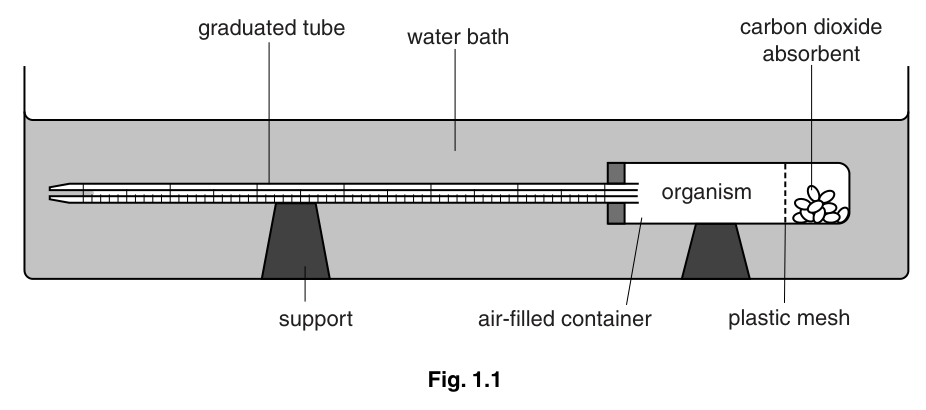
Fig. 1.1
After putting the germinating seeds into the air-filled container and attaching the graduated tube, the respirometer was lowered into a water bath. The seeds respired using oxygen and water moved into the graduated tube. The procedure was repeated for the other two organisms.
Suggest a hypothesis about the respiration of the different organisms that the student could test using this apparatus.
Answer
The rate of respiration (oxygen uptake) of the three organisms will be different from each other (e.g. the insect larvae will have the fastest rate of respiration, while the algae will have the slowest).
The rate of respiration (oxygen uptake) of the three organisms will be different from each other.
Background Concept
A hypothesis is a testable statement that predicts the relationship between the independent and dependent variables in an experiment. For this investigation, the independent variable is the type of organism and the dependent variable is the rate of respiration (measured as the rate of oxygen uptake in a respirometer). A good hypothesis must be specific, testable, and falsifiable. In a comparative investigation like this, the hypothesis predicts whether the values for the different organisms will be the same or different, and ideally states which is expected to be highest or lowest.
Understanding the Question
The student is using a respirometer to compare respiration in three very different organisms: germinating seeds (plant), insect larvae (animal) and single-celled green algae (aquatic photosynthetic organisms). Part (a)(i) specifically asks for a hypothesis that the student could test using this apparatus. The mark scheme allows any testable hypothesis provided it is in the context of all three organisms, so the statement must mention comparison between them.
Approach
Frame the hypothesis around the dependent variable (respiration rate / oxygen uptake) and state whether the three organisms are predicted to differ, with an optional prediction of which is fastest/slowest. Avoid vague language; a hypothesis is a precise prediction, not a question.
Step-by-Step Reasoning
The mark scheme accepts two main types of hypothesis:
- Difference hypothesis: "The rate of respiration of the three organisms will be different from each other." This is the safest, most general answer.
- Specific prediction: "The insect larvae will have a faster rate of respiration than the germinating seeds and the algae." This adds more detail and is still a valid testable prediction.
Either form must include all three organisms (or imply a comparison between them) and must relate to respiration or oxygen uptake, not to some other feature of the organisms. A statement like "the organisms are different" with no reference to respiration would not earn the mark because it does not predict the dependent variable.
Key Takeaways
- A hypothesis states a predicted relationship between variables.
- For comparative experiments, the hypothesis must address all groups being compared.
- The hypothesis is tested by collecting data on the dependent variable.
Common Mistakes
- Stating a hypothesis that only mentions one organism ("insect larvae respire" – too vague, no comparison).
- Phrasing the hypothesis as a question ("Will the organisms have different rates of respiration?") rather than a statement.
- Failing to mention respiration or oxygen uptake, and instead comparing an irrelevant feature.
Things to Be Careful About
The hypothesis must be a statement, not a question. It should be testable with the apparatus described – i.e. it should relate to a measurable feature of respiration in the respirometer.
Identify the independent and dependent variables in this investigation.
independent variable ______
dependent variable ______
Answer
- Independent variable: the (different / named) organisms
- Dependent variable: the distance moved by the water / air (along the capillary tube in a specific time)
Independent variable: the (different / named) organisms; Dependent variable: the distance moved by the water / air along the capillary tube in a specific time.
Background Concept
In any experiment, the independent variable is what the experimenter deliberately changes between test groups. The dependent variable is what is measured to record the effect of that change. Other variables that might affect the result should be kept constant (controlled variables).
Understanding the Question
The student is comparing the respiration rates of three different organisms using the same respirometer. The question asks for the two variables that define what the experiment is doing: what is being changed (the type of organism) and what is being measured (the respirometer reading over time).
Approach
Look at what the student deliberately alters from one experimental run to the next – that is the independent variable. Then look at what the student records a value for – that is the dependent variable.
Step-by-Step Reasoning
- The student puts different organisms into the respirometer on three separate occasions: germinating seeds, insect larvae, algae. The category being changed is therefore the organism used – this is the independent variable. The mark scheme accepts "(different / named) organisms" or a list of the three names.
- As each organism respires, it absorbs O₂ and (with the CO₂ absorbent present) the gas volume inside the closed container falls. Atmospheric pressure pushes water along the graduated tube towards the container. The student therefore measures the distance the water/air moves along the capillary tube in a set time. The mark scheme requires "distance moved by the water / air (along capillary in a specific time)".
- Common wrong answers: "amount of oxygen used" or "rate of respiration" are rejected because they are processed quantities (volume, rate), not the raw measurement from the apparatus. "Volume" is also rejected for the same reason.
Key Takeaways
- Independent variable = what is deliberately varied (the organism).
- Dependent variable = the raw measurement taken from the apparatus (distance moved in a known time).
- Processed quantities (rate, volume) are derived from the dependent variable, not the dependent variable itself.
Common Mistakes
- Writing "amount of O₂ used" or "rate of respiration" as the dependent variable – these are calculated later from the raw measurement.
- Confusing which is which (e.g. putting "time" as the independent variable).
Things to Be Careful About
The dependent variable must be a raw observation, not a derived value. "Distance moved in a specific time" is correct; "volume of O₂ used per minute" is a calculated quantity and would not earn the mark.
Describe a method, using the respirometer in Fig. 1.1, that the student could use to compare the rates of respiration of germinating seeds, insect larvae and a single celled green algae living in water.
Your method should be detailed enough for another person to use.
Answer
-
Set up the respirometer: Place a known / fixed mass (e.g. 5 g) of germinating seeds on the plastic mesh in the air-filled container, above an excess of carbon dioxide absorbent. Seal the container with the bung holding the graduated tube, ensuring the apparatus is airtight (smear the joint with petroleum jelly / use a rubber sleeve). Lower the apparatus into a water bath at a constant temperature (e.g. 25 °C).
-
Dark condition: Cover the respirometer (or water bath) with black material so the algae cannot photosynthesise during the experiment.
-
Equilibration: Leave the respirometer in the water bath for a few minutes to equilibrate (so the air inside reaches the bath temperature) before taking any readings.
-
Take a reading: Note the position of the water / air meniscus in the graduated tube (using the scale on the tube) at the start of the experiment. After a fixed time interval (e.g. 5 minutes), note the new position. Record the distance moved by the meniscus in that time.
-
Algae handling: Place the single-celled algae inside a small, open container (e.g. a small beaker or muslin bag) inside the respirometer so they are held in their water but the water is not in contact with the absorbent. (The seeds and larvae do not need this.)
-
Replicate: Repeat each experiment with the same organism at least three times in total, and calculate a mean distance moved per unit time. Identify and discard any anomalous readings.
-
Control: Set up the respirometer in the same way but with an inert material of the same mass (e.g. glass beads) in place of the organism. Any movement of the meniscus in the control is due to physical factors (temperature / pressure changes), not respiration, and can be subtracted from the experimental readings.
-
Repeat for the other organisms: Replace the absorbent and the air in the container between runs, then repeat the procedure with the same mass of insect larvae and the same volume / mass of algae.
-
Safety: Carbon dioxide absorbent (e.g. soda lime / potassium hydroxide) is corrosive – wear gloves and eye protection, and handle the absorbent with care. Take care when pushing the graduated tube into the bung to avoid cuts from glass.
See working above for the full method (≈ 9 steps covering setup, dark condition, equilibration, measurement, algae handling, replication, control, repetition for other organisms, and safety).
Background Concept
A respirometer measures the rate of oxygen uptake of an organism. The organism is sealed in a small air-filled chamber with a CO₂ absorbent (e.g. soda lime or KOH). As the organism respires aerobically:
The O₂ consumed is not replaced (the CO₂ released is absorbed), so the gas volume in the chamber falls. Atmospheric pressure pushes a drop of coloured water (or air–water meniscus) along the graduated capillary tube towards the chamber. The distance the meniscus moves in a given time is proportional to the volume of O₂ used.
For a fair comparison between organisms, the experiment must control all variables that affect respiration rate (mass, temperature, availability of O₂) except the type of organism.
Understanding the Question
The student must describe, in enough detail that another person could follow, how to use the respirometer in Fig. 1.1 to compare the rate of respiration of germinating seeds, insect larvae and single-celled green algae (which live in water). The mark scheme awards marks across several categories: independent variable handling, dependent variable measurement, controlled variables, safety and reliability.
Approach
Work through the categories the examiner will be looking for, in the order they would naturally appear in a good method:
- How you will set up and standardise the independent variable (mass of each organism).
- How you will measure the dependent variable (distance moved in a known time).
- Controlled variables (dark, temperature, airtight, equilibration, control, absorbent).
- Reliability (replication and a mean).
- Safety (one specific hazard and its precaution).
Step-by-Step Reasoning
Independent variable – the organism:
- The mark scheme requires the same mass of each organism (mp 1) so any difference in O₂ uptake is due to the organism, not its size. A stated/known/fixed mass earns the mark; "amount" or "number" alone does not.
- A dark condition (mp 2) is essential because algae photosynthesise in the light. Photosynthesis would release O₂, opposing the O₂ uptake being measured and giving a falsely low reading. Covering the respirometer (or the water bath) is acceptable.
Dependent variable – distance moved:
- Use the scale on the graduated tube (or a ruler laid alongside it) to read the position of the meniscus (mp 3). "Volume" is rejected; "distance moved" is the raw observation.
- Take readings at a specific / known time interval (mp 4) – e.g. 5 minutes – so that rate (distance ÷ time) can be calculated.
- For the aquatic algae, mark scheme mp 5 requires a method of holding them. They live in water but their water must not flood the absorbent or block the tube. A small open container (e.g. a small beaker or muslin bag) inside the chamber keeps the algae in place while still allowing gas exchange with the air in the chamber.
Controlled variables:
- The apparatus must be airtight (mp 6) so no air leaks in. Petroleum jelly or a rubber sleeve on the bung joint is the standard way to achieve this. "Watertight" alone is rejected because the chamber does not contain liquid.
- Constant temperature (mp 7) in the water bath: a stated temperature in the range 15–45 °C is accepted. The temperature affects the rate of respiration (Q10 effect) and the volume of gas in the chamber (Charles's law), so it must be standardised.
- Equilibration (mp 8): before taking readings, the respirometer should be left in the water bath for a few minutes so the air in the chamber reaches the bath temperature. Without this, thermal expansion or contraction of the air would move the meniscus and corrupt the reading.
- The air in the chamber should be replaced between runs (mp 9) so each organism starts with a fresh, O₂-rich atmosphere and the same starting conditions.
- A control with inert material of the same mass (mp 10) – e.g. glass beads, or dead organisms – accounts for any non-respiratory movement of the meniscus (due to temperature or pressure fluctuations). The control reading is subtracted from the experimental reading.
- The same mass (or volume) of CO₂ absorbent should be used (mp 11), and it should be sufficient to absorb all the CO₂ produced. If the absorbent becomes saturated, CO₂ will not be removed and the apparent O₂ uptake will be falsely low.
Safety (mp 12):
One specific hazard and one specific precaution earns the mark. Acceptable answers include:
- CO₂ absorbent (e.g. KOH / soda lime) is caustic/corrosive → wear gloves and eye protection.
- Glass graduated tube can break → handle carefully; hold the bung while attaching the tube.
- Allergic risk from organisms / absorbent → wear gloves/mask.
A generic "be careful" or "hot water" does not earn the mark.
Reliability (mp 13):
A minimum of three readings (the original + two more) for each organism, and calculation of a mean distance moved per unit time. Anomalies should be identified and discarded. The mean of multiple timed intervals from a single run (e.g. distances every minute, averaged) is rejected – the repeats must be independent experimental runs.
Key Takeaways
- A respirometer measures the distance the meniscus moves in a known time, which is proportional to O₂ uptake.
- For a fair comparison, all variables except the organism must be controlled: same mass, same temperature, dark, airtight, equilibration, same absorbent, plus a control with inert material.
- Replication and a mean are essential for reliability.
- One specific safety hazard and one precaution must be stated.
- Aquatic organisms need to be held in a small open container so they remain in water but the absorbent stays dry.
Common Mistakes
- Forgetting the dark condition – this is the only mark specifically for the algae treatment, and it is essential because photosynthesis would otherwise release O₂ and mask respiration.
- Writing "use the same amount" rather than "the same mass" – the mark scheme rejects "amount" or "number".
- Forgetting to control the temperature (or failing to state a value in 15–45 °C).
- Not including a control with inert material of the same mass.
- Vague safety statements ("be careful", "hot water") – these are rejected.
- "Replicate by taking readings every minute and averaging" – this is rejected; replicates must be independent full runs of the experiment.
Things to Be Careful About
- The dependent variable is distance moved in a known time, not volume or rate.
- The CO₂ absorbent must be sufficient to absorb all CO₂ produced, or the reading will be wrong.
- For the algae, the water they live in must not be in contact with the absorbent; they need a small open container inside the chamber.
The student calculated the rate of respiration as oxygen used per unit mass of the organisms.
Explain how this rate of respiration was calculated.
Answer
- Calculate the volume of oxygen used from the distance moved by the meniscus in the graduated tube:
where is the distance moved (cm) and is the radius of the bore of the tube (cm). (Alternatively, the tube may be pre-calibrated to read volume directly.)
- Divide the volume by the mass of the organism (g) to obtain volume per gram.
- Divide by the time interval (s or min) to obtain the rate.
The final rate is expressed in:
( is also acceptable.)
Rate of respiration = (volume of O₂ used) / (mass × time), where volume = distance moved × π r² of the tube bore, expressed in cm³ g⁻¹ s⁻¹ (or cm³ g⁻¹ min⁻¹).
Background Concept
The respirometer gives a raw reading of distance moved by the meniscus in a known time. To turn this into a meaningful rate that can be compared between organisms of different masses, three steps are required:
- Convert distance to volume of oxygen used (using the cross-sectional area of the tube bore).
- Standardise by mass so a small larva and a large mass of seeds can be compared.
- Standardise by time so a 1-minute and a 5-minute run can be compared.
The resulting quantity is a specific rate of oxygen uptake with units of volume per mass per time.
Understanding the Question
The student has collected data: distance moved by the meniscus, the mass of the organism used, and the time interval. The question asks how to combine these into the rate of respiration expressed as "oxygen used per unit mass".
Approach
Work forwards from the raw measurement:
- distance → volume (geometry of the tube)
- volume → volume per gram (divide by mass)
- volume per gram → volume per gram per second (divide by time)
Step-by-Step Reasoning
Step 1 – Volume of oxygen (mp 1):
The graduated tube is a cylinder of internal radius . The volume of gas drawn in equals the cross-sectional area × the length of tube travelled:
For example, if the meniscus moves 5 cm in a tube of bore radius 0.25 cm, .
The mark scheme accepts any valid method of obtaining volume: distance × , , , or use of a pre-calibrated tube.
Step 2 – Divide by mass (mp 2):
If and mass , this gives .
Step 3 – Divide by time (mp 3):
If (5 min), the rate is .
Units (mp 4):
The full rate must be quoted with units, e.g. or . "cm³/s" alone is wrong because it lacks the per-mass component.
Key Takeaways
- A respirometer reading (distance) must be converted to a volume using the bore area of the tube.
- The final rate is a specific rate: volume of O₂ per unit mass per unit time.
- The units of the final answer are critical: cm³ g⁻¹ s⁻¹ (or with min instead of s).
Common Mistakes
- Quoting the rate as just volume (cm³) or distance (cm) – the per-mass and per-time components are missing.
- Forgetting to convert distance to volume (i.e. reporting "distance moved per gram per second").
- Mixing up the formula: dividing by mass × time rather than dividing twice.
- Writing the units incorrectly, e.g. cm³/s (no mass) or g/s (no volume).
Things to Be Careful About
- The bore radius must be in cm if the distance is in cm, to give volume in cm³.
- The mass should be in grams (g) and time in seconds (s) or minutes (min) – the units of the answer follow from this choice.
- If you do not convert distance to volume, the mark scheme still allows mp 2 and mp 3 (i.e. "divide distance by mass and/or time"), but full credit requires the volume step.
The student determined the respiratory quotient (RQ) for each of the organisms. To do this the student needed to measure the rate of carbon dioxide production.
Outline how the student should use the respirometer to find the rate of carbon dioxide production.
Answer
- Set up the respirometer without the carbon dioxide absorbent (or weigh the absorbent at the start and again at the end of the experiment). In this case, the movement of the meniscus (or the change in mass of the absorbent) reflects the net change in gas volume = O₂ used – CO₂ produced. Combined with the O₂-only reading from part (b) (where the absorbent was present), the rate of CO₂ production can be calculated.
- Calculate the difference in distance moved (or volume) between the run with absorbent and the run without absorbent, and divide by the time to obtain the rate of CO₂ production per unit mass.
Repeat the respirometer experiment without the CO₂ absorbent (or weigh the absorbent before and after); the difference between the readings (with vs without absorbent) gives the volume of CO₂ produced, which is then divided by mass × time to give the rate of CO₂ production.
Background Concept
With the CO₂ absorbent present, the only gas change is the loss of O₂, so the meniscus movement directly measures O₂ uptake. Without the absorbent, CO₂ accumulates in the chamber, so:
The meniscus movement then reflects the net gas change. Comparing the two setups (with and without absorbent) allows CO₂ output to be deduced.
An alternative method is to weigh the CO₂ absorbent before and after the experiment: the increase in mass equals the mass of CO₂ absorbed, from which the volume of CO₂ (at known temperature and pressure) can be found.
Understanding the Question
The student already knows how to measure O₂ uptake (with the absorbent present). The RQ is CO₂ produced ÷ O₂ used, so the CO₂ production rate must be measured separately. The respirometer can be adapted for this.
Approach
Recognise that the respirometer is currently configured to absorb CO₂, which hides the CO₂ production signal. To measure CO₂, the absorbent must either be removed (so CO₂ stays in the chamber and alters the gas volume) or weighed (so the absorbed CO₂ is captured as a mass change).
Step-by-Step Reasoning
Method 1 – Remove the absorbent (mp 1 alternative):
- Set up the respirometer with the same mass of organism but with no CO₂ absorbent in the chamber.
- Take readings of meniscus position at start and after a known time interval.
- The meniscus moves according to (O₂ used – CO₂ produced). This gives the net volume change.
- Subtracting this reading from the O₂-only reading (with absorbent present) gives the volume of CO₂ produced. Divide by mass × time to get the rate.
Method 2 – Weigh the absorbent (mp 1 alternative):
- Weigh the CO₂ absorbent (e.g. soda lime) to a fixed precision (e.g. 0.01 g) at the start of the experiment.
- Run the respirometer as normal with the absorbent present.
- Reweigh the absorbent at the end. The increase in mass is the mass of CO₂ absorbed. Convert this to a volume of CO₂ (using or by applying the ideal gas law / molar volume at the bath temperature). Divide by mass × time to get the rate.
Difference in measurement (mp 2 or 3):
- Whichever method is used, the difference between the two measurements (with vs without absorbent, or the mass gained by the absorbent) gives the volume (or mass) of CO₂ produced. This value must then be divided by the time interval to obtain a rate.
Key Takeaways
- The respirometer with CO₂ absorbent measures O₂ uptake; without the absorbent, it measures (O₂ – CO₂).
- CO₂ output can therefore be found by subtraction, or directly by weighing the absorbent.
- The final rate is expressed per unit mass per unit time, in the same units as the O₂ rate.
Common Mistakes
- Suggesting that removing the absorbent will directly give the CO₂ production rate – it actually gives (O₂ – CO₂), not CO₂ alone. The candidate must state that a comparison is needed with the absorbent present.
- Forgetting to divide by time (and mass) when reporting a "rate".
- Weighing the absorbent but failing to convert the mass of CO₂ absorbed to a volume.
Things to Be Careful About
- The two runs (with and without absorbent) must use the same mass of organism, the same temperature and the same time interval for a valid comparison.
- If the absorbent is weighed, it should be handled quickly to avoid absorbing CO₂ from the atmosphere before the initial weighing.
- The mass gained by the absorbent is due to CO₂ + water vapour; some absorbents (e.g. soda lime) include an indicator that changes colour when exhausted, which can be used to confirm full absorption.
Table 1.1 shows the student’s results.
Table 1.1
| mean volume of oxygen used per unit mass per unit time | mean volume of carbon dioxide produced per unit mass per unit time | RQ | |
|---|---|---|---|
| germinating seeds | 0.74 | 0.53 | 0.72 |
| insect larvae | 1.23 | 0.98 | |
| single-celled green algae | 0.35 | 0.34 |
Complete Table 1.1 by writing in the RQ values for the insect larvae and the single celled green algae.
Answer
- Insect larvae:
- Single-celled green algae: (≈ )
| mean volume of O₂ used | mean volume of CO₂ produced | RQ | |
|---|---|---|---|
| germinating seeds | 0.74 | 0.53 | 0.72 |
| insect larvae | 1.23 | 0.98 | 0.80 |
| single-celled green algae | 0.35 | 0.34 | 0.97 |
Insect larvae RQ = 0.80; single-celled green algae RQ = 0.97 (≈ 1.00).
Background Concept
The respiratory quotient (RQ) is the ratio of the volume of carbon dioxide produced to the volume of oxygen consumed during respiration:
Because the units () are the same in both the numerator and denominator, they cancel, leaving a dimensionless number. The value of the RQ gives information about which respiratory substrate is being metabolised (see part (d)(ii)).
Understanding the Question
Table 1.1 gives the mean rates of O₂ uptake and CO₂ production for each organism (per unit mass per unit time), and the RQ has been pre-calculated for germinating seeds. The question asks the candidate to complete the RQ column for the insect larvae and the single-celled green algae.
Approach
Apply the RQ formula to the two pairs of mean values. The numerator and denominator have the same units, so the result is a pure number; round to two decimal places (matching the precision of the data).
Step-by-Step Reasoning
Insect larvae:
Single-celled green algae:
(The mark scheme accepts 0.97 or 1.00 for the algae.)
Both answers are quoted to two decimal places, consistent with the precision of the input data. The value 0.79 is rejected by the mark scheme – it is a rounding error.
Key Takeaways
- RQ = CO₂ produced / O₂ used.
- The RQ is dimensionless; quote to two decimal places.
- RQ ≈ 1.0 indicates carbohydrate respiration; RQ ≈ 0.7 indicates lipid; RQ ≈ 0.8–0.9 indicates protein.
Common Mistakes
- Inverting the ratio (dividing O₂ by CO₂).
- Rounding 0.797 down to 0.79 – the mark scheme rounds to 0.80.
- Failing to show any working – although the answer alone earns the mark, working prevents arithmetic slips.
Things to Be Careful About
- Both inputs are means per unit mass per unit time, so the per-mass and per-time components cancel and need not be re-stated in the RQ calculation.
- Quote the answer to the same precision as the input data (two decimal places here).
With reference to the RQ values in Table 1.1, what conclusions can be drawn about the type of substrate respired by each of the organisms tested?
Answer
- Single-celled green algae (RQ ≈ 0.97): RQ is approximately 1, so the algae are respiring mainly carbohydrate (e.g. glucose / sugars produced by photosynthesis).
- Insect larvae (RQ ≈ 0.80): RQ is approximately 0.8, so the insect larvae are respiring mainly protein / amino acids (a mixture of lipid and protein is also acceptable).
- Germinating seeds (RQ = 0.72): RQ is approximately 0.7, so the seeds are respiring mainly fat / lipid / oil (a fatty acid reserve). This is because the metabolism of fat uses proportionally more oxygen (and produces less CO₂) than the metabolism of carbohydrate, because fats contain relatively little oxygen already bound in the molecule.
Algae (RQ ≈ 1) → carbohydrate; insect larvae (RQ ≈ 0.8) → protein; germinating seeds (RQ ≈ 0.7) → lipid / fat. Fats require more O₂ per CO₂ released, hence the lower RQ.
Background Concept
The RQ depends on the chemical composition of the substrate being respired:
- Carbohydrate (e.g. glucose): already highly oxidised; complete oxidation to CO₂ and H₂O gives RQ = 1.00. Six CO₂ produced for every six O₂ used → RQ = 1.0.
- Lipid (e.g. a typical triglyceride / oil): already reduced; much more O₂ is needed to oxidise the long hydrocarbon chains, and less CO₂ is produced per O₂. RQ ≈ 0.7.
e.g. for tripalmitin: , giving RQ ≈ 0.7. - Protein / amino acids: the elements C, H, O, N, S require more O₂ per CO₂ than carbohydrate does, giving RQ ≈ 0.8–0.9.
The RQ therefore acts as a fingerprint of the substrate being metabolised.
Understanding the Question
The completed RQ column gives:
- Seeds: 0.72
- Larvae: 0.80
- Algae: 0.97
The question asks the candidate to use these values to draw conclusions about which substrate each organism is respiring.
Approach
Match each RQ to the closest standard value and state which substrate that RQ implies. For full credit, mention all three organisms and the reason for the low RQ of lipid (it consumes proportionally more O₂ than it releases as CO₂).
Step-by-Step Reasoning
Algae – RQ ≈ 0.97 (≈ 1.0):
The RQ is essentially 1, indicating respiration of a carbohydrate. This is biologically sensible: green algae photosynthesise and store the products as carbohydrate (e.g. starch, glucose); when they respire, the substrate is this stored sugar.
Insect larvae – RQ ≈ 0.80:
The RQ is in the range 0.8–0.9, indicating respiration of protein / amino acids (a mixture of lipid and protein is also acceptable). Many insects metabolise protein-rich diets or mobilised amino acids during development, giving RQ values in this range.
Germinating seeds – RQ = 0.72:
The RQ is ≈ 0.7, indicating respiration of fat / oil. Many seeds (e.g. sunflower, linseed, castor) store their food reserves as lipid rather than starch. The reason this gives a low RQ is that fats are highly reduced (long hydrocarbon chains with little internal O₂), so they require a large amount of additional O₂ from the atmosphere to be fully oxidised, while producing relatively little CO₂.
The mark scheme specifically requires the explanation that fat uses proportionally more oxygen than carbohydrate for respiration (mp 4). This is the underlying chemical reason: a triglyceride molecule has far more H and far less O than a sugar, so its oxidation consumes more O₂ per CO₂ released.
Key Takeaways
- RQ ≈ 1.0 → carbohydrate.
- RQ ≈ 0.7 → lipid / fat.
- RQ ≈ 0.8–0.9 → protein / amino acid (or a lipid + protein mix).
- The lower the RQ, the more reduced the substrate, and the more O₂ must be supplied per CO₂ released.
- Stored reserves of seeds (oils) and animal tissues (proteins) are reflected in the RQ during germination / development.
Common Mistakes
- Confusing the order: stating that the algae are respiring fat and the seeds are respiring carbohydrate.
- Failing to state a specific substrate (e.g. "a different substrate") – the mark scheme requires a named substrate (CHO, protein, lipid/oil/fat).
- Not explaining why fat has a low RQ (the mark scheme specifically requires this point for full marks).
- Saying "lipid" without realising that "fat" or "fatty acid" or "oil" are all accepted equivalents.
Things to Be Careful About
- RQ values are approximate indicators – an RQ of 0.8 could in principle indicate a mix of substrates (e.g. 50% carbohydrate + 50% lipid) rather than pure protein, but the simplest interpretation is correct here.
- The reasoning that fat uses more O₂ per CO₂ is the chemical basis for the low RQ – this is the one explanatory mark in this question and is essential for full marks.
- Always quote the RQ value(s) you are interpreting to make the link explicit.
The rest of this paper
1 more questions- Q2Analysis, Conclusions and Evaluation10M