Biology 9700/43 — October/November 2013
Cambridge A-Level · A Level Structured Questions · worked solutions for every part, with the mark scheme
Topics Classification, Biodiversity and Conservation · Control and Coordination · Inheritance · Selection and Evolution · Energy and Respiration · (outdated) Aspects of Human Reproduction · +4 more
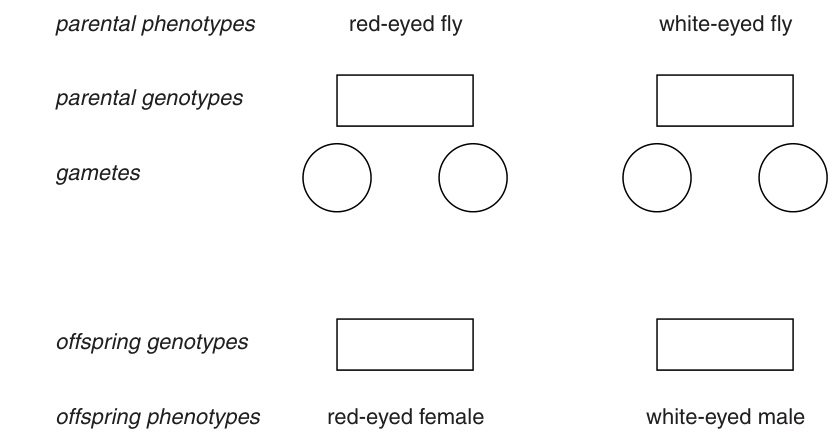
A mutation in a gene in the fruit fly, Drosophila melanogaster, gives rise to white-eyed flies instead of the normal red-eyed flies. The allele for red eyes () is dominant to the allele for white eyes ().
A student crossed a red-eyed fly with a white-eyed fly.
The results are shown in Table 1.1.
Table 1.1
| phenotype of fly | number of offspring |
|---|---|
| red-eyed female | 54 |
| red-eyed male | 0 |
| white-eyed female | 0 |
| white-eyed male | 46 |
In Drosophila, males possess two different sex chromosomes, X and Y, as in humans.
Complete the genetic diagram below to show how the results in Table 1.1 could have been produced.
The chi-squared () test can be used to analyse the results in Table 1.1.
The expected ratio of red-eyed females to white-eyed males is .
Complete Table 1.2 and use this to calculate a value for chi-squared ().
key
= sum of
= degrees of freedom
= number of classes
= observed value
= expected value
Table 1.2
| phenotype of fly | O | E | O-E | ||
|---|---|---|---|---|---|
| red-eyed female | |||||
| white-eyed male |
= ______
Use your calculated value of and the table of probabilities below, to test the significance of the difference between observed and expected results.
| degrees of freedom | probability | |||
|---|---|---|---|---|
| 0.90 | 0.50 | 0.10 | 0.05 | |
| 1 | 0.02 | 0.45 | 2.71 | 3.84 |
| 2 | 0.21 | 1.39 | 4.61 | 5.99 |
The rest of this paper
10 more questions- Q2Selection and Evolution15M
- Q3Energy and Respiration7M
- Q4(outdated) Aspects of Human Reproduction15M
- Q5Selection and Evolution · Classification, Biodiversity and Conservation · Inheritance10M
- Q6Control and Coordination · Classification, Biodiversity and Conservation10M
- Q7Photosynthesis8M
- Q8Classification, Biodiversity and Conservation5M
- Q9Control and Coordination7M
- Q10Genetic Technology15M
- Q11Homeostasis · Control and Coordination · (outdated) Biotechnology15M