Biology 9700/41 — October/November 2013
Cambridge A-Level · A Level Structured Questions · worked solutions for every part, with the mark scheme
Topics Inheritance · Selection and Evolution · Energy and Respiration · Control and Coordination · Classification, Biodiversity and Conservation · Genetic Technology · +4 more
Huntington’s disease (HD) is an inherited disease of the central nervous system. The symptoms of HD usually develop in adulthood and include uncontrollable muscular movements, short-term memory loss and changes in mood.
HD is caused by a dominant allele of the huntingtin gene on chromosome 4.
Explain what is meant by the terms allele and dominant.
allele ______
dominant ______
The dominant allele of the huntingtin gene contains many repeats of a triplet sequence of nucleotides, CAG. The age at which symptoms of HD first appear is linked with the number of CAG repeats.
This is shown in Fig. 1.1.
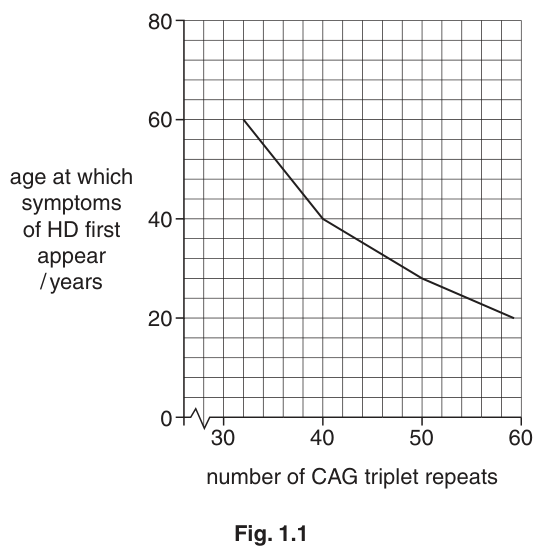
Describe the pattern shown in Fig. 1.1.
A blood test to detect the dominant allele is available for people at risk of HD.
Suggest why some people at risk of HD may decide not to take the blood test.
The rest of this paper
10 more questions- Q2Selection and Evolution · Inheritance · Homeostasis14M
- Q3Energy and Respiration8M
- Q4(outdated) Aspects of Human Reproduction · Selection and Evolution14M
- Q5(outdated) Crop Plants · Inheritance · Selection and Evolution10M
- Q6Control and Coordination11M
- Q7Photosynthesis8M
- Q8Classification, Biodiversity and Conservation6M
- Q9Control and Coordination · Inheritance7M
- Q10Inheritance15M
- Q11Classification, Biodiversity and Conservation · Energy and Respiration15M