Biology 9700/42 — May/June 2012
Cambridge A-Level · A2 Structured Questions · worked solutions for every part, with the mark scheme
Topics Genetic Technology · Inheritance · Homeostasis · Selection and Evolution · (outdated) Biotechnology · (outdated) Aspects of Human Reproduction · +4 more
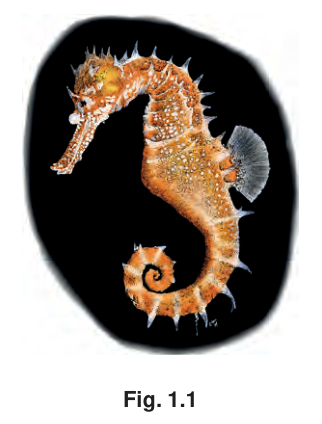
The seahorse, Hippocampus, is an unusual small fish. It gives birth to live young and it is the male rather than the female that becomes pregnant.
Fig. 1.1 shows a seahorse.
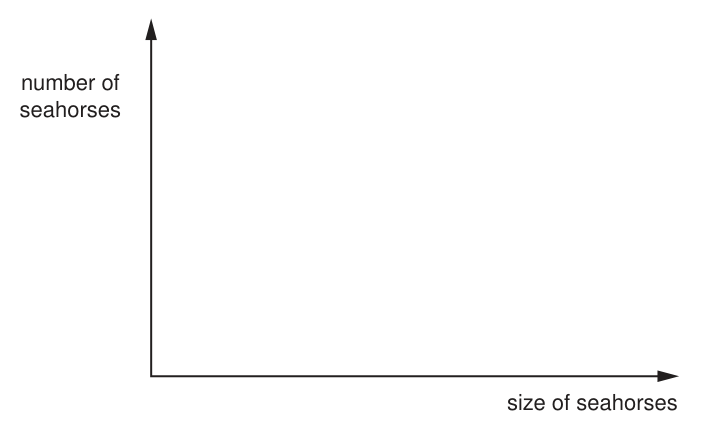
In one species of seahorse, a type of natural selection called disruptive selection occurs. This is where the extreme phenotypes are more likely to survive and reproduce than the intermediate phenotypes.
• Within a population, large females mate with large males and small females mate with small males.
• Few intermediate-sized individuals are produced and they have a low survival rate.
Sketch a graph on the axes below to show the distribution in size of seahorses as a result of disruptive selection.
Explain how disruptive selection has been maintained in this species of seahorse.
State the term given to the type of selection where variation in a characteristic is maintained in its existing form over time.
Two different species of seahorse are found in the coastal waters shown in Fig. 1.2.
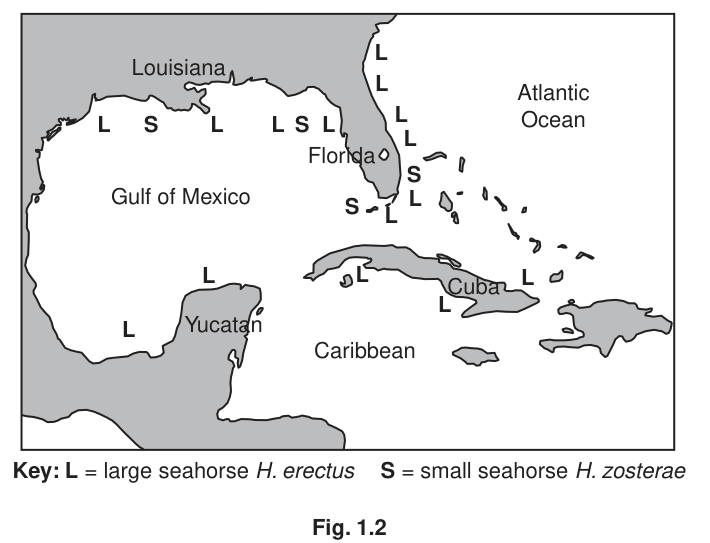
Suggest how these two different species of Hippocampus could have arisen.
The rest of this paper
9 more questions- Q2(outdated) Biotechnology15M
- Q3Genetic Technology8M
- Q4Genetic Technology · Inheritance14M
- Q5(outdated) Aspects of Human Reproduction9M
- Q6Classification, Biodiversity and Conservation8M
- Q7Inheritance8M
- Q8Homeostasis · Photosynthesis15M
- Q9Energy and Respiration15M
- Q10Homeostasis · Control and Coordination15M