Biology 9700/51 — October/November 2011
Cambridge A-Level · Planning, Analysis and Evaluation · worked solutions for every part, with the mark scheme
Topics Planning · Analysis, Conclusions and Evaluation
Photosynthesis was investigated in a species of unicellular alga using the apparatus shown in Fig. 1.1.
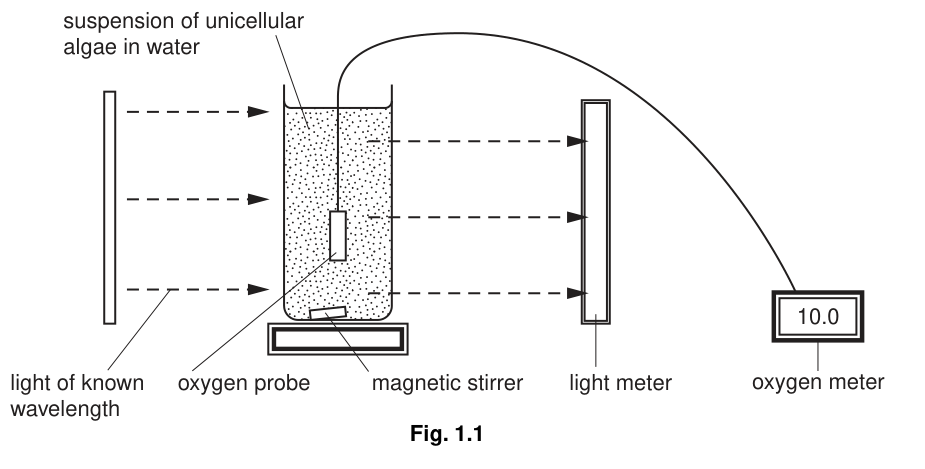
Two different strains of the species of alga were tested using a range of different wavelengths of light.
• Light of known wavelength was passed through the tube containing algae for two hours.
• The light transmission through the suspension and the oxygen concentration were then measured.
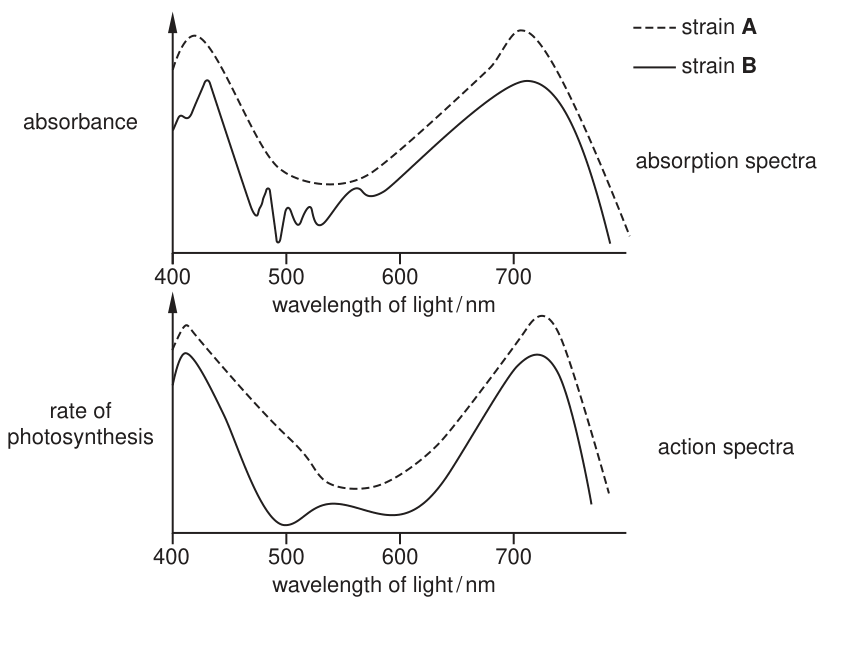
The results were used to plot the absorption spectrum and the action spectrum for each strain of alga.
Fig. 1.2 shows these spectra.
State the two dependent variables in this investigation.
-
______
-
______
Apart from temperature and pH, which have little effect, state two variables that should be standardised during this investigation.
-
______
-
______
Water with no suspended algae transmits 100% of the light. State how the data to plot the absorption spectrum was obtained.
State the data which would be used to plot the action spectrum.
The photosynthetic pigments of the algae were extracted and were separated by two-way chromatography.
The pigments were first separated by one solvent and then separated again by a second solvent at right angles to the first solvent.
Fig. 1.3 shows the results for the two different strains.
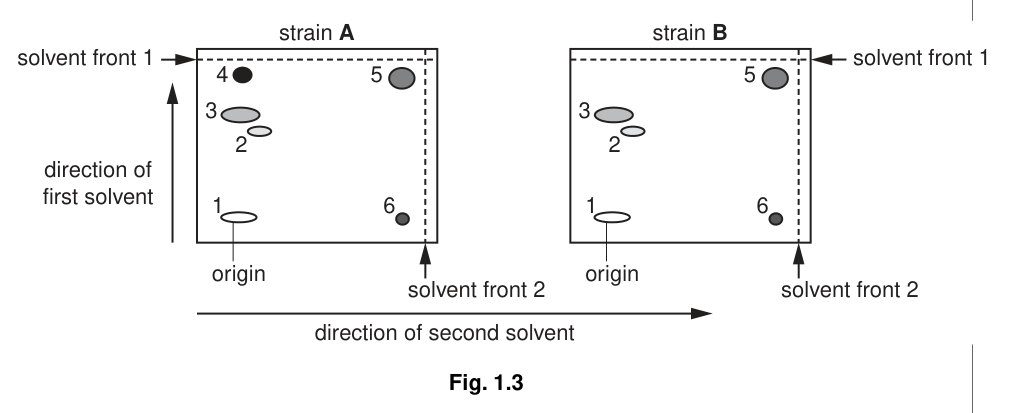
Using the information in Fig. 1.3, suggest why using two different solvents gives a better separation of these pigments than just using one solvent.
Outline a procedure that a student could use to extract the photosynthetic pigments and obtain these chromatograms.
Different photosynthetic pigments absorb different wavelengths of light.
Table 1.1 shows some information about the pigments, P, Q, R, S and T, found in these unicellular algae, including the wavelength of light at which maximum light absorption occurs.
Table 1.1
| pigment | wavelength of light / | Rf value solvent 1 | Rf value solvent 2 |
|---|---|---|---|
| P | 620 | 0.20 | 0.89 |
| Q | 545 and 547 | 0.60 | 0.29 |
| R | 420 and 660 | 0.65 | 0.11 |
| S | 490 | 0.91 | 0.19 |
| T | 430 and 645 | 0.82 | 0.92 |
One of the strains of algae lacks one of the pigments.
Using the information in Table 1.1, Fig. 1.2 and Fig. 1.3:
identify the strain of alga that lacks one of these pigments and state the letter of the missing pigment
state the evidence that supports your answer to (i).
In water, the shorter the wavelength of light, the deeper it travels.
Suggest why it is an advantage to have the pigment that you identified in (i).
The rest of this paper
1 more questions- Q2Planning · Analysis, Conclusions and Evaluation10M