Biology 9700/52 — May/June 2011
Cambridge A-Level · Planning, Analysis and Evaluation · worked solutions for every part, with the mark scheme
Topics Planning · Analysis, Conclusions and Evaluation
A student used the procedure outlined below to find the water potential of a plant storage tissue that has coloured cell sap.
- pieces of plant tissue are placed into different sucrose solutions of known concentrations to allow osmosis to occur
- damaged cells release pigment that colours the sucrose solutions that bathe the tissue
- the water potential of the sucrose solutions may change as a result of osmosis
- sucrose solutions become less dense if they gain water from the tissue
- a pipette is filled with the coloured sucrose solution that has bathed the plant tissue
- a drop of the coloured bathing sucrose solution is released half way down a tube of sucrose solution of the same concentration as the original bathing solution as shown in Fig. 1.1
- the direction and rate of movement of the drop of coloured solution is determined by its density
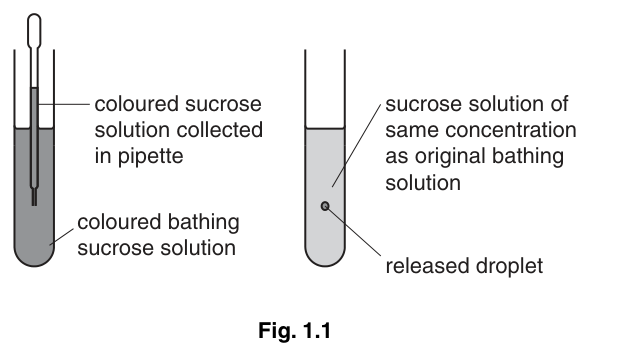
Fig. 1.1
Fig. 1.2 shows the results that the student plotted from the investigation.
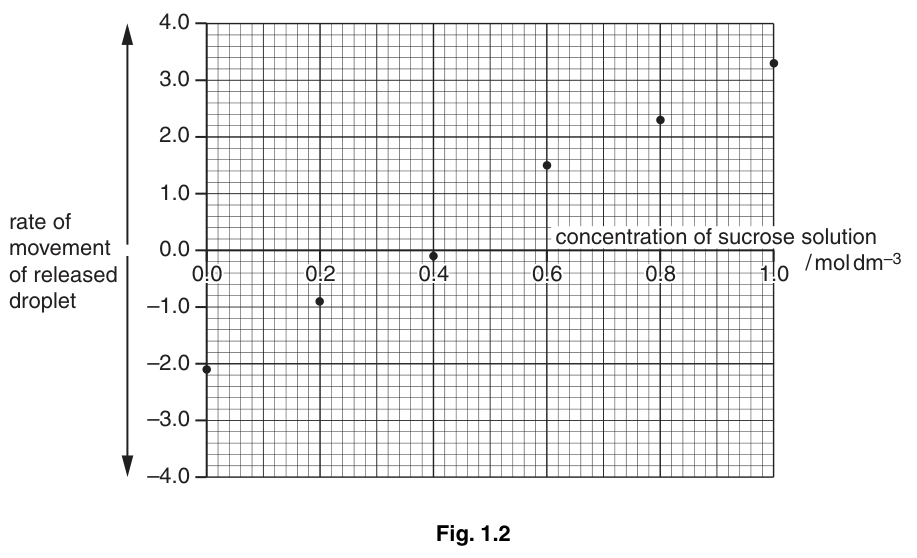
Fig. 1.2
Describe how the student could use this procedure to find the water potential of the plant storage tissue that has coloured cell sap.
Suggest suitable units for the rate of movement of the drop.
State how the student would estimate the water potential of the plant tissue.
Identify the independent and dependent variables in this investigation.
independent ______
dependent ______
Identify two variables which the student may not have adequately controlled during the investigation.
-
______
-
______
State how one of the variables you have identified in (c)(ii) may have influenced the results.
The student made direct observations of the cells of the tissues that had been immersed in and sucrose solutions.
Predict the appearance of the cells under the microscope when immersed in
sucrose solution ______
sucrose solution ______
Use the space below for any diagrams you include in your answer to (i).
Explain your answers to (d)(i).
The rest of this paper
1 more questions- Q2Planning · Analysis, Conclusions and Evaluation11M