Biology 9700/42 — May/June 2011
Cambridge A-Level · A Level Structured Questions · worked solutions for every part, with the mark scheme
Topics Genetic Technology · Selection and Evolution · Photosynthesis · Inheritance · Classification, Biodiversity and Conservation · (outdated) Biotechnology · +4 more
The natterjack toad, Bufo calamita, is an endangered amphibian species in the UK. It comes out of hibernation in April and breeds in pools by sand dunes along parts of the UK coast. A young natterjack toad will take about 10 weeks to develop from a fertilised egg. A natterjack toad feeds at night, by running at its prey, mainly insects and worms, on the sand dunes.
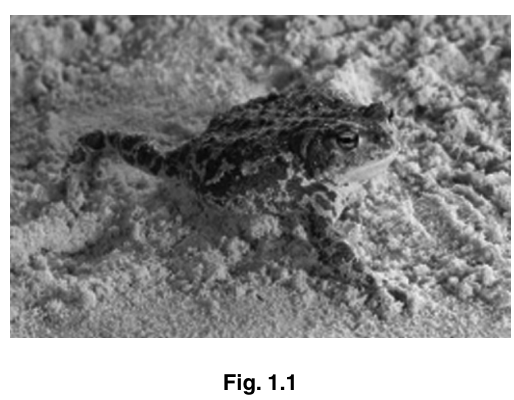
Fig. 1.1 shows a natterjack toad.
Suggest what may have caused the natterjack toad to become an endangered species in the UK.
Fig. 1.2 shows the number of adult natterjack toads counted from 1989 to 1997 in one area of the UK.
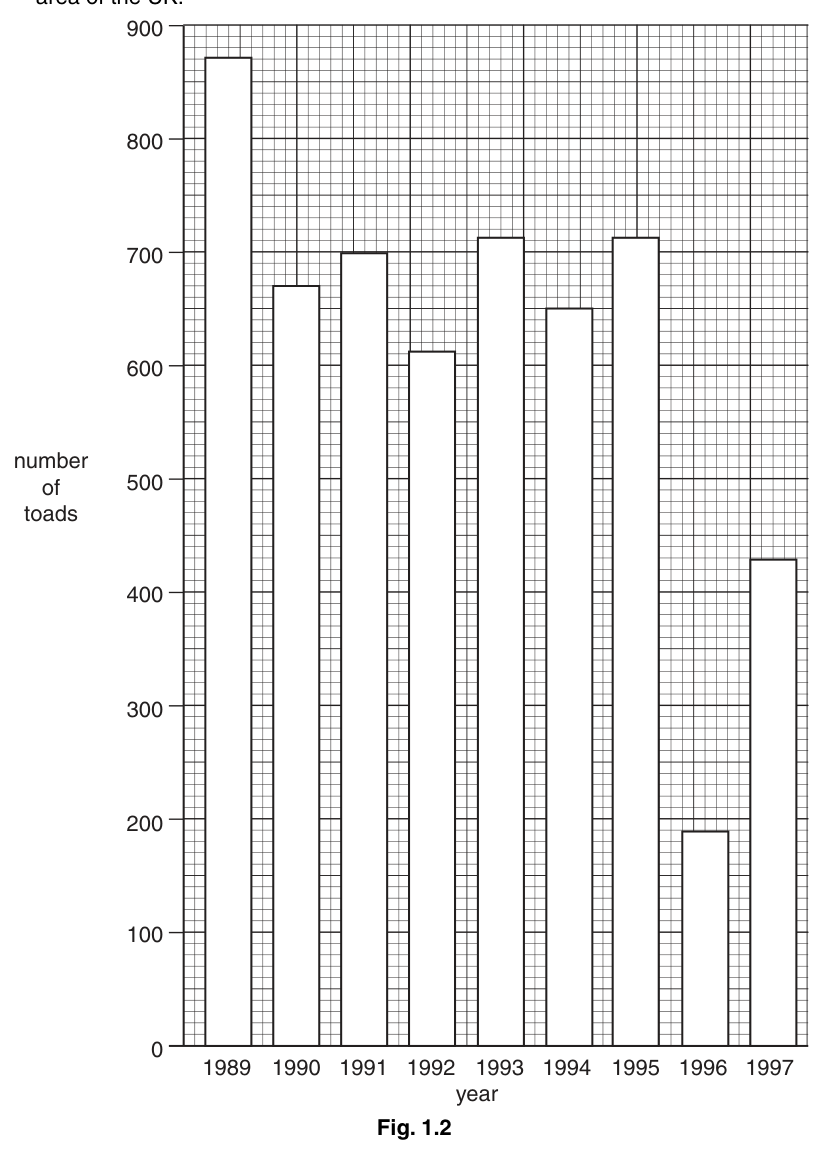
Calculate the mean annual number of adult natterjack toads counted from 1989 to 1997.
Give your answer to the nearest whole number.
Show your working.
answer = ______
The natterjack toad is heterotrophic.
Explain what is meant by heterotrophic.
Name two kingdoms that are exclusively heterotrophic.
-
______
-
______
Each year the International Union for the Conservation of Nature and Natural Resources (IUCN) publishes a list of endangered species called the Red List. The Red List has a very high proportion of vertebrates compared to invertebrates.
Suggest one reason why the Red List has many more vertebrates than invertebrates.
The rest of this paper
10 more questions- Q2(outdated) Biotechnology8M
- Q3(outdated) Aspects of Human Reproduction · Genetic Technology15M
- Q4Selection and Evolution · Photosynthesis15M
- Q5Genetic Technology7M
- Q6Energy and Respiration10M
- Q7Inheritance9M
- Q8Selection and Evolution5M
- Q9Inheritance7M
- Q10Photosynthesis15M
- Q11Homeostasis · Control and Coordination15M